Sunday
30 August, 2026
News Flash
News Flash
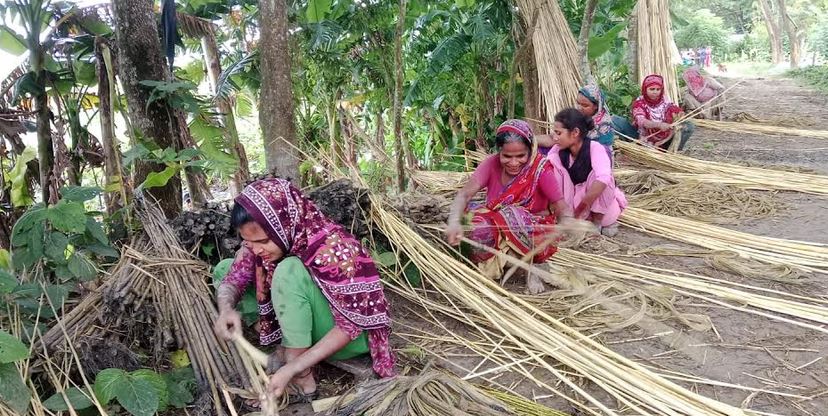
BARISHAL, Aug 30, 2026 (BSS) - Jute cultivation is returning to its heyday in Barishal this year as favorable weather, improved varieties and proper agricultural guidance have helped farmers achieve higher yields and better profits.
Farmers across the district are pleased with the performance of the eco-friendly golden fiber, particularly as market prices have risen significantly compared to last year. The improved returns have renewed their interest in jute cultivation after several years of losses caused by low prices.
Jalil Chowkidar of Rafiyadi village in Babuganj upazila has cultivated jute as usual this year. He harvested around 50 maunds of jute from his fields and said he was happy with the yield achieved at relatively low production costs.
“Last year, jute was sold at Taka 1,700 to Taka 1,900 per maund. This year, the price has risen to Taka 3,200 to Taka 4,000,” Jalil told BSS.
He recalled that jute was once one of the most popular crops in the district, with a large number of rural farmers engaged in its cultivation. However, declining prices discouraged farmers from growing the crop.
“Now farmers are becoming interested in jute cultivation again. We are getting higher yields and good profits at relatively low costs. The heyday of jute has returned,” he said.
Another farmer, Rahim of RG Kalikapur village, said jute cultivation had performed well this year and farmers were also receiving good prices. “If the price remains like this, it will be good for us,” he said.
Bachchu Khan, another farmer, said farmers had suffered for several years because jute prices did not cover rising production costs. This year, however, the situation has improved.
“We cultivated jute without using mulch and are getting 10 to 12 maunds per bigha. The market price is also very good. We are very happy,” he said.
At present, jute is being sold at local markets for between Taka 3,200 and Taka 4,000 per maund, depending on quality. Traders are also showing greater interest in purchasing jute directly from farmers at competitive prices.
Agricultural officials said the increased demand for jute and jute products, including jute bags, along with the government's measures to discourage the use of plastic products, has helped create favorable market conditions for the crop.
According to Department of Agricultural Extension (DAE), jute has been cultivated on 12,511 hectares of land in the district this year against a target of 12,591 hectares. Of the cultivated land, jute has so far been harvested from 12,203 hectares of land.
Of the total cultivated area, 920 hectares are in Sadar, 2,100 hectares in Babuganj, 215 hectares in Wazirpur, four hectares in Bakerganj, 655 hectares in Gournadi, 70 hectares in Agailjhara, 3,170 hectares in Muladi, 1,830 hectares in Hijla, 3,490 hectares in Mehendiganj and 52 hectares in Banaripara upazila.
This year, farmers have cultivated improved varieties of jute as well as the high-yielding variety BINA Toshapat-1, developed by the Bangladesh Institute of Nuclear Agriculture (BINA).
Agricultural officials have stated that favorable weather and timely rainfall helped farmers avoid a situation where they would have had to rush to harvest their crops. As a result, the jute fiber has developed a bright color and achieved good quality.
Mariam Begum, deputy director of DAE in Barisal, said the department has been providing farmers with various forms of technical advice and support.
“Jute cultivation has been quite good in Barishal this year. We are providing round-the-clock support to farmers,” she told BSS.
She expressed hope that continued government supervision, access to improved seeds and fair market prices would help jute regain its importance in the agricultural economy.
“If proper government supervision, improved seeds and fair market prices are maintained, the golden fiber will once again make a significant contribution to the country's economy,” she said.