Thursday
10 September, 2026
News Flash
News Flash
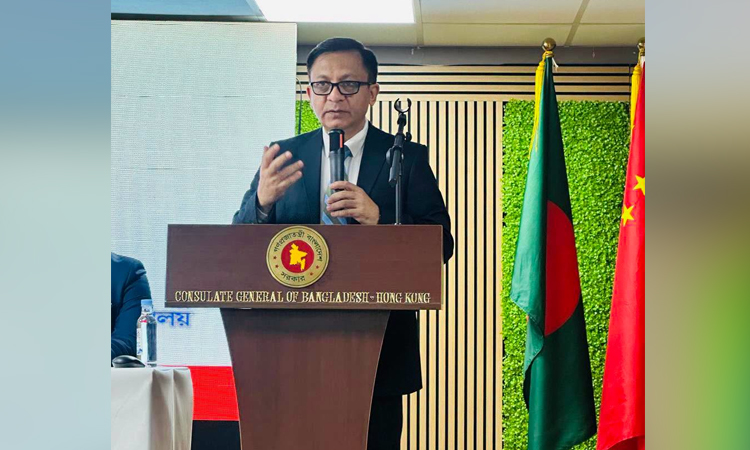
DHAKA, Sept 10, 2026 (BSS) - Commerce, Industries and Textiles and Jute Minister Khandakar Abdul Muktadir has stressed the need for making Bangladesh's economy internationally comparable and competitive to attract greater global investment.
He also underscored ensuring policy stability, reducing supply-chain costs, automating customs procedures and simplifying the process of starting a business to improve the country's investment climate.
The minister was speaking at a seminar titled "Prospects for Expanding Trade and Investment in Bangladesh" organised by the Bangladesh Consulate General in Hong Kong today, said a press release here.
He said technological advancement has enabled investors to easily assess the business and investment environment of any country around the world.
"Therefore, Bangladesh needs to ensure that its business environment, policies and capabilities are comparable with those of other countries to remain competitive in attracting investment," the minister said.
Muktadir said Bangladesh is negotiating trade agreements with different countries to retain trade benefits after graduating from the Least Developed Country (LDC) category in 2029.
He said Bangladesh has concluded economic partnership agreements with Japan and South Korea, while nearly 97 percent of Bangladeshi products now have access to the South Korean market duty-free.
Negotiations on free trade agreements with around 13 more countries are also underway, he added.
The minister said negotiations on a free trade agreement with the European Union would begin soon, expressing hope that Bangladesh would reach an understanding with the bloc before LDC graduation.
Even if that is not possible, Bangladesh will seek to retain the existing market facilities through a preferential trade agreement, he said.
Highlighting high supply-chain costs as a major challenge to Bangladesh's investment climate, Muktadir said supply-chain costs in the country account for around 16 percent of GDP, compared with the global average of about 10 percent.
"The gap must be narrowed by reducing transportation, production and import-export costs," he said.
He also highlighted initiatives to increase the capacity of Chattogram Port by involving international operators and to develop the Matarbari Deep Sea Port.
These infrastructure improvements are expected to reduce transportation and port-management costs, he said.
On easing the process of starting businesses, the minister said it currently can take several hundred days for a business to reach the stage of opening a letter of credit (LC).
The entire process is being digitised, he said, adding that in the future a new business will be able to reach the LC-opening stage within a maximum of 14 days.
He said initiatives are also underway to digitise various business processes, including trade licensing and share transfers, which would significantly reduce entrepreneurs' need to visit government offices physically.
Regarding customs reforms, Muktadir said automation would reduce the time and cost required for importers to clear goods.
He said the government is also moving towards risk-based customs management by reducing unnecessary physical inspections for established and reliable businesses.
"Within the next six months to one year, many unnecessary restrictions and procedures in customs will be relaxed," he assured.
The minister laid particular emphasis on policy continuity to build investors' confidence, saying investment is a long-term decision.
"If a policy is changed shortly after it is introduced, it creates uncertainty among investors," he said.
The minister suggested that when policy changes are necessary, they should preferably be applied to new investments so that investors have a clear understanding of the regulatory environment when making investment decisions.
At the seminar, Muktadir also highlighted ship recycling as a promising sector for new investment in Bangladesh.
Noting that Bangladesh and India account for around 90 percent of global ship recycling, he said there is further scope for investment in the sector, particularly in coastal areas.
He said making Bangladesh more competitive for investment by addressing weaknesses in the business environment remains one of the government's key priorities.
"To this end, continuous reforms are being carried out in infrastructure, policies, customs and business processes," the minister added.