Wednesday
05 August, 2026
News Flash
News Flash
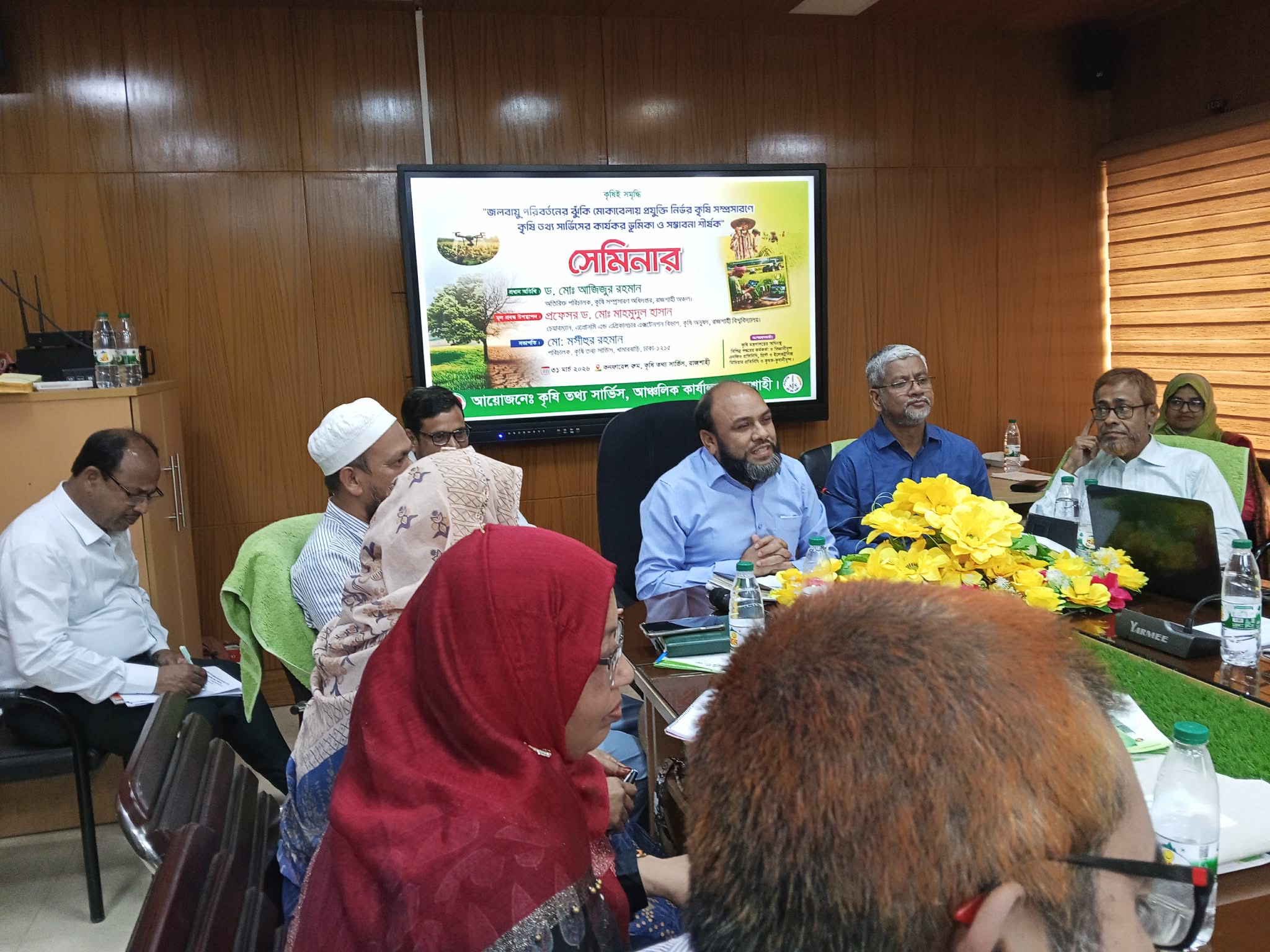
RAJSHAHI, March 31, 2026 (BSS)- United efforts of all organisations concerned can be the crucial means of mitigating the adverse impact of climate change on agriculture in the Barind area.
Climate change is a major threat to agriculture and technology-based agricultural extension can be highly effective in addressing these risks.
Agricultural experts and researchers made the observations while addressing a daylong seminar titled "Effective Role and Potential of Agricultural Information Services in Technology-Based Agricultural Extension to Address Climate Change Risks" here today.
The Regional Office of Agriculture Information Services (AIS) organised the seminar at its conference hall.
Additional Director of Department of Agricultural Extension (DAE) Dr Azizur Rahman addressed the seminar as the chief guest with AIS Director Mosihur Rahman in the chair.
Professor Mahmudul Hasan, chairman of Department of Agronomy and Agricultural Extension at Rajshahi University presented the keynote paper.
He said AIS can enhance farmers' adaptive capacity by providing timely, accurate, and relevant information.
With proper policies, infrastructure, and training, this can make Bangladesh's agriculture more stable, sustainable, and climate-resilient, he
added.
Prof Hasan attributed that Bangladesh is an agriculture-dependent country, where a large portion of the population relies on farming. Due to climate change, the agricultural sector is facing increasing risks.
The expansion of modern, technology-based agriculture and information services can help farmers make timely decisions. Therefore, the effective use of agricultural information services is crucial in addressing climate risks.
It is also important for food security, farmers' income, livelihoods, and the rural economy.
If timely, location-specific, scientific, and easily understandable information is delivered quickly to farmers, climate-related risks can be
significantly reduced.
"Therefore, providing the right information to farmers at the right time is now more important than ever" he added.
Principal Trainer of Agricultural Training Institute, Ishwardi, Abdullah Hil-Kafi, also presented a paper on "Role of Agricultural Information Services in Technology-Based Agricultural Extension".
Chief Scientific Officer of Bangladesh Rice Research Institute Dr Muhammad Hossain and Chief Scientific Officer of Fruit Research Station Dr Shafiqul Islam also spoke on the occasion disseminating their expertise on the issue.
In his remarks, Mosihur Rahman highlighted the potentials of AIS which included democratization of access to information, ability to reach even
remote farmers and promotion of climate-smart agricultural extension.
Rapid dissemination of climate-smart practices, increased productivity through informed decision-making, reduced risk for farmers, minimization of losses and improved adaptive capacity, engagement of youth in smart agriculture and attracting young farmers to digital agriculture are also
potentials.