Thursday
10 September, 2026
News Flash
News Flash
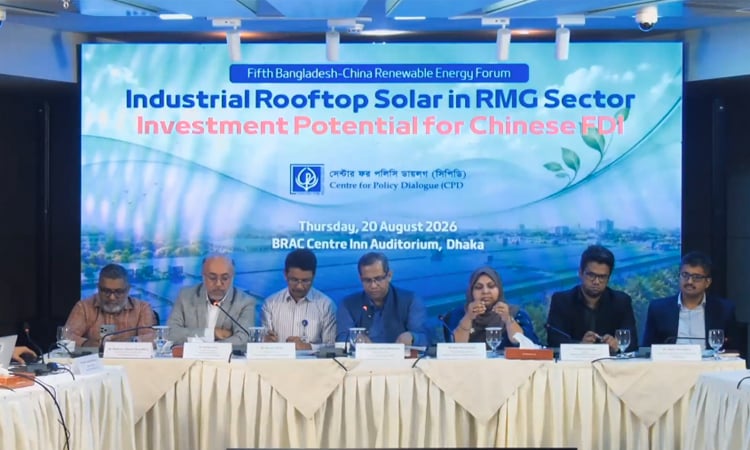
DHAKA, Aug 20, 2026 (BSS) - Centre for Policy Dialogue (CPD) today recommended blended green financing, faster regulatory approvals and cluster-based investment models to accelerate rooftop solar adoption in Bangladesh's ready-made garment (RMG) sector and attract Chinese foreign direct investment (FDI).
The recommendations were made at the Fifth Bangladesh-China Renewable Energy Forum titled "Industrial Rooftop Solar in RMG Sector: Investment Potential for Chinese FDI" at BRAC Centre Inn Auditorium in the capital.
CPD Research Director Dr Khondaker Golam Moazzem moderated the event, while CPD Research Associate Abrar Ahammed Bhuiyan and Programme Associate Noor Yana Jannat presented the study findings.
The study recommended that IDCOL and other financiers establish blended green financing facilities combining concessional loans at 5-7 percent with Chinese green investment capital to extend loan tenors and improve the bankability of rooftop solar projects.
For the Bangladesh Garment Manufacturers and Exporters Association (BGMEA), it proposed establishing a dedicated bilateral facilitation desk and fast-tracking incentives for member factories partnering with vetted Chinese engineering, procurement and construction (EPC) companies.
The study also recommended that the Bangladesh Knitwear Manufacturers and Exporters Association (BKMEA) develop cluster-based investment models by pooling small and medium-sized knitwear factories in industrial hubs such as Narayanganj into consolidated multi-megawatt portfolios to attract Chinese renewable energy service company (RESCO) investment.
It urged factory management to take advantage of early-adoption incentives to reduce upfront capital requirements and hedge against possible increases in grid electricity tariffs.
The study further called on EPC companies and investors to develop bundled RESCO and build-own-operate-transfer (BOOT) financing models for small and medium-sized factories.
It also recommended that the Sustainable and Renewable Energy Development Authority (SREDA) ensure faster and more predictable interconnection approvals.
Industry associations were urged to raise awareness among non-adopter factories by arranging visits to factories that have already installed rooftop solar systems, particularly Chinese-owned factories.
The recommendations come against the backdrop of significant rooftop solar potential in Bangladesh's RMG and textile sector.
According to the study, the sector has an estimated rooftop solar potential of around 2,815 megawatt-peak (MWp), requiring approximately Tk 12,669 crore in investment.
It identified a near-term opportunity of 879 MWp across 1,016 candidate companies.
The study identified financing conditions as one of the key determinants of project viability.
It found that capital expenditure, electricity tariffs, interest rates and loan tenors can substantially influence whether projects achieve the 1.25 times debt-service coverage ratio considered necessary for bankability.
The study also identified several operational and institutional barriers, including high financing costs for SMEs, delays in SREDA approvals, structural limitations of older factory buildings, import and letter-of-credit costs, payment and foreign-exchange risks, and uncertainty over grid interconnection.
It noted that only around 3 percent of electricity consumed by surveyed RMG factories comes from renewable sources, although rooftop solar could potentially meet a significant share of their electricity demand.