Sunday
09 August, 2026
News Flash
News Flash
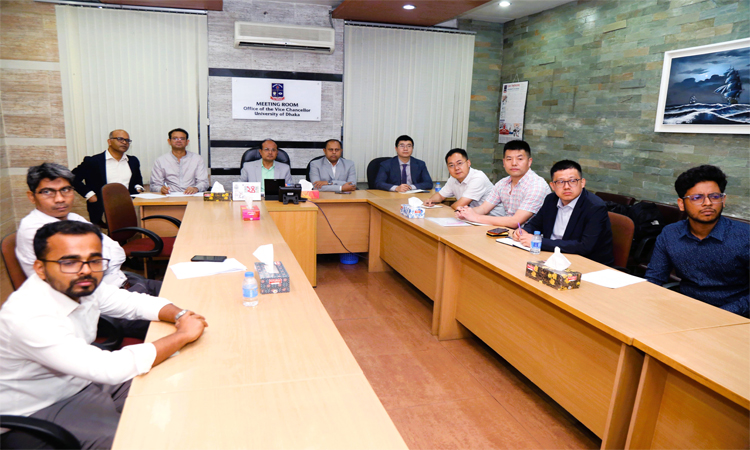
DHAKA, June 2, 2026 (BSS) - A day-long seminar was held at Dhaka University (DU) today to inaugurate a joint research initiative on modern ocean
observation and environmental modeling in the coastal waters of Bangladesh.
The program has been launched under a joint collaboration between the International Center for Ocean Governance of Dhaka University (ICOG-DU) and
the First Institute of Oceanography (FIO) of China under the HEAT ATF Sub-Project 13025.
Dhaka University Vice-Chancellor Prof A B M Obaidul Islam attended the inaugural session of the seminar as the chief guest.
The session was also addressed by the Dean of the Faculty of Earth and Environmental Sciences Prof Md. Humayun Kabir, international expert of the
HEAT project Dr. Tonia Astrid Capuano, and FIO scientist Dr. Shumin Jiang. Director of ICOG Prof K. M. Azam Chowdhury delivered the welcome address.
Speaking as the chief guest, DU Vice-Chancellor Prof A B M Obaidul Islam emphasized that international cooperation is vital for oceanography, coastal
environmental monitoring, and building climate resilience.
"The ongoing scientific collaboration between Bangladesh and China has opened up new horizons for marine resource management, tackling coastal risks, and promoting sustainable development," the VC said.
He noted that Bangladesh's economy, coastal livelihoods, biodiversity conservation, and climate resilience are heavily dependent on the sustainable
management of the Bay of Bengal. In this context, the joint research with China's FIO is significantly enhancing the country's ocean observation
capabilities.
Praising the progress of the HEAT sub-project, which was approved through international competition, the VC called it a global recognition of
Bangladeshi researchers' capabilities.
He urged young researchers and students to engage in international-standard research, as they must lead future marine and climate studies.
In the technical sessions, FIO scientists presented papers on modern ocean observation technologies, marine geo-hazards, and coastal environmental
management.
A documentary showcasing the progress of the HEAT project, its modeling framework, and the GNSS Buoy Deployment Project was also screened, followed
by a Q&A session.
The joint program integrates cutting-edge field technology with numerical modeling. Using the Delft3D modeling system, researchers will track climate-
induced pollution dynamics, toxic material dispersion, and identify pollution accumulation zones in coastal areas.
The initiative also plans to develop an interactive environmental database to support marine biodiversity conservation.
This initiative will provide researchers with opportunities to enhance skills in real-time buoy data analysis, oceanographic modeling, coastal risk
forecasting, and environmental monitoring. It will also establish an effective platform for scientific data-driven decision-making to assess and
mitigate the impacts of microplastics, heavy metals, and oil pollution.
Teachers, researchers, and students from various universities, alongside representatives from the Ministry of Fisheries and Livestock, Bangladesh
Navy, and Bangladesh Space Research and Remote Sensing Organization, participated in the seminar.