Wednesday
03 June, 2026
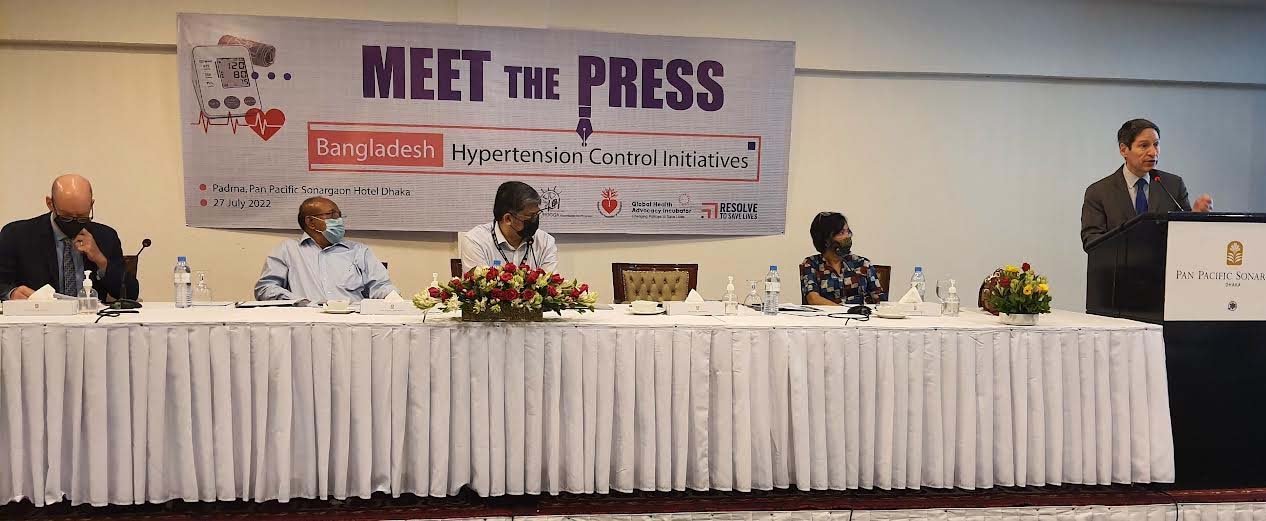
DHAKA, July 27, 2022 (BSS) - Life-saving care for high blood pressure, also known as hypertension - the leading preventable risk factor for heart disease, heart attacks, and strokes - could be expanded nationwide in Bangladesh for about US$9 per patient per year, according to a new study published in the British Medical Journal.
The study findings were shared today at a meet the press event titled "Bangladesh Hypertension Control Initiatives" held at Pan Pacific Sonargaon Hotel in the capital.
The event was jointly organised by the NCDC Programme of the Directorate General of Health Services (DGHS), PROGGA (Knowledge for Progress), the National Heart Foundation of Bangladesh (NHFB), Global Health Advocacy Incubator (GHAI), and Resolve to Save Lives, a joint press release said.
"In Bangladesh, one out of every five adults has hypertension," said Dr Tom Frieden, President and CEO of Resolve to Save Lives and former Director of the US Centers for Disease Control and Prevention. "Many lives can be saved - and heart attacks and strokes prevented - by investing in strengthening primary care services to provide blood pressure treatment to Bangladeshi adults."
Although most people's high blood pressure can be controlled with a simple medication regimen, of the estimated 22 million people with high blood pressure in Bangladesh, it is estimated that only 49 percent have been diagnosed, 35 percent are receiving treatment, and 14 percent have their blood pressure under control.
The hypertension control programme from NCDC DGHS and NHFB has been successfully implemented in 51 upazila health complexes, which offer hypertension care that aligns with the World Health Organizations' HEARTS technical package. The programme has so far registered 100,000 patients for treatment and has controlled blood pressure in 58 percent of patients in treatment.
"Thirty percent of deaths in Bangladesh are from heart disease, but less than 5 percent of Bangladesh's health sector budget is allocated to addressing non-communicable diseases," said National Professor Brig (Rtd.) Abdul Malik, Founder and President of the National Heart Foundation of Bangladesh.
"There is an urgent need to improve control of high blood pressure, which the pilot program shows can be done at low cost through primary health care, even at the national level," he said.
The study, which used the HEARTS costing tool, an application designed to estimate annual hypertension control programme costs, suggests that the HEARTS package would be even more affordable if there is more task-sharing among medical doctors and non-physicians and increased task sharing to allied health workers such as Community Health Care Providers, and further reduced by decreasing the unit cost of quality assured medications.
Expanding the roles of nurses and other health care providers to support blood pressure management could save money and make providing treatment more feasible nationally and more accessible to patients. The study was conducted with funding from Bloomberg Philanthropies.
"The hypertension control program piloted by NCDC DGHS, and the National Heart Foundation, in collaboration with Resolve to Save Lives, is succeeding by incorporating the principles of task-sharing and team-based care," said Professor Md Robed Amin, Line Director, Non-Communicable Disease Control Programme, DGHS.
"In the span of two years, the programme has registered more than 100,000 patients - averaging more than 4,000 new patients a month - with a 58 percent blood pressure control rate, almost fourfold the national average," he said.