Saturday
29 August, 2026
News Flash
News Flash
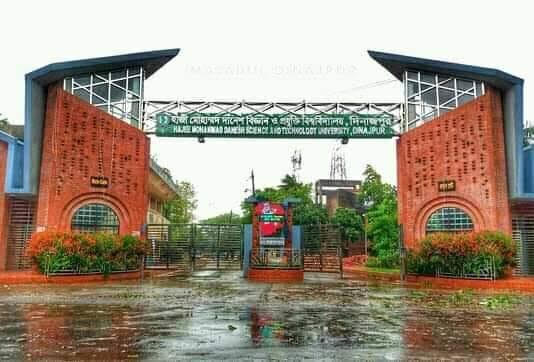
DINAJPUR, Aug 29, 2026 (BSS) - A student of Hajee Mohammad Danesh Science and Technology University (HSTU) in Dinajpur has developed an artificial intelligence (AI)-based technology that can recommend suitable crops for farmland by analysing soil and weather data.
Nahid Islam, a student of the Department of Electronics and Communication Engineering (ECE) at HSTU, developed the AI-based crop recommendation system using real soil data collected from different locations on the university campus.
HSTU Director of Public Relations Md. Khademul Islam confirmed the development to Bangladesh Sangbad Sangstha (BSS) in a press release issued on Friday.
According to the release, the system analyses soil pH, nitrogen, phosphorus, potassium, moisture, temperature and rainfall data to select suitable crops from a database of 28 crop varieties. It also incorporates an AI chatbot capable of answering farmers' questions in Bangla.
Nahid said the technology was recently tested at a nursery field of the Bangladesh Agricultural Development Corporation (BADC) in Dinajpur, where the AI model achieved an accuracy rate of more than 97 percent.
The researcher, a member of HSTU's 23rd batch in the ECE department, said he developed the crop recommendation system based on soil data collected from the university campus rather than relying solely on pre-existing datasets.
For the research, he collected soil samples from different locations on the campus and documented soil characteristics for 28 different crops. He then developed a machine-learning pipeline through data preprocessing, feature engineering, model training and validation.
The technology has been designed in four layers to make it accessible and practical for farmers.
The first layer consists of an Internet of Things (IoT)-based soil analysis device. The device can measure soil pH, nitrogen, phosphorus, potassium, moisture and temperature in the field and transmit the data directly to the cloud, reducing the need to send soil samples to a laboratory.
The second layer is the crop recommendation engine. Using a machine-learning model trained on soil data collected from the HSTU campus, the system analyses field conditions and selects the most suitable crop from 28 alternatives. The model recorded more than 97 percent accuracy during testing.
The third layer features a large language model (LLM)-based chatbot developed by Nahid himself. Farmers can ask questions in Bangla and receive immediate responses. According to the researcher, the chatbot does not rely on expensive third-party AI APIs, potentially making the technology more affordable and locally adaptable.
The final layer is an Android application through which farmers can access the system using an ordinary smartphone. The application is designed to provide crop recommendations based on information supplied by users without requiring specialised hardware.
The researcher said the main objective is to make the technology available to farmers, particularly those in remote areas, at a low cost.
To assess the technology's effectiveness, a field trial was recently conducted at a BADC nursery field in Dinajpur. Nahid installed the IoT-based soil analysis device at the site, collected soil data and demonstrated how the AI system could use the information to recommend suitable crops in real time.
The research was academically supervised by Professor Dr Md. Dulal Hasan of the Department of Electronics and Communication Engineering at HSTU. Agriculturist Shahana Parvin of BADC, Dinajpur, assisted with implementation of the research at the field level.
Professor Dulal Hasan said Nahid had gone beyond developing an AI model by independently collecting data on campus and building the entire technology pipeline.
“As a teacher, I am truly proud to see this. The system is a practical solution for farmers in the context of Bangladesh,” he said.