Thursday
20 August, 2026
News Flash
News Flash
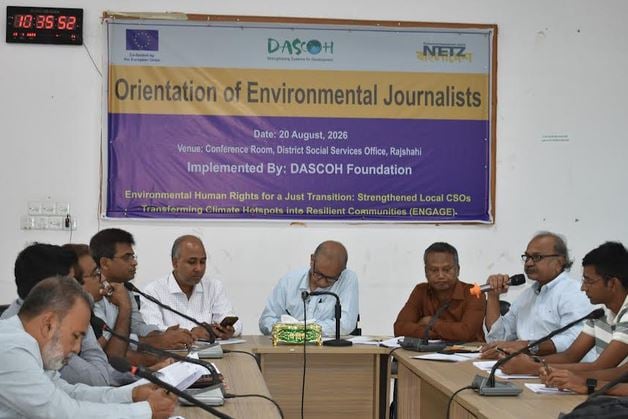
RAJSHAHI, Aug 20, 2026 (BSS) - An orientation meeting with environmental journalists was held in Rajshahi district today with the aim of protecting the rights of the most vulnerable communities at risk from climate change and environmental degradation.
The meeting was organised under the `Environmental Human Rights for a Just Transition: Strengthened Local CSOs Transforming Climate Hotspots into Resilient Communities (ENGAGE)’ project at the conference room of the District Social Service Office, Rajshahi.
The development organisation DASCOH Foundation organised the meeting with financial support from the European Union (EU) and NETZ Bangladesh.
DASCOH Foundation Project Director Jahangir Alam Khan delivered the welcome speech, while Project Coordinator Ruhul Amin gave a PowerPoint presentation on the project.
A total of 20 journalists from different media outlets in Rajshahi district and five content creators participated in the meeting.
During an open discussion on the impacts of climate change, participants discussed in detail issues such as the shortage of safe drinking water, excessive use of groundwater for agriculture, the use of pesticides and chemical fertilisers, filling of khas (government-owned) ponds, pollution from brick kilns and excessive use of plastic.
The participants made several recommendations to mitigate climate change risks in the Rajshahi region.
Other issues, including increasing the use of surface water, undertaking long-term initiatives for dredging rivers and canals, preventing unplanned pond excavation and reducing plastic use, were also discussed.
In his closing remarks, Project Director Jahangir Alam said the northern region is the country’s food basket, but the government has recently declared 47 unions as water-stressed areas, which is a matter of concern.
“So, we hope that through proper reporting, you will not only raise awareness among the general public by highlighting these issues, but also inform the authorities about possible alternatives to address the problems,” he said.