Tuesday
04 August, 2026
News Flash
News Flash
By S M Zahid Hossain
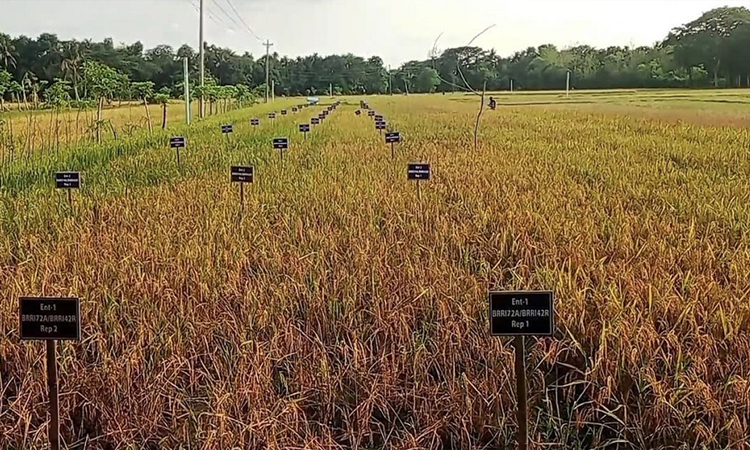
KHULNA, May 23, 2026 (BSS) - A unique technology village in Batiaghata upazila is reshaping the future of farming in the region by cultivating 58 distinct varieties of rice on a single field, providing farmers with a practical platform to learn modern, sustainable agricultural techniques.
The initiative has been developed across nearly 100 acres of land in Boyarbhanga village under the Bangladesh Rice Research Institute’s (BRRI) Locality-Based Rice Variety and Technology Innovation and Existing Laboratory Development (LSTD) project. The project focuses on creating climate-smart technologies tailored to specific regions, establishing six new regional stations, and setting up 15 technology villages nationwide.
The Batiaghata site displays 58 out of 61 rice varieties suitable for the Boro season. Serving as a live demonstration field, it allows farmers to directly compare the growth, yield potential, disease resistance, and environmental adaptability of high-yielding, salt-tolerant, aromatic, and nutrient-rich strains instead of relying on theoretical knowledge.
Billal Hossain, scientific officer at the BRRI Satellite Station in Khulna, told BSS that many local farmers have already benefited from cultivating BRRI Hybrid Dhan-8, which requires less pesticide and fertilizer due to its high disease resistance.
He noted that farmers are now cultivating both Inbred and Hybrid Boro and Aman varieties year-round. Every year, inbred Aman varieties like 109 and 110 are successfully grown in waterlogged areas, yielding at least 20 to 22 maunds per bigha. Meanwhile, salt-tolerant strains such as Inbred 67, 99, and 117 are thriving in Khulna's saline soils, producing up to 33 maunds per bigha.
Local farmers shared their success stories during a field visit on Friday.
Shaheen Molla, a farmer from Boyarbhanga village, reported harvesting 10 maunds and 5 kilograms of paddy from just five kathas of land, noting that lower production costs significantly boosted his profitability.
Another farmer, Moshiur Rahman, said they previously could not grow crops in waterlogged conditions, but he has been successfully cultivating Inbred Aman varieties in those fields for the last three years.
Beyond crop resilience, the technology village promotes eco-friendly and mechanized farming practices. Farmers reported achieving high yields with reduced labor costs and zero pesticide use on multi-bigha plots by adopting mechanical planting and harvesting.
Rafiqul Islam, Additional Director of the Department of Agricultural Extension (DAE) for the Khulna Region, emphasized that salinity and waterlogging are major climate-induced challenges for southwestern Bangladesh. He praised the technology village as a promising solution, where ongoing field trials of climate-resilient seeds are backed by government-supplied fertilizers, machinery, and technical support services.
LSTD Project Director Dr. Md. Anwar Hossain said that the Batiaghata technology village serves as a living model for future agriculture by seamlessly integrating scientific research, education, and practical farming experiences to transform the agricultural landscape of southern Bangladesh.