Tuesday
04 August, 2026
News Flash
News Flash
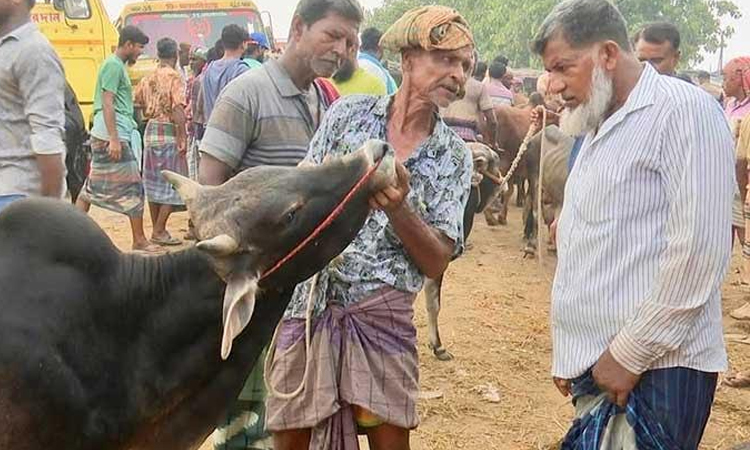
RAJSHAHI, May 23, 2026 (BSS) – With the holy Eid-ul-Azha approaching, Qurbani cattle markets across Rajshahi have become vibrant with buyers and sellers, with demand this year centering mainly on small and medium-sized animals.
The region’s largest cattle market, the historic City Haat in Rajshahi city, along with various upazila and rural markets, is witnessing a heavy influx of sacrificial animals, including cows, goats and sheep.
Market stakeholders said middle- and lower-income buyers are showing greater interest in medium-sized cattle and goats as rising living costs have made large cattle less affordable.
A visit to Rajshahi City Haat found brisk trading continuing from morning till night amid lively bargaining between buyers and sellers. Crowds were particularly noticeable around cattle priced between Tk 70,000 and Tk 120,000.
Goats priced between Tk 15,000 and Tk 30,000 were also in high demand.
Traders said cattle weighing slightly over two maunds were selling for Tk 85,000 to Tk 95,000, while those weighing between 3 and 3.5 maunds fetched Tk 140,000 to Tk 145,000.
Cattle weighing 5 to 5.5 maunds were selling for Tk 160,000 to Tk 180,000, while larger animals weighing between 10 and 12 maunds were priced at Tk 500,000 to Tk 550,000.
Buyers said the rising prices of essential commodities have forced many families to revise their Eid budgets.
Abdul Mannan, a resident of Rajshahi city’s Uposhohor area told BSS he had initially planned to buy a large cow but later changed his decision due to financial constraints.
“Given the current market situation, I am now looking for a good cow within Tk 90,000 to Tk 100,000. Medium-sized cattle are more suitable for ordinary people,” he said.
Another buyer, Shamim Patwary, said large cattle were now beyond the reach of many middle-class families.
“For families like ours, medium-sized cattle are the only option this year. There also appears to be a good supply of local breed cattle in the market,” he added.
Farmers and traders said they had prepared more small and medium-sized cattle this year after assessing market trends.
Ali Hossain, a farmer from Natore who brought cattle to Rajshahi City Haat, said buyers would find animals according to their affordability.
“Every year we bring cattle to this market for Qurbani. This year too, we have brought various types of cattle,” he said.
Another farmer, Sajjad Ali, said medium-sized cattle were selling faster than larger ones.
“Understanding the demand in Rajshahi markets, I brought mostly medium-sized cattle this year. Large cattle are taking more time to sell,” he said.
Local farmer Abdul Khalek said although feed and transportation costs had increased, farmers tried to keep buyers’ purchasing capacity in mind while preparing cattle for the market.
“Cattle weighing between 3 and 5 maunds are in the highest demand this year,” he said.
The goat market is also witnessing significant activity as small families continue to prefer goats for Qurbani.
Good-quality goats were selling between Tk 18,000 and Tk 20,000, while traders predicted prices could rise further closer to Eid.
At Nowhata Haat, goats weighing 12 to 14 kilograms were selling for Tk 15,000 to Tk 16,000, while those weighing 15 to 18 kilograms fetched Tk 20,000 to Tk 22,000. Goats weighing more than 20 kilograms were selling for around Tk 25,000.
Meanwhile, the District Livestock Office said there is an adequate supply of sacrificial animals in Rajshahi this year.
According to official estimates, the district has 463,011 animals suitable for Qurbani against an estimated demand of 371,058, leaving a surplus of around 91,953 animals.
The office data showed that a total of 104,841 cows, 3,425 buffaloes, 311,339 goats and 43,406 sheep have been prepared for Qurbani in Rajshahi division this year.
Officials said goats account for the largest share of available animals, followed by cows, sheep and buffaloes.
They also noted that as Rajshahi is not a major commercial city like Dhaka, the region has a comparatively larger middle- and lower-income population, resulting in consistently higher demand for small and medium-sized animals.
Market lessees said the supply situation remains stable due to increased production by local farms, reducing dependence on cattle from other districts.
However, they expect trading activity to intensify in the final days before Eid.
Rajshahi City Haat lessee Shawkat Ali said many visitors are still surveying the market before making purchases.
“The major buying and selling will take place two to three days before Eid. So far, supply is good and buyers are finding cattle according to their preference,” he said.
Meanwhile, police and local administration have strengthened security measures at the cattle markets.
Law enforcement agencies were seen working to prevent counterfeit currency circulation, theft, mugging and traffic congestion around the markets.