Tuesday
04 August, 2026
News Flash
News Flash
RAJSHAHI, May 19, 2026 (BSS) - Formulating a time-fitting policy and its implementation can be the crucial means of judicious use of harmful agrochemicals for survival of the pollinating insects.
Growing use of toxic pesticides has been triggering the death of pollinating insects, destruction of biodiversity, and environmental disaster. So there is no way but to control the frequent use of pesticides.
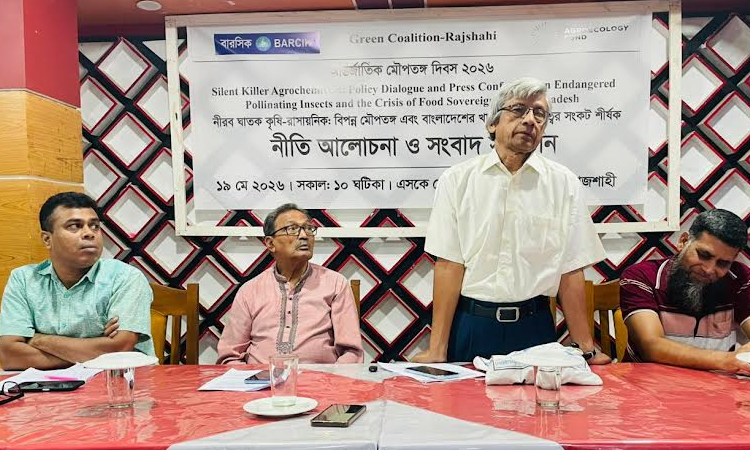
Experts and researchers made the observation while addressing a meeting titled “Silent Killer Agrochemicals: Policy Dialogue and Press Conference on Endangered Pollinating Insects and the Crisis of Food Sovereignty in Bangladesh” today.
Development research organization BARCIK and Green Coalition jointly organized the event at SK Food Seminar Hall in the city to mark the World Bee day 2026 with Green Coalition President Mahbub Siddique in the chair.
Distinguished environmental and zoological scientists, agricultural researchers, human rights activists, beekeepers and grassroots farmer representatives participated, presenting their demands and statements.
Addressing as focal person, Prof Bidhan Chandra Das retired from the Department of Zoology at Rajshahi University said around 20,000 species of pollinating insects have been documented in nature worldwide.
He called for research on this critical issue and demanded a national policy for pollinator protection, conservation of the natural environment, and a ban on excessive harmful pesticides.
Dr Bidhan Das said the use of high-risk and banned pesticides must be stopped together with formulating a National Pollinator Protection Policy.
Besides, agro-ecology and environmentally friendly agriculture must be expanded and undertaking a special environmental protection program for the Barind region is needed.
BARCIK Regional Coordinator Shahidul Islam presented a policy paper on the issue. He said expanding agroecological practices can protect against multi-species crises and the extinction of pollinators.
He also stated that it would simultaneously establish regional food sovereignty. He demanded the formulation of a national policy for the protection of pollinators.
Beekeeper Shafiqul Islam Babu said that extreme heat-waves are increasing day by day. Temperatures in the Barind region have risen and are fluctuating severely, causing problems for honeybees.
Participants in the policy discussion stated that pulses, oilseeds like mustard, vegetables, and most fruits in daily diet depend directly on natural pollination.