Monday
07 September, 2026
News Flash
News Flash
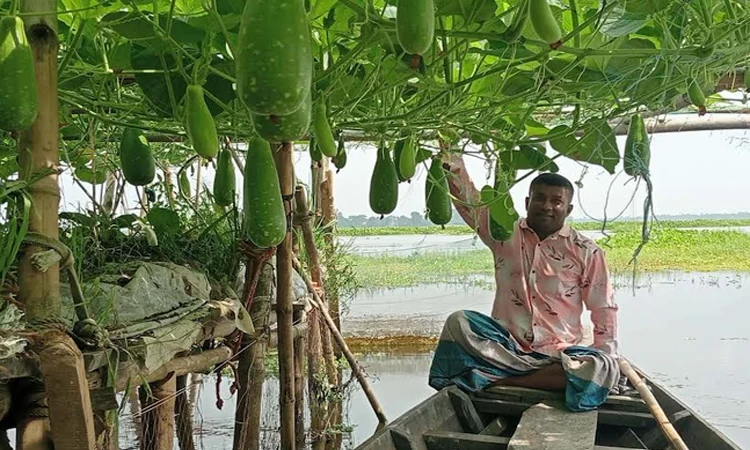
BRAHMANBARIA, Sept 7, 2026 (BSS) - Floating vegetable cultivations on waterlogged and fallow land are gaining popularity among farmers in Nabinagar upazila of the district, creating new opportunities to bring submerged farmland under agricultural production during the rainy season.
Conventional farming is not possible on many lands in the upazila as they remain submerged for four to five months every year. The floating cultivation method, however, has enabled farmers to grow vegetables on such waterlogged land.
Nabinagar, an area dominated by haors and wetlands, has around 8,500 hectares of agricultural land that remain waterlogged for a prolonged period during the monsoon.
Although Boro and other crops are cultivated there during the dry season, most of the land remains uncultivated when it goes underwater during the rainy season. To address the problem, the agriculture department has introduced floating-platform vegetable cultivation in the upazila.
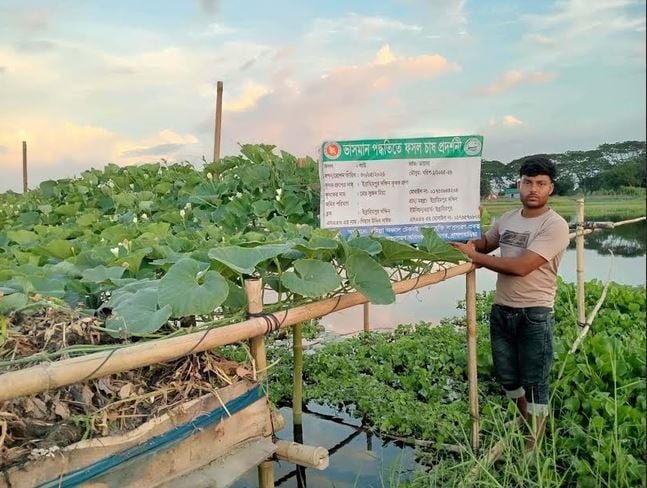
According to the Upazila Agriculture Office, farmers in Ibrahimpur, Natghar, Roshullabad, Barikandi, Salimganj, Nabinagar East and Satmora areas have been cultivating vegetables using floating platforms for the past two years with technical support from the Agriculture Department. Around 20 bighas of land are being used for floating vegetable cultivation in the current season.
Government assistances are being provided to farmers under the Flood Reconstruction Emergency Assistance Project (FREAP) programme of the Department of Agricultural Extension and the Sustainable Agriculture Technology Extension Project in Cumilla region. More than 200 farmers have also received training in floating-platform vegetable cultivation.
Farmers said they construct floating platforms with bamboo and other locally available materials and grow different vegetables, including bottle gourd, pumpkin, cucumber and bitter gourd. The method produces good yields, particularly during the rainy season when the supply of vegetables in local markets declines, enabling farmers to earn additional income.
They said the same structures can also be used for vegetable cultivation after the monsoon, reducing production costs. The method also requires comparatively less irrigation and is less vulnerable to pest and disease attacks, creating an opportunity to produce vegetables at lower costs on waterlogged and fallow land. Farmers also said vegetables produced through the method have good taste as relatively less chemical fertilisers and pesticides are used.
Emran Mia, a farmer from Roshullabad union, told BSS that he cultivated bottle gourd and pumpkin on around 20 percent of his land this season. He said cultivating vegetables on submerged land during the rainy season had once seemed impossible, but with assistance from the local agriculture department, it has now become a reality.
He cultivated bottle gourd on around 15 percent of his land using the floating-dali method and has already sold gourds worth around Taka 15,000. He expects to continue harvesting for another two months.
Ismail Mia, a farmer from Ibrahimpur union, said he has been cultivating vegetables using the floating method for the past two years following advice from the local agriculture department.
Earlier, there was no opportunity to cultivate vegetables for two to three months of the year. Seeing my success, many others in the area are now becoming interested in this method, he said.
Nabinagar Upazila Agriculture Officer Md Jahangir Alam Liton told BSS that floating vegetable cultivation has been introduced in Nabinagar for the first time on a wider scale.
Alongside providing training to farmers, we have arranged demonstration plots, constructed floating structures and supplied seeds and fertilisers. Deputy assistant agricultural officers are also regularly monitoring the cultivation, he said.
The initiative has opened a new avenue for agricultural production and income generation in the waterlogged areas of Nabinagar, officials and farmers said.