Saturday
29 August, 2026
News Flash
News Flash
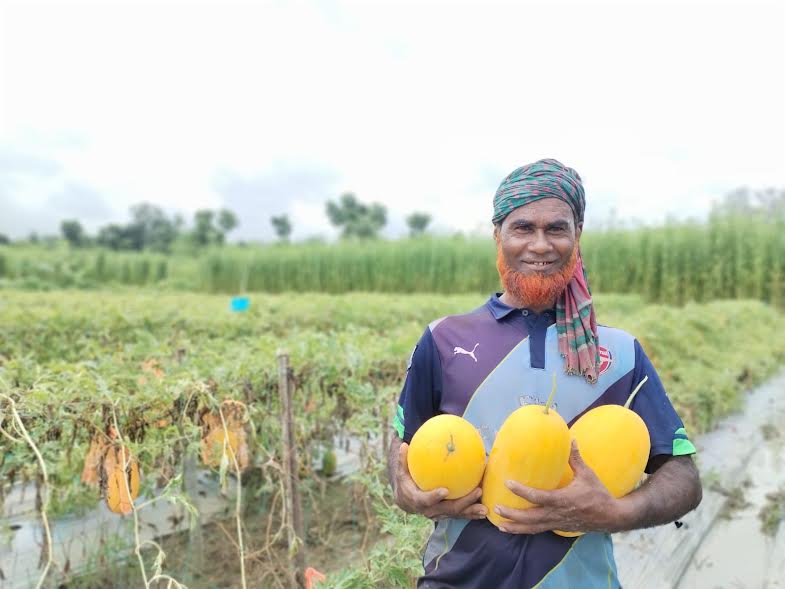
SATKHIRA, Aug 29, 2026 (BSS) - Off-season watermelon cultivation is gaining popularity among farmers in Satkhira as the crop is proving profitable, creating employment and making productive use of fallow land and areas surrounding fish enclosures.
At first glance, the watermelon plants appear like a colorful garland hanging from platforms beneath lush green leaves. Beneath the platforms, farmers are cultivating other crops, while fish swim in enclosures containing a mixture of fresh and brackish water.
Several varieties of out-of-season watermelon, including Supreme Honey, Tripti, Black Baby, Sugar Queen, Bengali Link, Astha, Kania and Dragon Plus, are being cultivated in different parts of the district.
According to the District Agricultural Extension Department, off-season watermelon has been cultivated on around 141 hectares of land in seven upazilas of Satkhira this season, about 65 hectares more than the previous season.
Farmers say the crop requires an investment of around Taka 40,000 to Taka 45,000 per bigha on flat land, while the produce can be sold for Taka 1.5 lakh to Taka 2 lakh per bigha, depending on yield and market prices.
A few years ago, many plots in Satkhira Sadar, Tala, Debhata and other upazilas remained fallow. The embankments of fish enclosures were also frequently left unused or covered with weeds.
The Department of Agricultural Extension initially encouraged experimental watermelon cultivation on such lands. Although many farmers were skeptical about whether watermelon could be successfully grown in areas affected by brackish water, the first harvest proved successful. The success gradually encouraged farmers in neighboring villages to take up the crop.
Farmers and agricultural officials now believe the cultivation method could offer a viable model for other coastal areas of Bangladesh.
Iqbal Hossain, a farmer from Tetulia area of Tala upazila, told BSS that he achieved satisfactory yields by cultivating off-season watermelon using the mulching method.
He cultivated Astha, Kania and Dragon Plus varieties and said both the yield and market price were encouraging.
"Wholesale traders come here from different parts of the country and buy watermelons directly from our area," he said, expressing hope of making a substantial profit this season.
The expansion of watermelon farming has also created employment opportunities for local people.
Akshed Ali, an employee at a watermelon farm, said the fruits, which have either red or yellow flesh, are delicious.
"Earlier, there was little work available in this area. Now we have employment here. We receive Taka 500 as a daily wage, so we no longer have to leave the area in search of work," he said.
Shirina Begum, another farmer from Tetulia, cultivated yellow-fleshed off-season watermelon on two bighas of land with seeds and fertilizer supplied with assistance from local NGO Unnayan Pratasha.
She said the yield had been good and that she was selling the watermelons herself from a roadside stall along the highway.
After deducting all expenses, she expects to earn between Taka 1 lakh and Taka 1.5 lakh from the two bighas.
Agriculturist Nayan Hossain of Unnayan Pratasha told BSS that, with support from the Palli Karma-Sahayak Foundation (PKSF) and under the organisation's SPD Agriculture programme, 21 farmers in Tetulia union of Tala upazila cultivated off-season watermelon on 28 bighas of land using the mulching method.
"Farmers are selling the watermelons wholesale at Taka 45 to Taka 50 per kilogram. The yield has also been encouraging. We expect the area under off-season watermelon cultivation to increase further because farmers are benefiting from it," Nayan said.
He said Satkhira's soil is suitable for watermelon cultivation and urged educated young people to become involved in agriculture rather than spending years seeking limited employment opportunities.
According to him, greater youth participation in agriculture could help create self-employment while contributing to the country's food and nutritional security.
Md Yakub Ali, executive director of Unnayan Pratasha in Tala, told BSS that the organisation has been implementing poverty alleviation and income-generating programmes in southwestern Bangladesh.
"We have been working to help disadvantaged people find new sources of employment and income by producing new crops," he said.
"Farmers are benefiting greatly from watermelon cultivation. They are earning around Tk 50,000 to Tk 60,000 per bigha within a short period," he said.
Agricultural expert Iqbal Ahmed, additional deputy director (Grains) of the Department of Agricultural Extension, Khamarbari, Satkhira, said summer watermelon has emerged as a promising crop for the district.
He said the Department of Agricultural Extension began supporting farmers with seeds for the off-season cultivation method in 2020 through the GKBSP project, followed by the SSCP and CCEP projects.
"Along with quality seeds and fertilizers, we provide farmers with materials for preparing the platforms and technical advice through the Upazila Agricultural Offices and field-level agricultural assistants," he said.
He said these initiatives have helped motivate farmers to expand cultivation, resulting in the crop now being grown on around 141 hectares across the district.
The Department of Agricultural Extension is continuing to provide quality seeds, technical advice and demonstration activities to encourage wider adoption of the cultivation method.