Monday
24 August, 2026
News Flash
News Flash
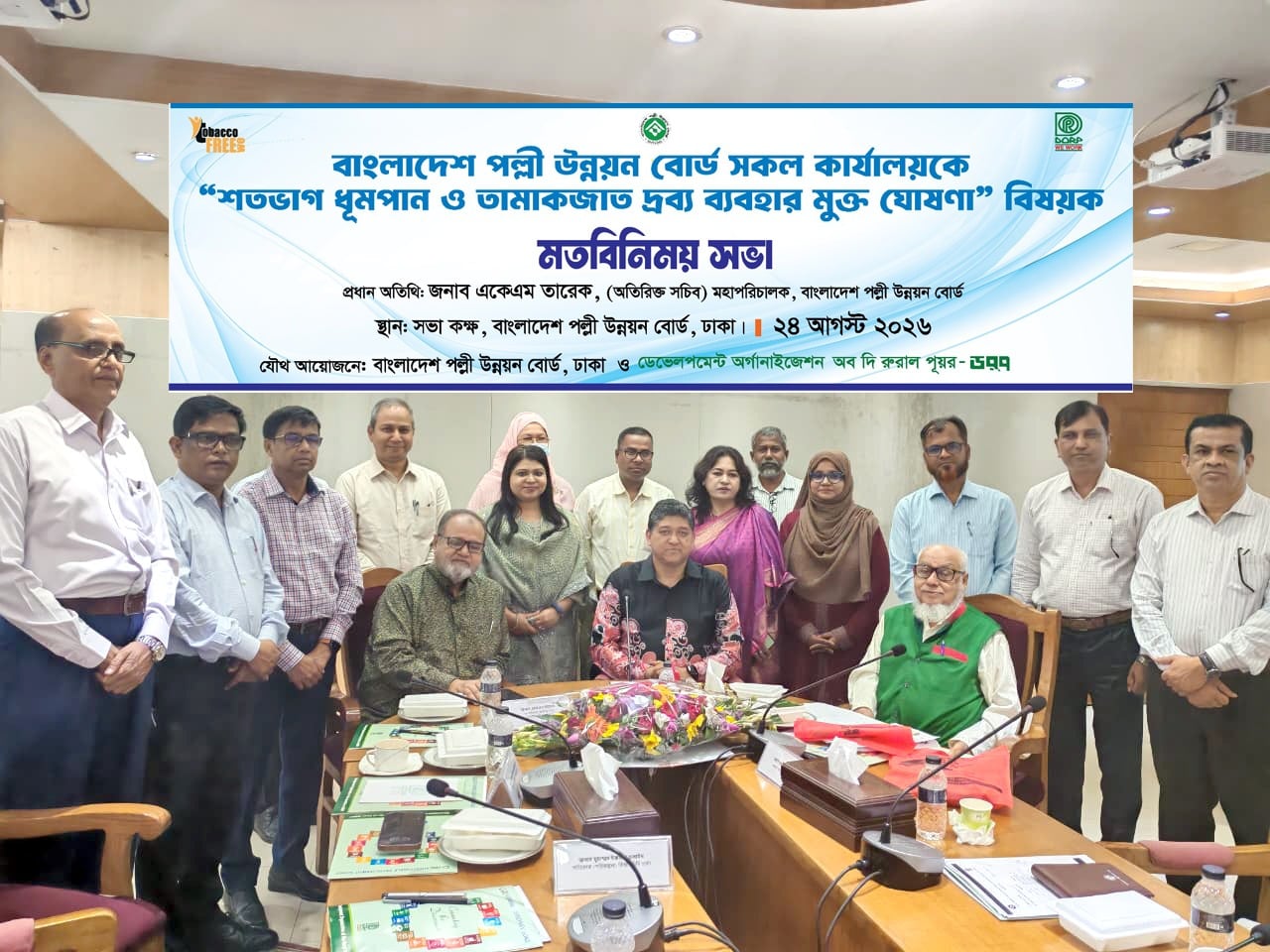
DHAKA, Aug 24, 2026 (BSS)- All 566 offices of the Bangladesh Rural Development Board (BRDB), including its headquarters, have been declared completely tobacco-free as part of a government initiative to protect public health and safeguard non smokers from the harmful effects of secondhand smoke.
The declaration was made by BRDB Director General (Additional Secretary) A.K.M. Tarek at a discussion titled “Declaration of All Bangladesh Rural Development Board Offices as Tobacco-Free”, held today at the conference room of the BRDB headquarters, said a press release here.
Speaking as the chief guest, he said that smoking not only harms the smokers, but also those who are nearby. Non-smokers are also exposed to similar health risks like the active smokers.
Smokeless tobacco products can cause various serious diseases, including oral cancer, and pose a major threat to public health as a whole.
“Therefore, from today, the use, sale and promotion of all tobacco products, including cigarettes, biris, zarda, gul and sadapata, will be completely prohibited within the premises of all BRDB offices. This decision has been taken to protect officers, employees and visiting service recipients from the harmful effects of tobacco. The initiative to ensure a 100 percent tobacco-free environment in government institutions will play an important role in protecting public health and preventing non-communicable diseases,” he added.
In his welcome remarks, DORP Founder and CEO A.H.M. Noman said that Bangladesh is one of the countries with a high prevalence of tobacco use in the world. Among South Asian countries, Bangladesh has the highest rate of tobacco use at 35.3 percent. Therefore, he emphasized that ensuring tobacco-free workplaces through effective measures in all institutions is essential for tobacco control.
Presenting the keynote paper, DORP Tobacco Control Project Coordinator Zeba Afroza said that according to GATS 2017 data, 38.4 million adults in Bangladesh are exposed to secondhand smoke every day in workplaces, public places and public transport.
Approximately 42.7 percent of adults are exposed to secondhand smoke in covered workplaces. In addition, more than 61,000 children under the age of 15 suffer from diseases caused by secondhand smoke.