Monday
24 August, 2026
News Flash
News Flash
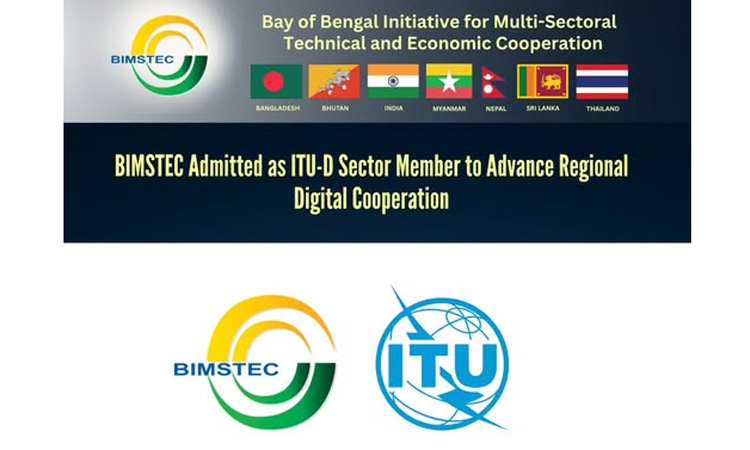
DHAKA, June 1, 2026 (BSS) - BIMSTEC has been admitted as a Sector Member of
the International Telecommunication Union Development Sector (ITU-D), marking
a significant step towards strengthening regional cooperation in digital
connectivity, telecommunications and emerging technologies.
The International Telecommunication Union (ITU) Council approved BIMSTEC's
application during its 2026 session held from April 28 to May 8 last,
according to a BIMSTEC Secretariat press release issued here today.
The decision was formally conveyed by ITU Secretary-General Doreen Bogdan-
Martin in a letter dated May 28 to BIMSTEC Secretary General Indra Mani
Pandey.
The BIMSTEC Secretariat described the development as a major milestone in
enhancing engagement between BIMSTEC and the United Nations specialised
agency responsible for information and communication technologies (ICTs).
As a Sector Member of ITU-D, BIMSTEC is expected to deepen cooperation with
the global telecommunications body in areas including digital connectivity,
artificial intelligence (AI), ICT development, capacity building and
telecommunications infrastructure.
The membership will also enable BIMSTEC member states to benefit from ITU's
technical expertise, development programmes, resources and policy support
aimed at advancing digital transformation and sustainable development.
The Secretariat said it would seek to maximise opportunities arising from the
new partnership, particularly in ICT and AI-related sectors, to support
socio-economic development and regional integration across the BIMSTEC
region.
BIMSTEC considers digital and AI technologies as key drivers of innovation,
regional connectivity and inclusive economic growth.
The association with ITU is expected to provide a stronger platform for
cooperation in emerging technologies and help accelerate digital
transformation initiatives among member states.
Headquartered in Dhaka, BIMSTEC comprises seven Bay of Bengal countries-
Bangladesh, Bhutan, India, Myanmar, Nepal, Sri Lanka and Thailand.
The regional grouping promotes cooperation across a wide range of sectors,
including connectivity, trade and investment, energy, science and technology,
tourism, health, security, disaster management, climate change, agriculture
and women's development.