Tuesday
08 September, 2026
News Flash
News Flash
By Md Aynal Haque
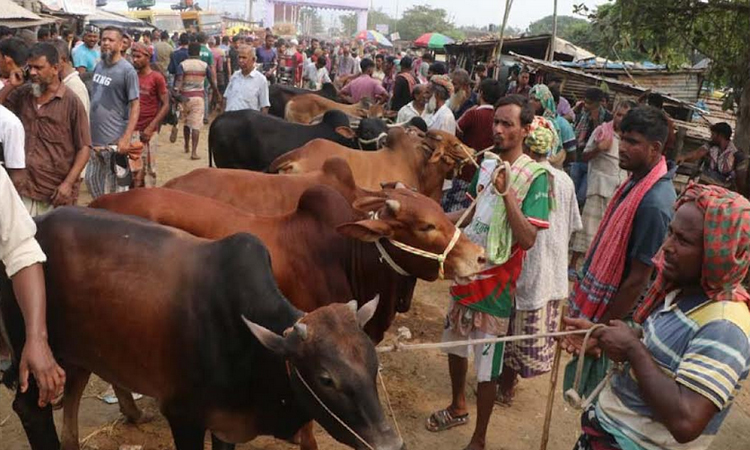
RAJSHAHI, May 24, 2026 (BSS)- Only three days remain until the Muslim festival of sacrifice, Eid-Ul-Adha , huge animals are arriving at the markets, sales also have picked up.
However, for various reasons, many buyers are turning away from the markets. They are putting their trust in farms. There, the animals are weighed directly in front of them, and they choose what they like.
The reason given for avoiding the markets is harassment in various forms by the market leaseholders' men and by middlemen. To avoid the hassle of the markets, buyers are going to farms to buy their animals.
There are 26,234 farms, small and large combined, in Rajshahi district and metropolitan area.
Rajshahi also has several large farms. At these farms, cattle are being sold by weight. Meanwhile, cattle from small farms are being taken to various markets across the country.
These farms raise Shahiwal, Deshal, Albino, Buffalo, Hasha, Ulbari, Nepali, and Bhutti cattle. The farms have cattle priced from Taka 100,000 to as high as Taka 10 lakh. At these farms, cattle are being sold at Taka 550 to Taka 600 per kilogram.
Buyers can be seen visiting these farms every day. If they like an animal, they have it put on the weighing scale, check the weight, and leave the cattle at the farm.
They will take the animal one or two days before Eid. Wholesalers from other districts are also buying from these farms.
However, while buyers and sellers benefit from this method of selling cattle, the government is losing revenue.
Buyers say there are many advantages to buying and selling cattle on a scale. Because the cattle are weighed, neither the buyer nor the seller worries about being cheated. They can buy a healthy, strong animal according to their budget.
Farmers say that this year, demand for medium-sized cattle is higher than for large ones. Already, about 60 percent of the sacrificial animals at various farms in Rajshahi have been sold.
Many people have bought in advance and will take delivery before Eid. Some farms have also arranged their own transport vehicles. Because the cost of cattle feed, medicine, labor, and care has increased, the cost of raising cattle has risen significantly this year.
For that reason, many farms have reduced the number of cattle compared to last year.
Visiting several farms in Rajshahi, it was seen that some people are walking around with their families looking at cattle, while others are checking teeth, weight, eating habits, and health before bargaining.
Many are pre-booking their preferred animals. Shamsul Islam, a service holder, said, "If you go to the market, you can't see properly because of the crowd. Here you can take your time and buy. It's easier to compare prices at the market.
The price at the farm seems a bit higher. Even so, I came to the farm to avoid the heat and the crowd."
Mahfuzur Rahman said, "Because of rising commodity prices, I plan to perform the sacrifice within a limited budget this year. But the price of large cattle is now out of reach. So I'm looking for a medium-sized cow between 80,000 and 100,000 taka."
Mehrab Hossain, owner of SJ Padma Agro, said, "Earlier we used to prepare 200 to 300 cattle. This time we have reduced the number. Most have already been booked. We are keeping the price according to weight. Prices have increased compared to last year."
Rajshahi's largest cattle market is City Haat. This market sits every Sunday and Wednesday. A visit on Wednesday afternoon showed that, compared to previous years, fewer cattle had arrived and higher prices were being asked.
In past years, this market saw crowds of wholesalers from different parts of the country as well as local buyers, but this time that was not seen. Only a handful of wholesalers were found, and buying and selling was not like before.
At the market, it was seen that a cow that could be bought for 70,000 to 75,000 taka last year now costs Taka 85,000 to 90,000.
Wholesalers Foyez Uddin Bepari and Junaid Ahmed, who came from Dhaka to buy cattle, said that in other years, 15 to 20 days before Eid al-Adha, wholesalers from Dhaka, Chattogram and other areas would come and buy cattle from the markets in Rangpur. This time that number is very low.
As reasons, they cited forced collection of excessive fees in the name of 'hasil' or toll by the market leaseholder's men, the nuisance of middlemen, and higher transport costs than before, which have discouraged wholesalers.
They said that while excessive toll collection has not happened much this year yet, the harassment by middlemen is unbearable. They also said that because buyers are coming early to purchase, sellers are not willing to lower the price of cattle.
City Haat leaseholder Shawkat Ali said, "Even though Eid is approaching, both cattle arrivals and the number of buyers are low in the market so far this year.”
On Wednesday, 4,000 to 5,000 cattle were brought to the market. More cattle came to the previous market. But hopefully sales will pick up from next Sunday.
After today (Sunday), the market will sit every day.
Meanwhile, according to the Department of Livestock Services, a total of 43 lakh sacrificial animals have been prepared in Rajshahi division this year, while the demand is around 24 lakh. As a result, after meeting the demand of this region, about 19 lakh animals will be sent to different areas of the country.
Rajshahi District Livestock Officer Dr. Md. Atowar Rahman said this year too, Rajshahi district has a surplus of about 91,953 animals compared to demand. These surplus animals will go to various markets across the country. It is hoped that farmers will get a fair price.
All necessary veterinary and other facilities have been provided at the markets for farmers to buy and sell their animals.