Tuesday
08 September, 2026
News Flash
News Flash

By Md. Jahir Uddin Babor
DHAKA, May 2, 2026 (BSS) - Bangladesh has recorded significant physical and financial progress in constructing 34 modern buffer fertilizer warehouses across the country, a priority project under the Bangladesh Chemical Industries Corporation (BCIC) aimed at securing national fertilizer sovereignty.
The initiative is designed to bolster agricultural productivity by ensuring the scientific preservation of fertilizers and streamlining their distribution to the doorsteps of farmers, thereby eliminating supply chain bottlenecks during peak cultivation seasons.
The Executive Committee of the National Economic Council (ECNEC) approved the project on November 4, 2018, under the title "Construction of 34 Buffer Warehouses in Different Parts of the Country for Storage and Distribution Facilities," with an initial cost of Tk 1,983.03 crore and a timeline from September 2018 to June 2021.
Implementation was delayed due to the COVID-19 pandemic, leading the Planning Commission to authorize a time extension to June 2022 without additional cost implications.
Later, a revised Development Project Proforma (DPP), approved on April 11, 2023, increased the project cost to Tk 2,482.84 crore. Although completion was initially targeted for June 2025, the deadline has been further extended to June 2027 without additional budget increases.
While the completion target was set for June 2025, an administrative adjustment made on June 19, 2025, has extended the implementation period to June 2027 to ensure all technical specifications are met, notably without any further increase in the project budget.
The project is set to augment the nation's storage infrastructure by a cumulative capacity of 5.10 lakh metric tons (MT).
To ensure operational efficiency and regional suitability, the warehouses are being constructed across four distinct capacity categories: four units of 25,000 MT capacity, eight units of 20,000 MT, six units of 15,000 MT, and sixteen units of 10,000 MT, bringing the total number of facilities to 34.
The facilities are being developed at 34 locations across 33 districts to ensure better access for farmers nationwide. The geographic coverage includes northern region such as Bogura, Naogaon, Rangpur, and Dinajpur; western and southwestern areas including Jashore, Kushtia, and Khulna; southern coastal districts like Patuakhali and Bhola; and central and eastern regions including Mymensingh, Cumilla, and Munshiganj.
Project Director Manjurul Haque confirmed that land acquisition has been successfully concluded in 33 districts, noting that acquisition proceedings for the remaining site in Kushtia are currently in the final stages and will be completed in accordance with standard administrative regulations.
Despite the nationwide scope, the project has faced localized challenges; however, construction activities are now actively progressing at 20 separate sites.
Highlighting the project's people-centric philosophy, he said fertilizers will go to the farmers, not the farmers to the fertilizers, adding that the operationalization of these warehouses would significantly curtail transportation costs and eliminate the seasonal distress of marginal farmers.
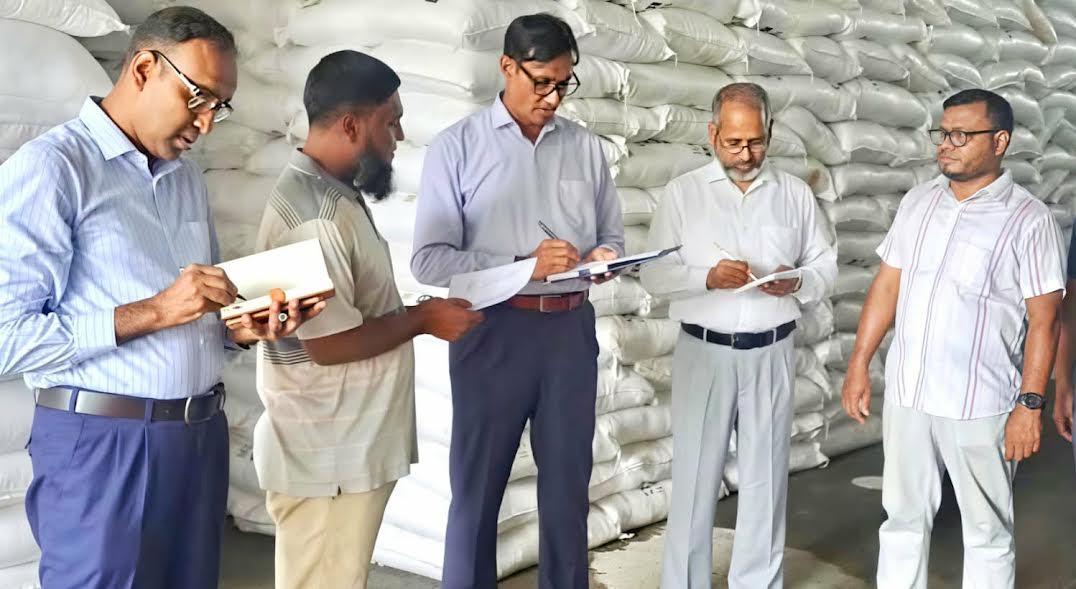
To maintain the highest standards of construction and ensure adherence to the revised timeline, BCIC has established a robust monitoring framework, including four specialized three-member internal monitoring committees conducting periodic field visits and submitting comprehensive progress reports, a 24/7 CCTV surveillance system linking the Ministry of Industries, the Project Director's office and project sites, and dedicated on-site monitoring teams supervising daily technical operations.
The Project Director acknowledged that several multifaceted obstacles contributed to the initial delays and subsequent revision of the DPP, including complexities in land acquisition across diverse terrains, the presence of existing utilities such as electric poles, legal and administrative hurdles involving railway land, khas land and river-classified land, challenges related to connectivity and access road development, delays in securing mandatory environmental clearances, and localized demands for changes in warehouse locations.
The 34-warehouse project is a cornerstone of Bangladesh's strategy for food security. Currently, the annual demand for urea stands at approximately 25 lakh MT, which, when combined with a mandatory emergency buffer of 8 lakh MT, requires a total management capacity of 33 lakh MT.
Domestic production from BCIC's six urea factories accounts for only 10 lakh MT, necessitating substantial imports.
At present, BCIC's 25 existing warehouses can store only 3.07 lakh MT, forcing a significant volume of fertilizer to be stored in open spaces or under the custody of transport contractors.
Exposure to the elements creates a severe risk of clumping and quality degradation, leading to economic losses and reduced efficacy for crops.
While the Bangladesh Agricultural Development Corporation (BADC) operates 24 emergency godowns with a capacity of 1,45,500 MT, these are insufficient to handle the 17 to 18 lakh MT of urea distributed annually.
The addition of 5.10 lakh MT of modern storage through this project will enable the government to maintain a minimum reserve of 8 lakh MT during peak agricultural seasons, ensuring that high-quality, free-flowing fertilizer remains available to farmers year-round.