Monday
24 August, 2026
News Flash
News Flash
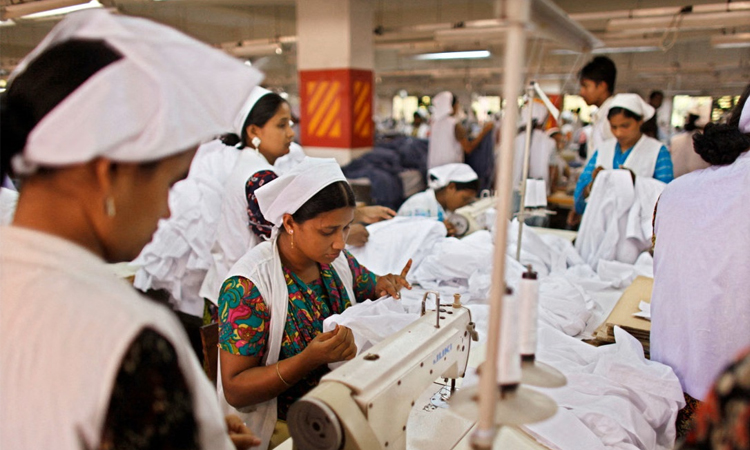
DHAKA, May 22, 2026 (BSS) - Women’s labour is woven into every thread of Bangladesh’s economy- from garment factories and agricultural fields to tea gardens, construction sites and the IT sector. Yet they continue to face widespread discrimination, exploitation and deprivation in the workplace.
Statistics and field-level observations show that although women are now a major driving force of the country’s economy, they remain the most vulnerable to inequality, low wages, job insecurity and lack of labour rights.
According to the Bangladesh Bureau of Statistics (BBS) Labour Force Survey 2024, women now make up nearly 44.2 percent of the country’s total labour force, up from only 36 percent in 2017. While this increase appears encouraging, the reality behind the figures remains troubling.
World Bank data for 2024 showed that 96.6 percent of working women in Bangladesh are employed in the informal sector. This means that a vast number of women are working without protection under labour laws, pension benefits or job security. The barriers for women were identified as follows:
Declining female participation in RMG:
At one time, nearly 80 percent of workers in Bangladesh’s ready-made garment sector were women. They migrated from villages during the 1990s largely fuelled the sector’s growth. However, according to the 2024 report of the Bangladesh Garment Manufacturers and Exporters Association (BGMEA) and data from BRAC University’s MIB project, female participation in the sector has now fallen to 53.7 percent.
The increasing use of automation and machine-based production systems is a major reason behind this decline. Lack of training and the digital divide are preventing many women from adapting to technological changes.
The life story of RMG worker Ayesha Akter from Mirpur-10 in the capital reflects this crisis. After losing her garment factory job for joining a movement, she now works as a day labourer at a brick kiln in Aminbazar.
She said, “There is no environment in garment factories where I can work with my child, and wages are often delayed. Here, at least, I work if I want to, and stop if I don’t.”
Like Ayesha, thousands of women are leaving the garment sector and moving into uncertain professions.
Bangladesh Institute of Labour Studies (BILS) Director Kohinur Mahmud believes the growing use of automated machines, sexual harassment and lack of quality daycare centres are discouraging women to stay in the sector.
Persisting wage discrimination:
Although Bangladesh’s labour law guarantees “equal pay for equal work,” implementation remains limited in practice.
According to the International Labour Organization (ILO) 2023 data, women in the garment industry receive on average 21 percent lower wages than male workers in the same positions. In the agricultural sector, the disparity is even more severe, where women workers earn 30 percent less than men.
The situation in tea gardens is even more alarming. Bangladesh Center for Workers’ Solidarity Executive Director Kalpona Akter said that although 70 percent of tea garden workers were women, their daily wages range from only Taka 170 to 185.
With such meagre earnings, their access to healthcare and sanitation remains beyond reach. Generation after generation, they remain trapped in what she described as “modern slavery.”
Lack of maternity benefits
The absence of maternity rights has become one of the biggest barriers for women in the workplace. Field surveys show that 68 percent of female workers fear losing their jobs if they take maternity leave. Only 5 to 10 percent of factories have effective daycare facilities.
As a result, many women are forced to choose between motherhood and their careers. Due to inadequate social protection, experienced female workers often leave their jobs midway through their professional lives.
Unsafe working conditions in construction and service sectors-
The number of women workers in the construction industry is increasing steadily. However, according to 2024 reports by the ILO and BGMEA, 60 percent of female workers do not receive any personal protective equipment (PPE).
Similarly, workers in service sectors such as hotels, restaurants and beauty parlours often work long hours without appointment letters, leaving them constantly vulnerable to dismissal.
Safety and Rights Society Executive Director Sekendar Ali Mina said, although wage discrimination in garment factories has somewhat declined, women remain severely deprived in terms of promotion. Women hold only 8 to 10 percent of leadership positions, so their demands rarely reach policy-making levels.
Invisible barriers and structural discrimination-
Experts say discrimination against women is not only economic but also deeply rooted in social attitudes and structural inequality. Women own only 12 percent of agricultural land in Bangladesh. Their labour in agriculture is often viewed merely as “supportive labour,” reducing its financial value.
Meanwhile, more than two million domestic workers remain outside labour law protections and are deprived of minimum wages and dignity. In urban areas, the average income of a domestic worker is around Taka 7,000, nearly half of the national minimum wage.
Way forward-
According to experts, coordinated initiatives by both the government and employers are necessary to ensure protection for women workers. Female workers in informal sectors such as domestic work and agriculture should be brought under labour law protections. At the same time, specialised technical training should be introduced to help women cope with the challenges of automation.
Experts also stressed the need for government initiatives to ensure housing, education and healthcare facilities in industrial areas.
BKMEA Director Engineer Belayet Hossain said, if the state takes responsibility for these issues, it will become easier for owners to ensure fair wages. From the institutions’ side, we are ready to provide whatever support is necessary.
World Bank research suggests that ensuring equal opportunities for men and women in the workplace could increase Bangladesh’s GDP by as much as 30 percent. In this sense, women’s empowerment is not only a matter of human rights but also a key driver of economic prosperity.
Labour Reform Commission chief Syed Sultan Uddin Ahmed said, “We are bringing women to cities for work for 30 years, but we are not thinking about their security or sustainable housing. This neglect must end.”
He added that the title of a “developing Bangladesh” would only be meaningful if women workers, who keep the wheels of the economy moving, receive the dignity and rights they deserve. Otherwise, this invisible wall of deprivation may one day obstruct the country’s entire economic progress.