Tuesday
08 September, 2026
News Flash
News Flash
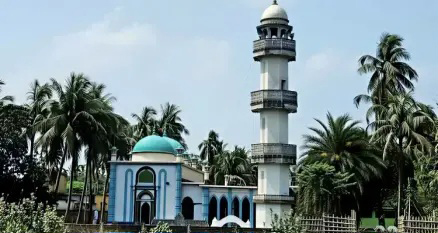
DINAJPUR, April 30, 2026 (BSS) - A 422-year-old mosque located in Bhavki village under Bhognagar union of Birganj upazila in Dinajpur continues to stand as a silent witness to centuries of history, drawing both worshippers and tourists alike.
Known as the historic Eidgah Mosque, the structure is considered one of the district’s notable traditional religious establishments. Despite its small size—measuring only 12 feet in long and wide and about 30 feet in height including its minaret—the mosque remains active. However, the mosque has recently undergone renovations and now regular devotees are offering five daily prayers.
An inscription on the mosque indicates that it was built in 1010 Bangla year (1604 AD). Once surrounded by dense forest, the mosque now sits amid growing settlements, reflecting the transformation of the area’s landscape over time.
Local residents say the mosque had long remained neglected, with prayers offered only occasionally in the past. However, community initiative led to renovation work in 2011, helping restore its usability. Since then, regular worship has resumed, and visitors—both domestic and international—frequently come to see the historical structure and offer prayers.
Md. Rafiqul Islam, a local Union Parishad member, emphasized the importance of preserving the mosque as both a place of worship and a historical monument. He said that proper conservation initiative from the government could ensure its protection for future generations.
Caretaker Md. Yusuf Ali, whose ancestors are believed to have built the mosque, said the structure was originally designed to accommodate only 10 to 12 devotees at a time due to the sparse population in the area centuries ago. He said the surrounding forest that once enveloped the mosque has long since disappeared.
Local educationist Md. Mahatab Uddin observed that while the mosque’s use has evolved, it continues to serve both religious and cultural purposes. In addition to daily prayers, the adjacent Eidgah ground is still used for congregational Eid prayers twice a year.
However, concerns have been raised over the quality of past renovations. Locals argue that work carried out without the supervision of the Department of Archaeology may have altered some of the mosque’s original architectural features. Though attempts were made to follow the original design, parts of the historic craftsmanship may have been lost.
Md. Narul Islam, who was involved in the 2011 renovation, said the mosque was in a dilapidated state before restoration, overgrown with vegetation and suffering structural damage. He acknowledged that expert intervention could have preserved its authenticity more effectively.
Member of Parliament for Dinajpur-1, Md. Manjurul Islam, described the mosque as a significant traditional site and said he would look into the matter to explore further preservation measures.
Today, the centuries-old Eidgah Mosque stands as a powerful symbol of the region’s religious heritage and architectural history, bridging the past with the present.