Friday
14 August, 2026
News Flash
News Flash
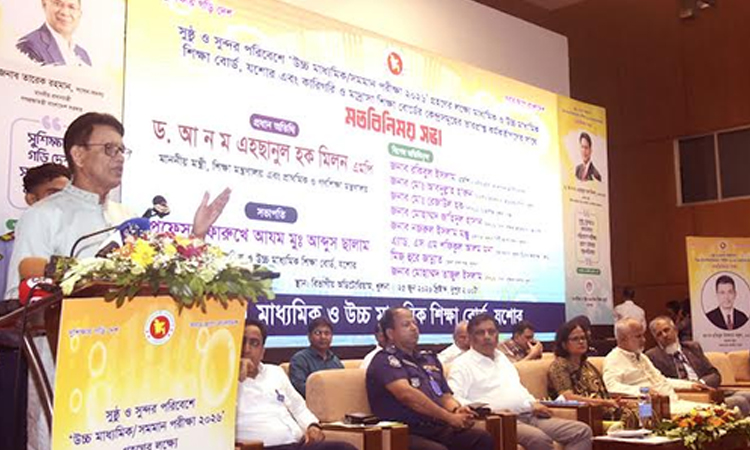
KHULNA, June 25, 2026 (BSS) – Education and Primary and Mass Education Minister Dr A N M Ehsanul Hoque Milon today said the government would formally launch the Mid-Day Meal programme in all primary schools across the country from July.
He warned that officials responsible for the programme would be held accountable if students were served spoiled or substandard food.
“If any negligence is found in providing quality food to children, those responsible will face severe disciplinary and legal action, including dismissal from the service,” he said.
The minister made the remarks while addressing a views-exchange meeting with centre secretaries of the Khulna region ahead of the HSC and equivalent examinations-2026 at the Khulna Divisional Auditorium this afternoon.
Board of Intermediate and Secondary Education, Jashore, organized the programme.
Highlighting the importance of the school feeding initiative, Dr. Milon said the government had undertaken the programme to improve children's nutrition and intellectual development.
“If any official’s or teacher's negligence results in children being served spoiled food, the persons concerned will not only lose their jobs but may also face legal action. No compromise will be made in this regard,” he added.
Referring to the upcoming HSC examinations, the minister said traditional methods of cheating had largely disappeared, but organised groups were now attempting to undermine the education system through digital cheating and rumours of question paper leaks on social media.
He instructed law enforcement agencies to take immediate action against anyone spreading false information or rumours about question leaks on platforms such as Facebook.
“If such offences are proven, the maximum punishment under cybercrime laws will be ensured. We cannot allow the country's education system to become a target of social media misinformation,” he said.
The minister also criticised the practice of some education officials remaining in the same posting for long periods without adequate field supervision.
The minister said teachers who have left rural schools and remained in urban areas for the past two decades would be transferred back to villages to address the shortage of teachers in rural institutions.
“Rural areas cannot be deprived of quality education while teachers continue to enjoy the facilities and opportunities available in cities. Education in rural Bangladesh must not remain neglected,” he said.
He said the country's education system is currently operating with a shortage of around 60,000 teachers, making it difficult to improve the quality of education. To overcome the crisis, teachers will be recruited in phases, he added.
Referring to examination management, Milon said the government had previously succeeded in curbing cheating in public examinations, but the tendency has increased in recent years.
“We are determined to stop cheating at any cost. To ensure this, examinations under all nine education boards are now being conducted using the same question papers,” he said.
He asked authorities to prepare a list of inactive officials, particularly those stationed in Dhaka and other major cities, saying they would be transferred to upazila-level postings if found neglecting their responsibilities.
“If any candidate is found carrying books or papers inside the examination room, the invigilator concerned will also be held responsible,” he said.
Questioning the pass rates under the madrasa education system, he also stressed the need for closer monitoring of answer script assessment to prevent over-marking or under-marking by examiners.
Professor Faruk-e-Azam Md Abdus Salam, chairman of the board, presided over the meeting.
Local lawmakers, senior administrative officials, heads of secondary and higher secondary educational institutions, madrasa and technical education institutions, and examination-related officials from Khulna and Jashore regions attended the meeting.