Monday
12 January, 2026
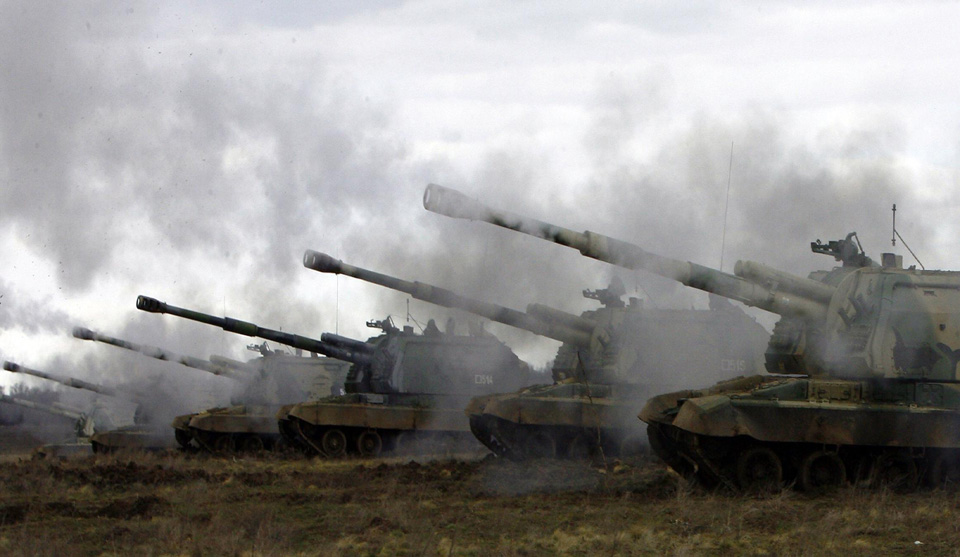
KYIV, Ukraine, April 26, 2022 (BSS/AFP) - Russia has warned of the "real"
threat of World War III breaking out, ahead of a Tuesday meeting between the
United States and allies over sending further arms to war-torn Ukraine.
Moscow's invasion of its neighbour has triggered an outburst of support from
Western nations that has seen weapons pour into the country to help it wage
war against Russian troops.
But Western powers have been reluctant to deepen their involvement, for fear
of sparking a conflict against nuclear-armed Russia.
Speaking to Russian news agencies, Moscow's Foreign Minister Sergei Lavrov
warned the risk of a World War III "is serious" and criticised Kyiv's
approach to floundering peace talks.
"It is real, you can't underestimate it," Lavrov said.
For months, President Volodymyr Zelensky has been asking Ukraine's Western
allies for heavy weapons -- including artillery and fighter jets -- vowing
his forces could turn the tide of the war with more firepower.
The calls appear to be resonating now, with a host of NATO countries pledging
to provide a range of heavy weapons and equipment, despite protests from
Moscow.
In a landmark trip to Kyiv over the weekend, Pentagon chief Lloyd Austin and
Secretary of State Antony Blinken met Zelensky and promised $700 million in
new aid to Ukraine.
"The first step in winning is believing that you can win," Austin told a
group of journalists after meeting the Ukrainian leader.
"We believe that we can win -- they can win -- if they have the right
equipment, the right support."
And on the invitation of the United States, 40 countries will also hold a
security summit in Germany on Tuesday to discuss further arms to Ukraine --
as well as to ensure the country's longer-term security once the war is over.
Among the invited countries are European allies of the United States, but
also Australia and Japan -- who fear that a Russian victory in Ukraine will
set a precedent and encourage the territorial ambitions of China.
Finland and Sweden -- traditionally neutral countries that have been
considering NATO membership since Russia's invasion of Ukraine -- are also on
the guestlist.
And on the Russian side, President Vladimir Putin is due to hold talks with
Turkish counterpart Recep Tayyip Erdogan on Tuesday, his spokesman told RIA
Novosti.
- Death and destruction -
But far from the diplomatic hustle and bustle, on the frontline, civilians
continue to die in fighting raging across war-torn Ukraine.
At least five people were killed and another 18 wounded on Monday after a
Russian rocket attack targeted railway infrastructure in the central Ukraine
region of Vinnytsia.
The head of Ukraine Railways, Alexander Kamyshin, had earlier announced the
attacks, accusing Moscow's army of "systematically" destroying railway
infrastructure.
Dozens of people were killed earlier this month in Russian strikes on a train
station used for evacuations in the eastern city of Kramatorsk.
Ukraine's second city, Kharkiv, remains partially surrounded and Moscow's
forces are regrouping in the south, but a Russian attempt to break through
towards Zaporizhzhia in the east failed, the ministry added.
In Kharkiv -- which has faced a daily barrage of Russian rocket attacks since
the war began over three months ago -- children spoke to AFP about the
bombings, their daily life and hopes for peace.
"I miss my kickboxing training and dance classes," said Alina, 9, who has
been forced to sleep in an underground car park.
"Victory would make me very happy. The war won't end straight away, but it
will in a few weeks, I made a wish."
Meanwhile, on Monday, the governor of a Russian region bordering Ukraine
accused Kyiv of bombing one of its villages, injuring two civilians and
damaging several houses.
"A village was targeted... It is already clear that there are injured
civilians," Belgorod region governor Vyacheslav Gladkov wrote on Telegram.
Russia has in recent weeks accused Ukrainian forces of striking targets on
Russian soil, including two villages in Belgorod and another in the region of
Bryansk.
Moscow also accused Kyiv of preventing civilians trapped with Ukrainian
soldiers in Mariupol's Azovstal steelworks from leaving the besieged
industrial complex despite a ceasefire announcement.
The Russian defence ministry had said it would allow a civilian evacuation
from Mariupol's sprawling steel plant, which has been sheltering the
remaining Ukrainian resistance in the southeastern port city.
But the Russian army on Monday evening said no one used the proposed
humanitarian corridor.
"The Kyiv authorities have again cynically undermined this humanitarian
operation," it said in a statement, accusing the Ukrainian government of
"indifference" towards its citizens.
- 'International crimes' -
Forty German diplomats will meanwhile be heading home from Russia after
Moscow announced their expulsion, following Berlin's decision to kick out 40
Russian diplomats earlier this month.
From The Hague, the International Criminal Court's chief prosecutor will join
an EU investigations team to probe "alleged core international crimes
committed in Ukraine", officials said.
The chief prosecutor visited the town of Bucha -- the scene of civilian
killings that Ukraine has blamed on Russian forces -- almost two weeks ago.
Russia has denied responsibility for the deaths.
"Ukraine is a crime scene. We're here because we have reasonable grounds to
believe that crimes within the jurisdiction of the court are being
committed," Karim Khan said at the time.
Meanwhile, the IMF warned that Asian nations, like the rest of the world, are
being battered by the war, with Russia's invasion of Ukraine and Western
sanctions on Moscow driving up food and fuel prices worldwide.
"This is a challenging time for policymakers as they try to address pressures
on growth and tackle rising inflation," IMF official Anne-Marie Gulde-Wolf
wrote in a blog.
And the UN is set to vote Tuesday on a resolution that would require the five
permanent members of the Security Council to justify their use of the veto in
future.
"It is not directed against Russia," said co-sponsor Christian Wenaweser,
Liechtenstein's ambassador to the body.
The proposal was on ice for more than two years and its revival came as the
Security Council has proven incapable of condemning Russia's invasion of
Ukraine, due to Moscow's veto power.
But its application "will shed light" on the use of the veto right and on the
"blockages" within the Security Council, said one ambassador on condition of
anonymity.