Friday
03 April, 2026
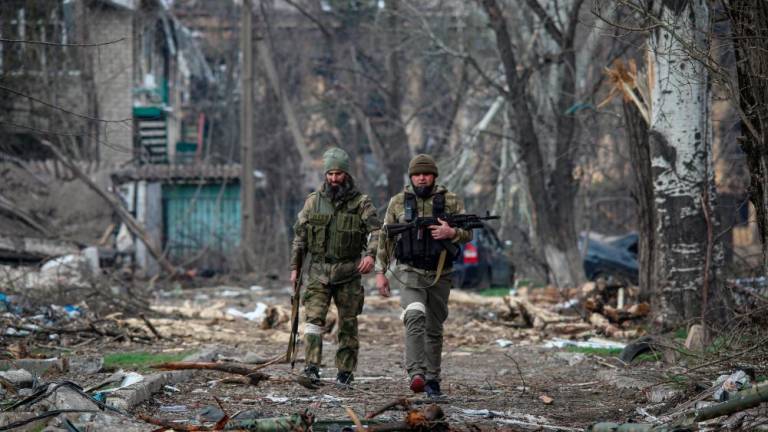
KYIV, Ukraine, April 17, 2022 (BSS/AFP) - Ukraine's President Volodymyr
Zelensky said the situation in Mariupol is "inhuman" and called on the West
to immediately provide heavy weapons, as Russia claimed it was in control of
almost all of the strategic port city and urged its last defenders to
surrender.
Moscow said Ukrainian forces in the city must lay down their arms by Sunday,
after weeks of relative calm in the capital Kyiv were brought to an end by
renewed Russian airstrikes.
Austria's chancellor, the first European leader to meet with Vladimir Putin
in person since the invasion began, said he thought the Russian president
"believes he is winning the war" in Ukraine.
But in the south, the devastated city of Mariupol has become a symbol of
Ukraine's unexpectedly fierce resistance since Russian troops invaded the
former Soviet state on February 24.
Moscow officials now say they are in full control there, though Ukrainian
fighters remain holed up in the city's fortress-like steelworks.
"The situation in Mariupol remains as severe as possible. Just inhuman,"
President Zelensky said in a video address.
"Russia is deliberately trying to destroy everyone who is there."
Ukraine's Minister of Digital Transformation Mykhailo Fedorov said the city
was on "the verge of a humanitarian catastrophe" and warned the country was
compiling evidence of alleged Russian atrocities there.
"We will hand everything over to The Hague. There will be no impunity," he
said.
Moscow Saturday issued an ultimatum to the fighters, urging them to lay down
their arms by 6:00 am Moscow time (0300 GMT) and to evacuate the premises
before 13:00 pm.
But with the Russian forces closing in, Zelensky issued his own warning.
"The elimination of our troops, of our men (in Mariupol) will put an end to
any negotiations," Zelensky told the Ukrainska Pravda news website.
"We don't negotiate neither our territories nor our people."
- 'Insidious and ruthless' -
In the capital, smoke rose from the Darnyrsky district in the southeast of
the capital after what Moscow said were "high-precision long-range" strikes
on an armaments plant, killing one person and wounding several others.
A heavy police and military presence was deployed around the factory, which
was badly damaged.
"Our forces are doing everything possible to protect us, but the enemy is
insidious and ruthless," Kyiv Mayor Vitali Klitschko said.
The strike came a day after a similar attack on a plant that produced Neptune
missiles -- the type which, according to Kyiv and Washington, sank Russia's
Black Sea flagship Moskva on Thursday.
It was among the first attacks since Russian forces began withdrawing from
that region last month, instead turning their focus on gaining control of the
eastern Donbas region, for years controlled in part by pro-Russian
separatists.
Kyiv regional governor Oleksandr Pavliuk said there were at least two other
Russian strikes on the city Friday and that civilians thinking about
returning should "wait for quieter times".
Nevertheless, families and off-duty soldiers were out in the parks of central
Kyiv on Saturday, bringing a semblance of normality to the once bustling
city.
"It's the first time we've been back in the city centre... It's really making
me happy to see people out and about," 43-year-old vet Nataliya Makrieva told
AFP.
Meanwhile, in Ukraine's second-largest city Kharkiv, in the northeast of the
country, a Russian missile strike on a residential district killed at least
two people on Saturday and wounded 18 others, the public prosecutor's office
said.
Incoming fire in the city's centre turned an industrial kitchen inside out,
pitching loaves of bread into the street.
"The blast was so big that at first we didn't understand what was happening,"
52-year-old volunteer worker Genadiy Vlasov told AFP. "When the walls started
moving we all knew we had to get out."
And Ukrainian Interior Minister Denys Monastyrsky said three people were
killed and four others critically wounded in a demining operation near the
city.
- 'War logic' -
Austrian Chancellor Karl Nehammer, who met Putin on Monday in Moscow, said he
thinks the Russian president believes the war is necessary for his country's
security.
"I think he is now in his own war logic," Nehammer said in an interview with
NBC's "Meet the Press", portions of which were released Saturday.
"I think he believes he is winning the war."
Adding to tit-for-tat sanctions imposed since the invasion began, Russia said
Saturday it was banning entry to British Prime Minister Boris Johnson and
several other top officials.
The foreign ministry accused London of "unprecedented hostile actions", in
particular referring to sanctions on senior Russian officials, and "pumping
the Kyiv regime with lethal weapons".
Moscow's new entry blacklist includes Deputy Prime Minister Dominic Raab,
Foreign Secretary Liz Truss, and Defence Secretary Ben Wallace.
Johnson paid a surprise visit to Kyiv a week earlier, and was filmed walking
through the capital's empty streets with Zelensky.
Britain has been part of an international effort to punish Russia with asset
freezes, travel bans and economic sanctions, while several Western countries
have supplied Ukraine with extensive weaponry.
Russia warned the United States this week of "unpredictable consequences" if
it sends its "most sensitive" weapons systems to Ukraine.
Its defence ministry claimed Saturday to have shot down a Ukrainian transport
plane in the Odessa region, carrying weapons supplied by Western nations.
Zelensky meanwhile issued a fresh warning about the possibility of Russia
using nuclear weapons as the conflict wears on -- echoing comments by CIA
director William Burns this week.
Kremlin spokesman Dmitry Peskov earlier told CNN that Russia would only use
nuclear weapons in the context of the Ukraine conflict if it were facing an
"existential threat".
- No way home -
Zelensky said Friday that between 2,500 and 3,000 Ukrainian soldiers had been
killed in the conflict, compared to 19,000-20,000 Russian dead.
Moscow has said its losses were far smaller.
Russia's apparent new focus on seizing the eastern Donbas, where Russian-
backed separatists control the Donetsk and Lugansk areas, would allow Moscow
to create a land corridor to occupied Crimea.
Ukrainian authorities have urged people in the region to quickly leave ahead
of what is expected to be a large-scale Russian offensive.
In Geneva, the UN refugee agency warned that many of the nearly five million
people who have fled the conflict will not have homes to return to.
Many have gone abroad, with thousands seeking refuge in Israel, according to
the country's immigration ministry figures.
Joining them are many Russians, too, who say they no longer feel safe in
their home country under the increasingly repressive rule of Vladimir Putin.
"I lost my country. It was stolen from me. It was taken by Putin and those
KGB thugs," Moscow-born linguist Olga Romanova told AFP.