Thursday
11 December, 2025
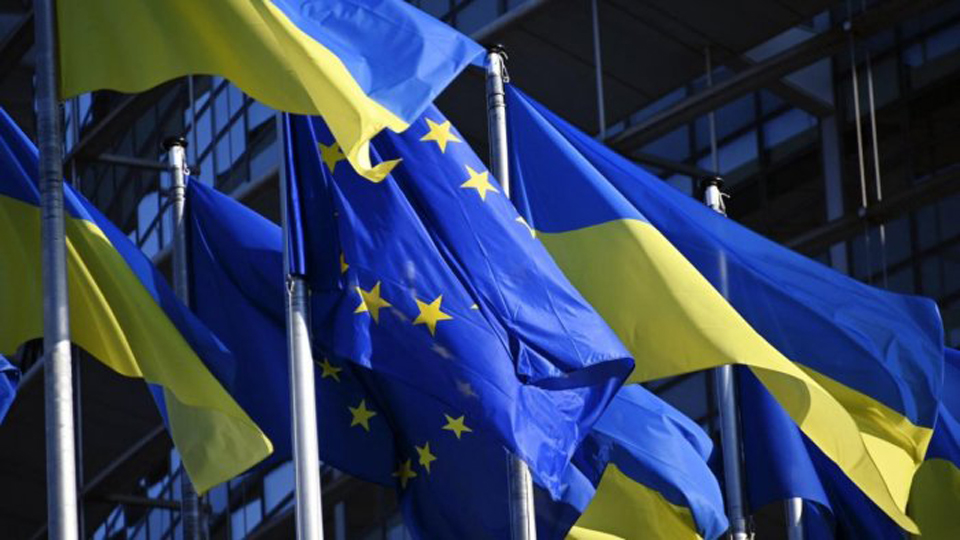
VERSAILLES, France, March 11, 2022 (BSS/AFP) - EU leaders doused Ukraine's
hopes Thursday of quickly gaining European Union membership, as they met to
urgently address the fallout of Russia's invasion of its pro-Brussels
neighbour.
The meeting at the palace of Versailles was set to be the high point of
France's six-month EU presidency. But President Emmanuel Macron is instead
leading a crisis summit following Russian leader Vladimir Putin's invasion
which has upended decades of stability in Europe.
The Ukraine war and the EU's energy supply dominated the two-day meeting,
with leaders sitting down for dinner in the same Hall of Mirrors where
Western allies carved out a new map of Europe in 1919 after World War I.
"Europe changed with the pandemic and it will change even faster and
stronger with the war," Macron said as he greeted his counterparts at the
former residence of France's Sun King, Louis XIV.
The 27 heads of state and government met as fighting raged for a 15th day
in Ukraine, with an outcry over the bombing of a maternity hospital in the
besieged Ukrainian city of Mariupol.
Macron dubbed it a "disgraceful act of war", with leaders from across the
bloc condemning the atrocity and pointing the finger at Moscow, which has
denied responsibility.
The conflict has seen a swell of support in the EU for Ukrainian President
Volodymyr Zelensky, but leaders used the talks to reiterate that a speedy
path to membership was impossible.
"There is no such thing as a fast track," Dutch Prime Minister Mark Rutte
said as he arrived for the talks.
"I want to focus on what can we do for Volodymyr Zelensky tonight,
tomorrow, and EU accession of Ukraine is something for the long-term -- if at
all," he added.
Former eastern bloc countries wanted a firmer signal towards EU membership,
led by Poland which has seen 1.5 million refugees pour over its border.
There are those "who think that .. Ukrainians are fighting for their lives
and (deserve) a strong political message ... and those who are still debating
the procedures," said Slovenian Prime Minister Janez Jansa. - 'Biggest issue'
-
Even before the war, Macron's ambition for the summit was to lay down a
path to strengthen Europe's stature on the world stage.
The issue took greater significance with Russia's war on the bloc's eastern
edge, and leaders were to explore ways to shore-up Europe's self-reliance in
an unstable world, especially on energy.
The conflict has seen energy prices skyrocket, threatened the economy and
sparked a pressing discussion on where Europeans can turn for gas and oil.
The problem became more acute with the wave of Western sanctions against
Russia that also put pressure on energy markets.
The EU imports about 40 percent of its natural gas from Russia with
Germany, Europe's biggest economy, especially dependent on the energy flow,
along with Italy and several central European countries.
About a quarter of the EU's oil imports also come from Russia.
Europe's dependency on Russian energy even caused the first crack in the
West's unified response to Putin's aggression, with the EU this week shying
away from a ban on Russian oil imports implemented by the United States and
Britain.
European Commission chief Ursula Von Der Leyen said the 27 leaders agreed
to explore ways to eliminate the bloc's dependency on Russian fossil fuels in
five years.
- 'Resolutely invest' -
The leaders on Friday will also try to advance on ways Europe can gain
independence in highly sensitive sectors, including semiconductors, food
production and, most notably, defence.
Collective security in the European Union is primarily handled by the US-
led NATO alliance, but France, the EU's biggest military power, seeks an
enhanced role for the bloc.
Since Russia's invasion of its pro-EU neighbour, bloc members have approved
a total of half a billion euros in defence aid to Ukraine.
Berlin dramatically broke with long-standing doctrine when it announced it
will plough 100 billion euros ($110 billion) into national defence.
In view of the challenges, "we must resolutely invest more and better in
defence capabilities and innovative technologies", the leaders were expected
to say.