Monday
20 July, 2026
News Flash
News Flash
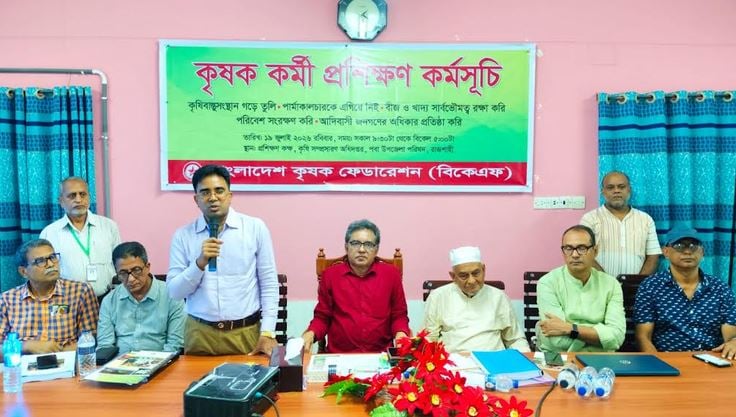
RAJSHAHI, July 19, 2026 (BSS)- Bangladesh Krishak Federation (BKF) has announced a five-point outline to put the country's agriculture on a sustainable footing although the farmers are facing multiple crises such as climate change, rising production costs, and not getting fair prices of crops,
Speakers said that to ensure agro-ecology, seed and food sovereignty, environmental protection, and the rights of indigenous communities, everyone must unite to protect farmers' rights.
These remarks were made at a day-long farmer activist training program organized today in the conference room of the Paba Upazila Agriculture Office here.
Organized by the Bangladesh Krishak Federation, farmers from various upazilas of the district, leaders of farmers' organizations, development workers, environmental activists, and journalists participated in the program.
The chief guest at the program was Paba Upazila Agriculture Officer Agriculturist M.A. Mannan. The program was presided over by Rulfa Director Afzal Hossain.
The program was conducted by Bangladesh Krishak Federation President Badrul Alam. Special guests included Jahangir Alam Jony and Director of Policy Research of UBINIG (Unnayan Bikalper Nitinirdharoni Gobeshona) Dr. M.A. Sobhan.
Caritas Rajshahi Coordinator Zillur Rahman, BELA's Rajshahi Divisional Coordinator Tanmoy Kumar Sanyal, Training and Monitoring Officer of Bangladesh Association for Sustainable Development Bishnupada Mondal, and Paba Upazila Press Club President Kazi Nazmul Islam also present.
The overall management was handled by SM Hasinur Rahman, Convener of Bangladesh Krishak Federation, Rajshahi District.
Throughout the training program, banners and festoons displaying various slogans related to eco-friendly agriculture and farmers' rights were exhibited.
Speakers said that although agriculture is one of the foundations of the country's economy, it is the marginal farmers who are in the most uncertainty.
Along with drought, irregular rainfall, and natural disasters, rising prices of fertilizer, seeds, and pesticides have made agricultural production more expensive.
On the other hand, farmers' financial crisis is increasing as they do not get fair prices for their produce.
The training discussed in detail about agro-ecology, permaculture, seed and food sovereignty, environmental protection, and the rights of indigenous peoples.
Emphasis was placed on conservation and exchange of local variety seeds, reducing pesticide use and practicing eco-friendly agriculture, protecting agricultural land, and extensive tree plantation.
The discussion also raised the issue of risks to the environment and public health due to vehicle emissions and microplastic pollution.