Friday
14 August, 2026
News Flash
News Flash
By Md Mamun Islam
RANGPUR, Aug 14, 2026 (BSS) - As farmers have achieved success in recent years by growing ginger in sacks and fetching attractive prices, this initiative is also gaining popularity among other farmers in many parts of the Rangpur agricultural region.
In this simplest and lowest-cost bagging method used by farmers in ginger farming, ginger tubers are planted in sacks filled with soil and organic fertilizer (such as cow dung or mustard greens).
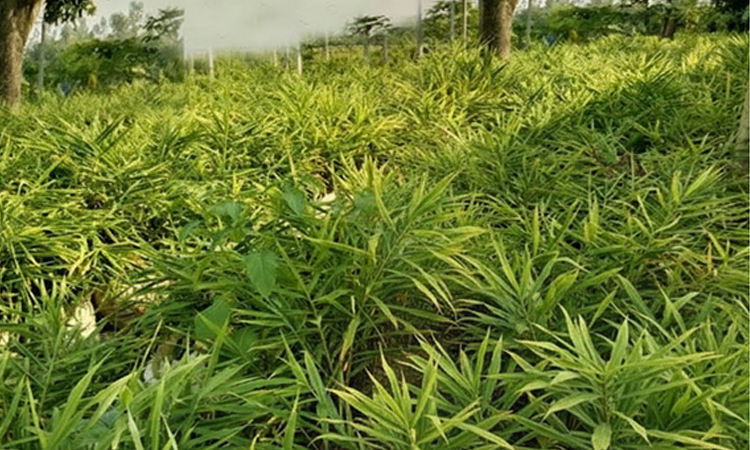
The sacks are placed under trees, in orchards, or in shaded or unused areas around homesteads both in the mainland and riverine char areas which also reduce land waste and reduce the risk of natural disasters such as floods.
This way of ginger cultivation is not limited to farmers alone, but many people are cultivating ginger on the roof of their houses or in the courtyard and by clearing the bushes around the house and filling the soil in sacks using this bagging method.
Talking to BSS, farmer Md Shahinul Islam Bokul, one of the pioneers of the bagging method of ginger farming of Moyenpur village in Mithapukur upazila of Rangpur, narrated how he has been cultivating ginger in sacks in orchards in recent years.
He has been cultivating Bari-2 and Thai varieties of ginger showing an effective way to make the country self-reliant in its own production of spices like ginger and turmeric, thereby saving a huge amount of foreign exchange on imports.
His school teacher wife Mukta Khatun helps Bakul in all respects, including seed, fertiliser and irrigation management, accounts keeping, making payments to their daily farm labourers, in running his ginger farming in bags initiative.
At one stage, Bokul thought to use the fallow land in Haribhanga mango orchard and cultivate ginger there.
When he expressed his desire of cultivating ginger in the Haribhanga mango orchards, the then Deputy Director of the Burirhat Horticulture Center of the DAE three years ago, Rangpur Dr Md Abu Sayem came forward to assist him.
When Bokul started cultivating ginger in 500 sacs in his exhibition plot and in more 12,000 sacs on his 50 decimals of land in the Haribhanga mango orchard three years ago, local people were attracted and they also started farming the same in sacs.
"After completing harvest last year, I got 115 mounds (every 40-kg is a mound) of ginger from 16,000 sacs," Bokul said, adding that he has cultivated ginger in 18,000 sacks on his 80 decimals of land in his Haribhanga mango orchard this season.
Being inspired by the success of Bokul, more than 350 villagers have also cultivated ginger in 40,000 sacs in their Haribhanga mango orchards, homesteads and fallow lands in Moyenpur village and adjoining areas this season.
Farmers were inspired by ginger prices of Taka 400 per kg last year when they cultivated ginger in sacs in the village.
However, the prices fell to Taka 100 and Taka 130 later as there are no preservation facilities for ginger.
"If modern preservation facilities, like cold storages, are established and all lands in Haribhanga mango orchards and homesteads are brought under ginger farming in sacs, it is quite possible to achieve self-reliance in ginger production on our own," Bokul said.
Additional Director of the Department of Agricultural Extension (DAE) for Rangpur region Agriculturist Md Sirajul Islam said, ginger production could be enhanced manifold through further expanding its cultivation using sacs.
"However, ample facilities should be established so that farmers could easily preserve their produced ginger to get better price and ensure smooth supply of their produced and stored ginger round the year," Islam added.