Wednesday
05 August, 2026
News Flash
News Flash
CHATTOGRAM, Aug 5, 2026 (BSS) - On August 5, 2024, at around 2:30 PM, the atmosphere in Chattogram transformed dramatically following the announcement of the resignation and departure of the then authoritarian Prime Minister Sheikh Hasina.
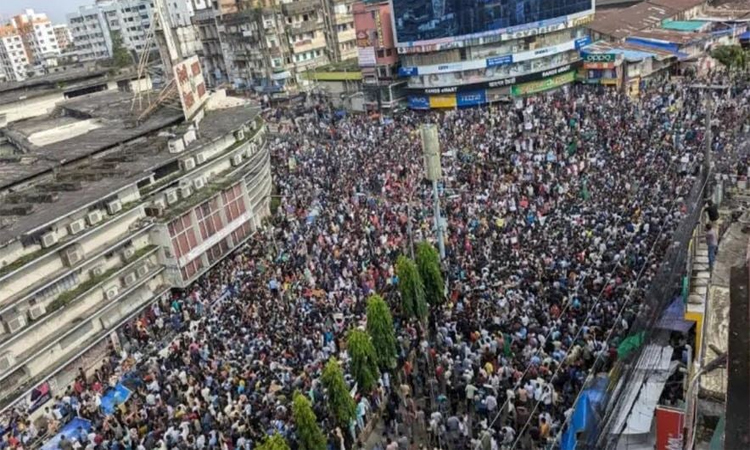
As the news spread, hundreds of thousands of students and citizens flooded the streets. Overcoming feelings of anger, anxiety, and sorrow, the skies and air of the port city became infused with a sense of successful joy. Individuals emerged in large numbers from their homes, workplaces, and shops, brandishing national flags and chanting slogans of victory.
From the afternoon onwards, sweets were distributed at various intersections throughout the city. People, both familiar and strangers, embraced one another. Many were observed shedding tears of joy. The atmosphere in Chattogram remained tense until the morning over ‘March to Dhaka’ event organized by the anti-discrimination student movement.
In just a few hours, Chattogram transformed into a vibrant city with celebrations of victory. Students from diverse educational institutions, employees, business owners, laborers, rickshaw drivers, parents, and individuals from various backgrounds and professions spontaneously participated in the victory procession. From afternoon until night, nearly all major roads in the city were filled with people.
Following the dissemination of news regarding Hasina's fleeing, police officers and personnel from various police stations in the city retreated due to concerns for their safety. In numerous locations, local residents and participants in the movement assisted the police in departing securely. But, in certain areas, enraged individuals launched attacks on the police.
New Market Intersection: From a hub of resistance to a site of triumph. Throughout the July Movement, New Market intersection in Chattogram emerged as a focal point for resistance and confrontations. A period of calm prevailed there until noon on August 5. However, after noon, upon confirmation of the government's fall , thousands of individuals surged from the adjacent streets and highways, flooding into New Market Square.
Men and women of all ages took to the streets, brandishing national flags. Many embraced one another, shedding tears of relief following the sacrifices of countless martyrs.
Kazir Deuri: On that day, people from all walks of life gathered at the Kazir Deuri intersection. Millions celebrated the news of the fall of the tyrannical dictator Sheikh Hasina. Students and the crowd pursued a police unit, compelling them to seek refuge in the circuit house. Those officers managed to survive that day by removing their uniforms. Individuals from various professions, including doctors, journalists, and engineers, celebrated the downfall of the dictator.
Awami League leaders and activists fled in the opposite direction. Bahaddarhat to GEC: A lengthy procession of victory. In addition to New Market, throngs also gathered at Bahaddarhat, one of the most violent areas of the movement, on that day.
The streets of Bahaddarhat, which had recently been vibrant with life, echoed with songs of triumph on that day. Numerous processions gathered at the intersections of GEC, Lalkhan Bazar, and WASA. Rickshaws, motorcycles, and trucks were filled with people on that day, all waving red and green flags. The entire city was alive with the distribution of sweets and chants celebrating the end of dictatorship.
In Bora Pol, thousands of individuals congregated until 4 pm that day. The residents of the city celebrated the demolition of Mujib's statue using several excavators. Many captured the moment on their mobile devices. As the afternoon progressed, the crowd began to set fire to Sheikh Mujib's statue, images of Hasina, and various banners, billboards, offices, and extortion centers associated with the Awami League across different locations. The shackles of fascist rule had been shattered. Touhidul Islam, a student from Chattogram University, said, "The joy of the people was instinctive following the news of the flight of fascist Hasina. However, we later understood that it was essential for everyone to take responsibility to maintain order. Therefore, I joined my classmates to manage traffic. Some of us also provided security for places of worship." He noted that, taking advantage of the absence of police, organized criminals attacked, vandalized, and looted various police stations.
Mohammad Abdul Quader, a businessman and resident of the Agrabad area in the city, said, "I have never experienced a day like this in my life. Everyone was waiting until noon. In the afternoon, people joyfully took to the streets." He continued, "Behind the elation of victory that day, there was a complex mix of sorrow and triumph, rooted in a profound history of suffering. From the WASA intersection to CRB, Sholashar, and the Chattogram University campus, every brick bore the blood of martyrs. In the triumphant voices of the crowd, alongside the joy of victory, was the deep sorrow for the loss of martyrs such as Wasim, Hridoy, and Shanto. That afternoon of August 5 represented a new dawn for Chattogram. The entire port city came together, united in the vision of a new Bangladesh free from discrimination, having emerged from the oppressive shadow of tyranny”.
Sadman Karim, a student at Chattogram Mohsin College and an activist in the anti-discrimination student movement, said that from the morning of August 6, the day following the events of August 5, students involved in the movement took to the streets to manage traffic at various key intersections throughout the city. They directed traffic in several locations, including GEC intersection, Tiger Pass, Agrabad, Muradpur, and OR Nizam Road, he said, adding that simultaneously, the students acted as volunteers to facilitate the normal movement of the general public.