Tuesday
30 June, 2026
News Flash
News Flash
By Md Aynal Haque
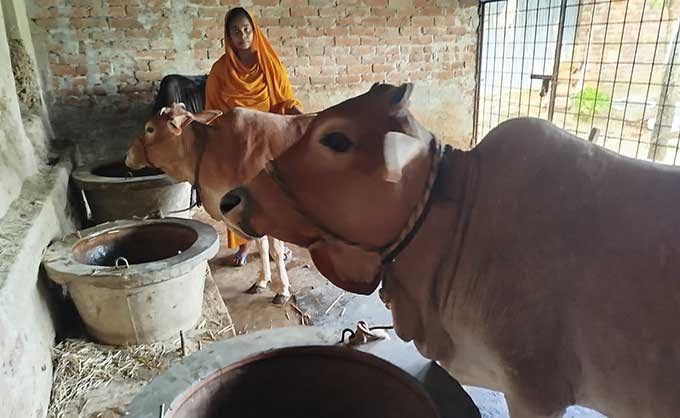
RAJSHAHI, May 19, 2026 (BSS) - The trend of raising cows and goats among women from farming and day labourer families has increased in every village of the Barind region, including Rajshahi.
Raising livestock in villages costs less as they are fed on green grass from Barind fields, Aman paddy straw and husk, under the care of rural women. Small farmers are seeing bigger profits as cattle and goat prices have been rising in the market in recent years.
Because of this, thousands of families are becoming self-reliant through cattle rearing in a short time, and the responsibility of raising these cows and goats has fallen on women's shoulders.
As a result, family income is rising while women are also becoming self-reliant.
In the villages, there is hardly any farmer or day labourer family that does not raise cows or goats. Many families are raising between two and five cows. They have built small sheds at their homes and established cattle farms.
This year in the district, the total number of animals fit for Eid-ul-Azha sacrifice is 463,011, while the estimated demand is 371,058. That means there are about 91,953 more animals than demand. As a result, officials said there will be no shortage in the supply of sacrificial animals.
According to available data, 104,841 cows, 3,425 buffaloes, 311,339 goats and 43,406 sheep have been prepared for sacrifice in Rajshahi division.
In terms of numbers, goats make up the largest share of available animals, followed by cows, sheep and buffaloes.
Hasan Ali is a day labourer from Panchandar Schoolpara, a remote village in Tanore upazila of Rajshahi, known as part of the Barind region.
To support their struggling household, his wife Sefali Begum took a loan of Tk 80,000 from an NGO three years ago and bought two small cows. Sefali Begum raised the two cows for a full year and sold them during Eid-ul-Azha that year for Tk 170,000.
Sefali Begum said her husband is a day labourer. They have a son and a daughter. After running the household with her husband's wages, no money was left. So she decided to take a Tk 80,000 loan and start raising cows.
In that first year, she repaid the loan with the profit and was left with enough capital to buy two more small cows. Since then, every year she buys two small cows, raises them for a year and sells them during Eid-ul-Azha. Now there is no more poverty in the family. With her saved profits, they built a semi-brick house last year.
Reema, wife of Hannan from the same village, raises several cows at home every year. They primarily raise cattle targeting Eid-ul-Azha.
Hannan's wife said her husband works in the fields all day. She handles all the care for the cows at home. Raising cattle has increased their family's income.
This story of self-reliance is not just Sefali Begum's or Reema's. Across Rajshahi and the entire Barind region, thousands of day labourer families in village after village have become self-reliant within a few years through livestock rearing.
Multiple farmer and day labourer families in the villages said that Indian cattle have not been entering the country for the past few years, and with cattle prices rising in the domestic market, many in the villages have turned to small-scale farming.
Most farmers are investing their own small savings to raise livestock for the Eid market. However, if Indian cattle start entering the country again, small farmers will suffer a major blow. That would dim their dreams of becoming self-reliant.