News Flash

DHAKA, June 30, 2026 (BSS) - Prime Minister's Special Assistant on health affairs Dr SM Ziauddin Hyder today said cataract remains one of the leading
causes of blindness in Bangladesh, although most patients can regain full vision through timely diagnosis and modern surgical treatment.
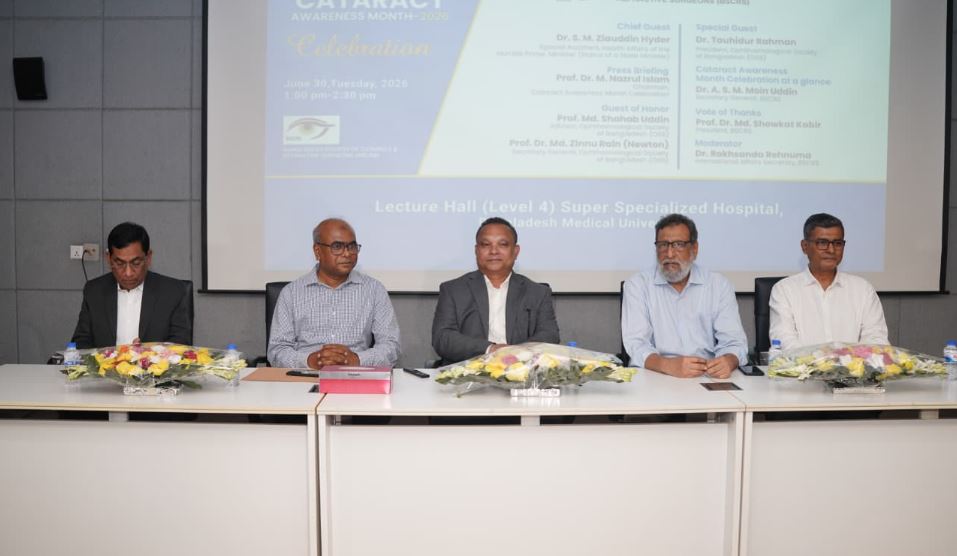
He made the remarks while addressing an awareness programme organised at the lecture hall of the Super Specialised Hospital of Bangladesh Medical
University (BMU), marking Cataract Awareness Month 2026, observed worldwide. The programme was organised by the Bangladesh Society of Cataract and
Refractive Surgeons (BSCRS).
Dr Hyder stressed the need for concerted efforts to raise public awareness about cataracts and expand quality eye care services to remote areas across
the country.
He said cataracts account for nearly 51 percent of blindness worldwide, while the figure is around 80 percent in Bangladesh. He noted that the country's
healthcare system has long remained treatment-oriented, resulting in gaps in the early detection of diseases.
"The government has now undertaken initiatives to transform the healthcare system from a treatment-centred approach to one focused on disease prevention
and health promotion," he said.
The special assistant said regular health screening and disease detection programmes would be strengthened through union-level health centres and
community health workers to ensure early identification of eye diseases and other chronic illnesses.
Chaired by BSCRS President Professor Dr Md Shawkat Kabir, it was also addressed by Chairman of the Cataract Awareness Month Celebration Committee
Professor Dr M Nazrul Islam and BSCRS Secretary General Dr ASM Moin Uddin.
Presenting the keynote paper, Dr Moin Uddin said the country currently has a backlog of nearly one million cataract surgeries. He said there is only one
qualified cataract surgeon for every 833 patients awaiting surgery.
He added that Bangladesh has around 2,200 ophthalmologists, nearly four times fewer than the number required under international standards.
Dr Moin Uddin also said that of an estimated 40,000 blind children in the country, nearly 12,000 have treatable conditions but have yet to undergo
childhood cataract surgery.
"If a surgeon is responsible for nearly 1,000 patients, it is impossible to reduce the existing backlog," he said, calling for a coordinated national
initiative to prevent avoidable blindness.
Speakers at the discussion said modern technology-based cataract surgery is now highly safe, effective and ensures rapid recovery. They urged people not
to ignore blurred vision or be influenced by fear or misconceptions, but instead seek prompt consultation with an eye specialist.
They also advised everyone aged 40 years and above to undergo regular eye examinations and seek immediate medical attention if they experience blurred
vision, deteriorating eyesight or other symptoms of cataracts.
"Do not ignore blurred vision-consult an eye specialist. Timely cataract surgery is the most effective way to prevent blindness," they said.