Monday
24 August, 2026
News Flash
News Flash
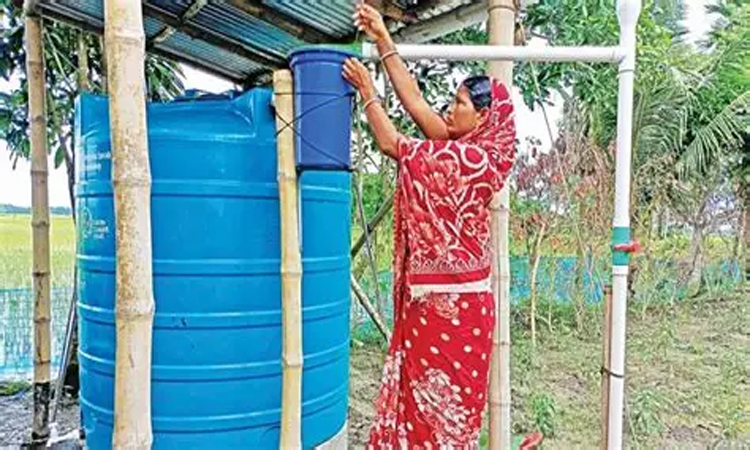
DHAKA, May 12, 2026 (BSS) - In many coastal communities, access to safe drinking water remains a daily struggle due to salinity, shrinking freshwater sources and climate changes impacts. Women and girls often bear the burden of walking long distances to collect water, spending hours each day on the task essential for family survival. But, rainwater harvesting process ensures women's access to safe water in Bangladesh's south-western coastal region, helping them grow vegetables to avail climate-resilient livelihood opportunities.
In the past, every morning began with a major worry for Ambia Khatun thinking that where she would get safe drinking water for family. The homemaker from North Bedkashi Union in Koyra Upazila of Khulna faced a constant shortage of clean water. Every day, she had to walk several kilometres to collect water from distant sources.
At that time, unsafe pond water was Ambia Khatun's only option. During the dry season, the hardship became even worse as ponds dried up, water sources became scarce, and even basic tasks like cooking faced difficulty.
Recalling those days, Ambia said once she could not cook timely because of the lack of water. She had to spend two to three hours every day for collecting water, making her physically exhausted and sometimes ill.
The water crisis affected Ambia Khatun's entire family, but things have now changed. A 2,000-litre rainwater harvesting tank has been installed in her yard, allowing her to meet her family's need for safe water throughout the year.
This transformation has also changed her daily life. Instead of spending hours for collecting water, she now focuses on caring for her family and earning an income.
After receiving training in homestead vegetable farming through a project in 2021, she started growing vegetables herself. She now produces seasonal vegetables in her yard such as bottle gourd, red spinach, chilli and eggplant, helping meet her family's nutritional needs while also generating extra income through selling these vegetables.
Ambia Khatun's story reflects the reality faced by many women in Bangladesh's south-western coastal region, where access to safe drinking water has long been a major challenge.
Rising salinity in rivers and groundwater, sea-level rise, and inadequate infrastructure have made clean water increasingly difficult to obtain, with women bearing most of the burden of collecting water for their families.
Research shows that salinity levels in many coastal water sources exceed national standards, while some tube wells and ponds contain harmful metal elements that pose to health risks.
The shortage of safe water not only disrupts daily life but also increases health risks for local communities.
A study on water conditions in south-western coastal Bangladesh found that residents face safe water shortages for an average of 4 to 6 months each year, with some areas suffering for more than seven months. The study also revealed that only 16 percent of families have their own water source, forcing most people to rely on external supplies.
Women basically suffer the most for the coastal region's water crisis, as they generally collect water in nearly 80 percent of households in line with the Bangladesh tradion. Fetching water from distant sources impacts on them physically, wastes time, and exposes them to health risks.
Purnima Rani Dey from Budhhata Union in Ashashuni Upazila of Satkhira faced similar hardships. Living alone after her two daughters got married, she had to walk about two kilometres every day to collect water. Even when she felt sick, she was often forced to drink unsafe pond water, which caused repeated waterborne illnesses.
Her situation has now improved after a rainwater harvesting tank was installed at her home. She no longer needs to travel far for safe water, reducing both her health risks and time for collecting water. So, having excess time in hand, she has also started growing vegetables in her yard, meeting her household needs and earning some additional income.
Purnima said that earlier she had to walk far for water and often became sicker after drinking pond water during illness, but having safe water at home has removed a major hardship from her life.
A coordinated initiative has driven major improvements in safe water access and livelihoods in Bangladesh's coastal regions.
Under the programme, hundreds of community-based rainwater harvesting systems has been installed, and more than a thousand women have been organised into livelihood groups. These groups regularly meet to discuss market analysis, financial planning, production methods, and disaster preparedness.
The project has also introduced several climate-resilient livelihood practices, including homestead vegetable farming, hydroponic agriculture, crab and sesame farming, nursery development, fish and crab feed production, and aquageoponic farming that combines fish and vegetable cultivation. Hydroponic farming has proven especially effective in saline-prone coastal areas because it does not require soil and can easily be adapted during adverse weather conditions.
Experts said access to safe water in Bangladesh's coastal areas is closely linked to women's health, with studies showing higher reproductive health problems among women who must travel long distances to collect water. Ensuring safe water not only reduces hardship but also improves health, nutrition, economic stability, and women's empowerment.
Water and climate expert Ainun Nishat emphasized the urgent need for ecosystem-based water management, climate justice, and evidence-based policies in coastal Bangladesh.
He called for rapid repair of embankments, protection of water sources, and coordinated action to help vulnerable communities survive climate impacts.
The coastal development initiative has also gained international recognition. In 2025, the project was honoured as one of the world's 20 most innovative initiatives at a global climate conference, highlighting how effective local solutions can achieve global significance.
The experiences of coastal women show that proper planning, technology, and women-focused initiatives can successfully help communities adapt to climate change.