Tuesday
08 September, 2026
News Flash
News Flash
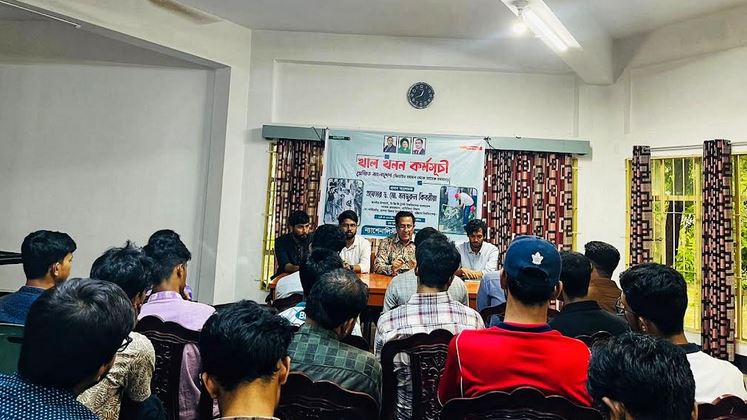
CHITTAGONG UNIVERSITY, May 10, 2026 (BSS)- A discussion titled “Canal Excavation Programme: Bangladesh Perspective (From Ziaur Rahman to Tarique Rahman)” was held today at Chittagong University (CU) at the initiative of leaders of Jatiotabadi Chatradal.
The discussion was organised under the banner of ‘Nationalist Reading Circle’ on the second floor of the CUCSU building.
The main speaker at the event was Prof. Dr. Md. Manzoorul Kibria, vice-chancellor of BGC Trust University Bangladesh and coordinator of the Halda River Research Centre Laboratory.
He highlighted various aspects of former President Ziaur Rahman’s canal excavation programme and explained the importance of re-excavating canals in present-day riverine Bangladesh.
Dr. Kibria said, “If rivers survive, Bangladesh will survive. At present, the country has 1,415 rivers and several thousand canals. There is hardly any sector of our livelihood that can be imagined without rivers.”
He said, “We call the canal excavation programme the ‘Zia Model’. Through the implementation of 279 projects under the initiative of Ziaur Rahman, around 5,851 kilometres of canals were excavated.
He further said that through Ziaur Rahman’s canal excavation programme, it became possible within just one and a half years to rehabilitate the war-ravaged and famine-stricken country by improving agriculture and the rural economy, reducing unemployment, addressing environmental and climate crises, developing the communication system, and utilising voluntary labour.
Mentioning that environmental balance had been damaged due to the encroachment and pollution of rivers and canals during the previous autocratic government.
He said, “During the previous fascist government, the country’s rivers, canals and wetlands were gradually disappearing. Fish species in water bodies also declined alarmingly. For example, the Karnaphuli River once had around 139 species of fish, but now only four or five species remain. Besides, waterlogging is increasing everywhere from villages to cities, threatening public life and the economy.”
Dr. Kibria said, “Just as blood circulation is vital for the human body, rivers are equally vital for Bangladesh. The initiative to re-excavate nearly 20,000 kilometres of rivers and canals is extremely positive. I call this programme a ‘multi-vitamin’.”
He said that re-excavation of rivers and canals would bring positive changes in agricultural production, irrigation facilities, communication systems and employment generation, while also helping resolve waterlogging, tackle floods and droughts, preserve bio-diversity, and mitigate the negative impacts of climate change.
Emphasising an agriculture-based economy, he said, “If we fail to strengthen agricultural production, our economy will never stand on a solid foundation. Foreign currency reserves alone do not constitute a sustainable economy. The only sustainable economy is an agriculture-based one. And such an economy can only be built by keeping rivers and canals functional and establishing a river-centred agricultural system.”