Thursday
09 July, 2026
News Flash
News Flash
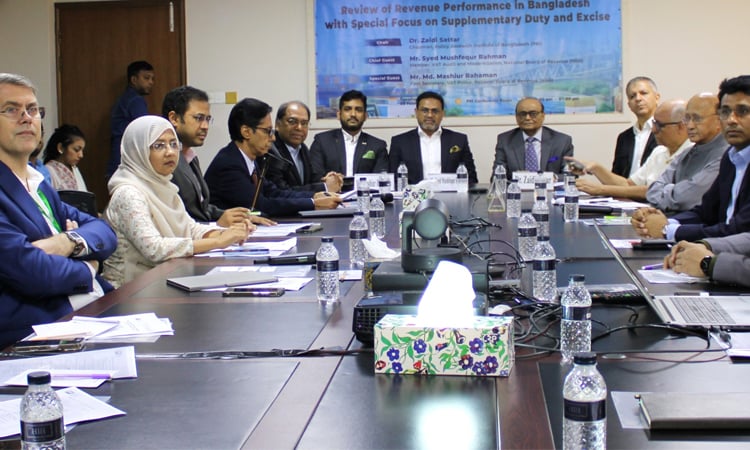
DHAKA, Feb 3, 2026 (BSS) - The Policy Research Institute of Bangladesh (PRI) today organized a workshop titled “Review of Revenue Performance in Bangladesh with Special Focus on Supplementary Duty (SD) and Excise”.
The workshop was chaired by Dr. Zaidi Sattar, Chairman, PRI, Syed Mushfequr Rahman, Member, VAT Audit and Modernization, National Board of Revenue (NBR), attended as the chief guest, while Md. Mashiur Rahaman, First Secretary, VAT Policy, National Board of Revenue (NBR), joined as the special guest.
Mushfequr Rahman said, “We do not want to encourage excessively high tax rates, but revenue collection must also be ensured. Currently, there are nearly 17,000 benchmark rates under the domestic supplementary duty structure, which is not conducive to investment and trade expansion.”
Revenue performance from small and medium-income individuals and enterprises remains unsatisfactory, largely due to irrational rate structures, he said adding determining tax rates involves numerous challenges across personal, corporate, and other forms of taxation.
Special guest Rahaman emphasized the need for broader stakeholder engagement in tax policy discussions.
“Institutions such as the World Health Organization, the Ministry of Health, and the Department of Environment should be included in consultations on supplementary duty determination,” he said.
He further stressed the importance of adopting a business-friendly tax policy to sustain and promote enterprises that contribute to economic growth.
Dr. Bazlul Haque Khondker, Research Director at PRI, delivered the trigger presentation.
He highlighted that despite steady growth in per capita GDP, Bangladesh’s tax-to-GDP ratio has been declining, contrary to the experience of comparable countries.
“Around 17 percent of GDP currently comes from excise duties, which is outdated by modern standards. Corporate tax and VAT rates in Bangladesh are relatively high. Moreover, while most countries apply excise duties based on quantity, Bangladesh primarily imposes them on price,” Dr. Khondker noted.
He added that further in-depth analysis would be undertaken in the next phase of the research to recommend a more effective and contemporary excise duty structure.
The programme opened with remarks by Mr. Hafiz Choudhury, Principal, The M Group, Inc., who joined virtually.
He questioned whether the current NBR framework is capable of ensuring fair and rational excise duty assessment.
In his concluding remarks, Dr. Zaidi Sattar said, “Conflicting demands in the 2012 tax law resulted in a complex and outdated tax policy introduced in 2019. The National Task Force on Tax Reform has recommended adopting a unified and simplified tax system to address these issues.”
He further stated that a dual-rate tax structure could be more suitable for Bangladesh’s economy, one lower rate for small and medium enterprises and a standard rate for others. Currently, a discriminatory excise duty system exists, where imported goods are taxed at higher rates than domestic products. While around 1,400 tariff lines are followed in general, excise duties cover nearly 1,700 tariff lines, with about 90 percent imposing lower rates on local products compared to imports.
Such disparities contradict World Trade Organization principles and may pose challenges as Bangladesh transitions out of LDC status, he added.
Dr. Sattar emphasized the urgent need for comprehensive tax reform to establish a modern, efficient, and equitable revenue system.
The presentation was followed by an open floor discussion, during which participants shared views on strengthening domestic resource mobilization through evidence-based tax policy reforms.
The workshop concluded with closing remarks by Dr. Khurshid Alam, Executive Director of PRI, who thanked the speakers and participants and reaffirmed PRI’s commitment to supporting informed policy dialogue on fiscal and economic reforms.