Thursday
27 August, 2026
News Flash
News Flash
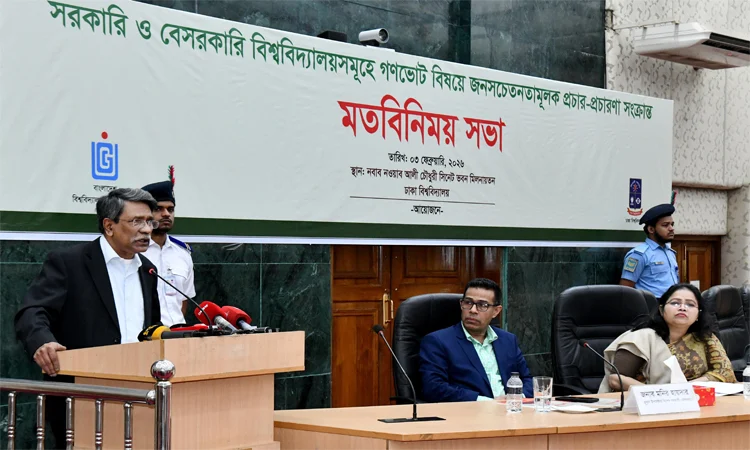
DHAKA, Feb 3, 2026 (BSS) – Chief Adviser’s Special Assistant Professor Ali Riaz today said the July Charter is a pledge signed in letters of blood.
“We owe a great debt to everyone—the young people who took to the streets, the youths who left their work to join the protests, the fathers who sent their sons to the rallies and sat in prayer, and the workers who stirred a storm of resistance,” he said.
Ali Riaz said: “That debt is the July Charter. Though every letter of it is written in black ink, its backdrop stands on blood. The July Charter is a pledge signed in letters of blood.”
He made these remarks while speaking as the chief guest at a views-exchange meeting held at the Nabab Nawab Ali Chowdhury Senate Bhaban of Dhaka University.
The University Grants Commission organized the meeting to promote the referendum campaign and to motivate voters.
Ali Riaz said people must endorse the July Charter and make “Yes” victorious in the upcoming referendum to stop return of autocracy, enforced disappearances, snatching away of people’s voting rights and freedom of expression.
“Those who over the past sixteen years sacrificed their lives in the struggle to free the country from fascist rule, who were victims of enforced disappearances and killings, and who endured arrests and torture, gave several responsibilities to us,” he said.
He said these responsibilities include blocking the return of personal autocracy once and for all. Another responsibility is to chart the course for the future of Bangladesh, he said.
“One-third of the country’s population is under the age of 27 to 37. For at least the next 40 years, it is our responsibility—yours and mine—to determine which path our beloved motherland will take,” he said
Ali Riaz said, “We believe that the sacrifices of countless martyrs will not go in vain; the people of this country will speak in favour of the July Charter, and Bangladesh will move forward on the path of success and prosperity.”
Referring to past instances where constitutional amendments were made at the will of a single individual, he said that after the Awami League came to power in 2009, a parliamentary committee was formed to correct flaws and deviations in the caretaker government system.
“That committee had no members from any party other than the Awami League. After holding 25 meetings and taking opinions from 104 individuals, the committee recommended that the caretaker government system should remain, albeit with certain conditions—such as a maximum duration of 90 days and restrictions on signing international agreements,” he said.
“However, this was changed in a single meeting held with the Prime Minister. By the unilateral decision of the Prime Minister, the 15th Amendment was enacted and the caretaker government system was abolished at the will of one person. Preventing constitutional amendments from becoming a child’s play is a demand of the time,” he said.
Mentioning that three farcical elections were held in 2014, 2018, and 2024, Ali Riaz said in 2012, under the pretence of appointing the Chief Election Commissioner, the then President staged a “drama” called a “search committee.”
It was said that the President would appoint the Chief Election Commissioner based on the recommendations of the search committee, he said adding however, it later emerged that the name “Kazi Rakib Uddin” was not among the search committee’s recommendations.
He said this too happened at the will of one person, and that democracy was exiled through farcical elections.
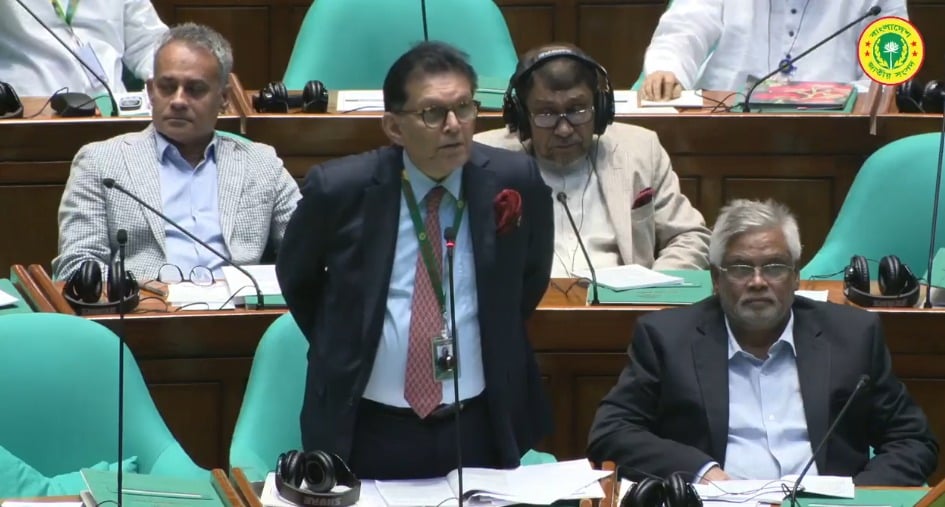
Speaking as a special guest at the exchange meeting, Monir Haidar, Special Assistant to the Chief Adviser, said 48 recommendations related to constitutional reform are coming to the referendum under four categories.
“Although there are 48 recommendations across four categories, in reality there is only one question: are you for the July uprising, or against it?” he said.
He said that if the referendum fails, fascism will return, and “we cannot even imagine how horrific, ruthless, and brutal it could be”.
Monir Haidar said according to the Proclamation of Independence, the goal of the Liberation War was to build a state based on equality, human dignity, and social justice.
“Unfortunately, over the past 54 years, that state has not been achieved. Instead, during this long period, individuals and particular groups have abused our independence for their own petty interests,” he said.
“The July Uprising has now given us the opportunity to achieve the goals of the Liberation War. We must utilize this opportunity through the referendum,” he said.
University Grants Commission Chairman Prof Dr. SMA Faiz presided over the event.
Students and teachers from public and private universities in Dhaka were present at views -exchange meeting.