Thursday
21 May, 2026
News Flash
News Flash
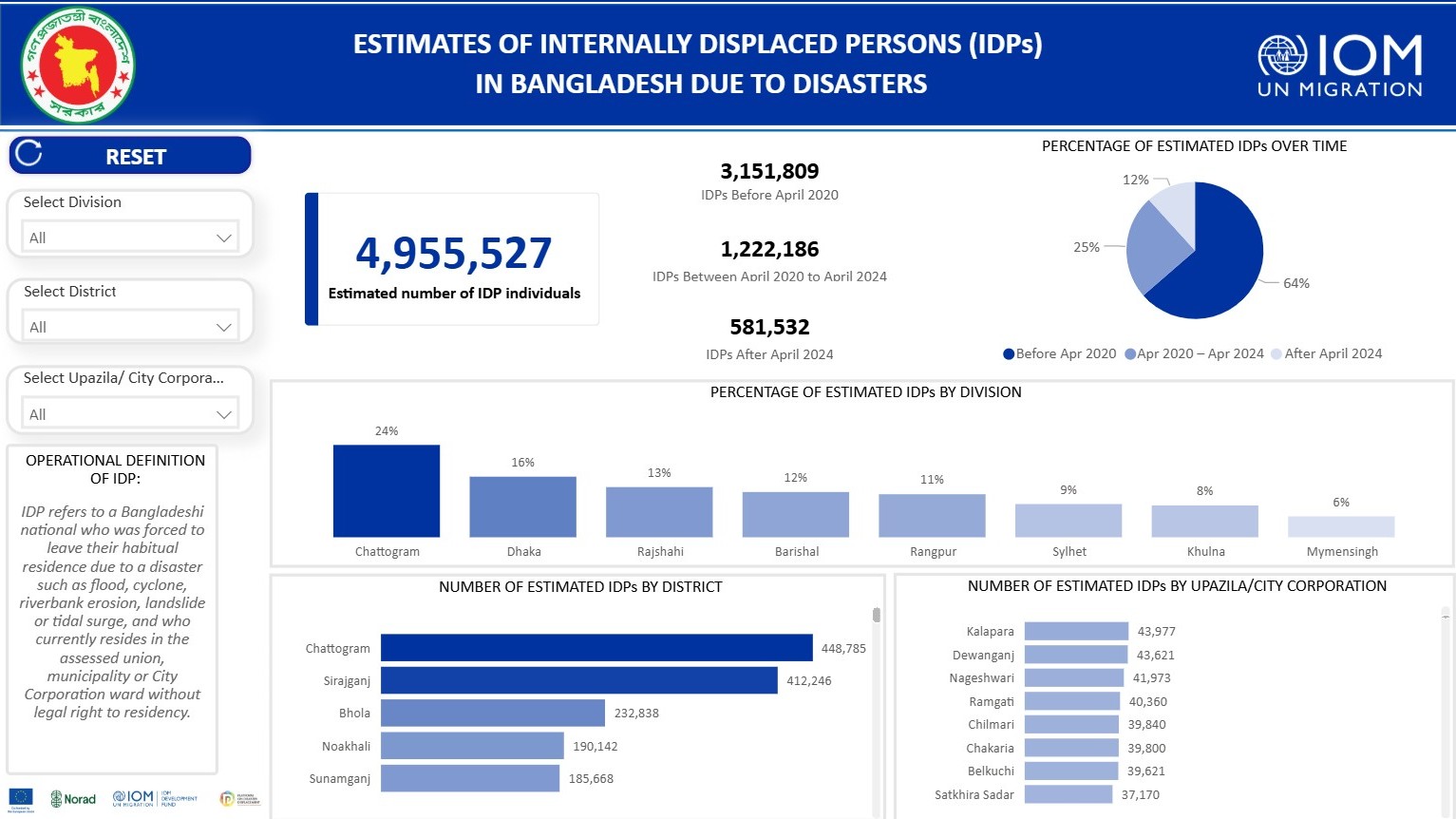
DHAKA, Dec 10, 2025 (BSS) - About 4,955,527 people are currently internally displaced in the country due to natural disasters, according to a new assessment.
The data was shared at an event at a city hotel today while the International Organization for Migration (IOM-UN Migration), together with the government of Bangladesh and development partners launched its first comprehensive nationwide estimate of internally displaced persons (IDPs) caused by natural hazards.
The findings offer a clear picture of how floods, cyclones, river erosion and other hazards continue to disrupt lives across Bangladesh, an IOM press release said.
Bangladesh faces repeated natural hazards each year, but until now, there has been no verified nationwide estimate of how many people have been forced to leave their homes due to disasters.
To close this gap, the IOM carried out the nationwide assessment across all eight divisions, 64 districts, 4,579 unions, 329 municipalities and 480 city corporation wards.
Data was collected between September and October 2025. The assessment collectively interviewed more than 29,000 key informants through 5,388 field visits, making it the most extensive exercise of its kind in Bangladesh.
Speaking at the event, Lance Bonneau, Chief of Mission of IOM Bangladesh, said: "Understanding the scale of displacement is essential for effective disaster management and long-term planning. These findings give national authorities, local leaders and development partners a shared foundation to respond to displacement with greater clarity and coordination."
Key findings of the assessment include: two out of three IDPs (63%) were displaced before April 2020, pointing to long-term, unresolved displacement across the country. One in four IDPs (25%) were displaced between April 2020 and April 2024.
The assessment found that Chattogram Division hosts the largest share of IDPs (1.21 million), followed by Dhaka (0.79 million) and Rajshahi (0.66 million). Four districts - Chattogram, Sirajganj, Bhola and Noakhali - account for a quarter of all displaced persons. Most IDPs (85%) live in rural union areas.
Representatives of the Government of Bangladesh welcomed the report as a major step toward strengthening implementation of the National Strategy on Internal Displacement Management, which calls for regular, systematic data collection on displaced populations.
Aleya Akter, Secretary of Statistics and Informatics Division, addressing as chief guest, paid the remarks virtually.
K M Abdul Wadud, Additional Secretary, Additional Secretary of Ministry of Disaster Management and Relief (MoDMR); Mohammad Navid Saifullah, Additional Secretary of Ministry of Environment, Forest and Climate Change (MoEFCC); and Eva Atanassova from the European Union also spoke, among others.
The event included a presentation on the methodology, an official unveiling of the report and a panel discussion on how to incorporate IDP estimation into government data systems, featuring representatives from the Department of Disaster Management (DDM), Department of Environment (DoE), Bangladesh Bureau of Statistics (BBS) and development partners.
Partners who supported this initiative reaffirmed their commitment to work with Bangladesh in building more resilient and inclusive systems for disaster response.
Representatives from the Government of Bangladesh and other partners also attended the event.
The new estimate marks an important milestone in Bangladesh's effort to better understand and address internal displacement. It will help guide policies on disaster preparedness, relocation planning, social protection, climate adaptation and long-term development.