Thursday
21 May, 2026
News Flash
News Flash
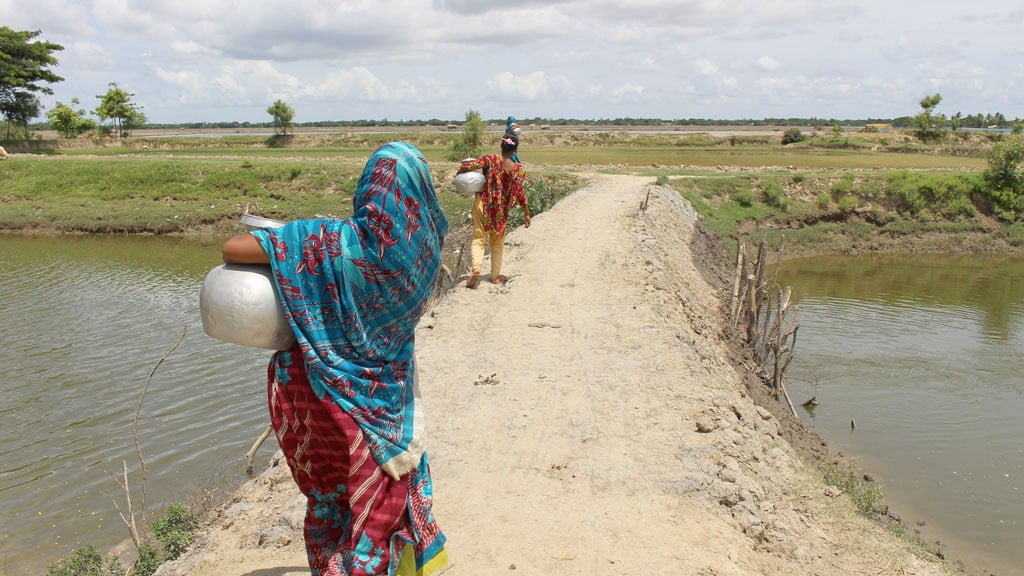
By Md Aynal Haque
RAJSHAHI, Dec 8, 2025 (BSS) - Surface water conservation is of the essence of mitigating the water crisis, which is being deepened due to the deficit of rainfall, in the region, including its vast Barind tract.
The groundwater level in the region is falling drastically due to indiscriminate extraction of water, mainly for irrigation purposes.
Indiscriminate lifting of groundwater and use of pesticides in crop fields have increased alarmingly, especially over the past 20 years.
Talking to BSS here today, Prof Chowdhury Sarwar Jahan said the present interim government has recently published a gazette declaring 4,911 villages in 25 upazilas under Rajshahi, Naogaon and Chapainawabganj districts as water-stressed.
As per the decision of the 18th meeting of the National Water Resources Council (NWRC), the area has been declared water-stressed for 10 years.
Restrictions have been imposed on the extraction of underground water for any other purposes, excluding only drinking water.
Quoting the gazette notification Prof Sarwar Jahan, who teaches at the department of geology and mining at Rajshahi University, said no more extracted water will be used for irrigation and other industrial purposes in the restricted area.
To mitigate the water crisis, he attributed that surface water resources must be enriched. Water from the Padma River needs to be introduced into the Barind area for irrigation purposes. Rainwater harvesting and conservation are of essence at present.
He also opined that leasing of government ponds, canals, beels and wetlands should be stopped, and the water of those should remain open for agricultural purposes.
Simultaneously, less water-consuming crops should be promoted on a large scale.
Development activist Jahangir Alam Khan told BSS that there are around 10,000 ponds, 200 canals and ten other large waterbodies in the barind areas, including Beelbhatia, a vast water body and wetland of around 6,388 acres, at Bholahat upazila in Chapainawabganj.
Tens of thousands of hectares of farmland can be irrigated round the year through using the conserved water of the beel if it is re-excavated.
There is another four to five kilometer long water body at Rohanpur in Gomastapur upazila of the same district. If it is re-excavated, around 10,000 hectares of land of 25,000 farmers can be brought under surface water irrigation.
Apart from this, the two-kilometer Chowdala-Boalia canal remained in a derelict condition for a long time. Around 150 hectares of farmland can be irrigated with water from the canal if it is renovated.
Transformation of all the existing underground water-based irrigation into surface water ones can be crucial in lessening the gradually mounting pressure on groundwater.
Khan said that the gradually declining water resources are posing a serious threat to the living and livelihood conditions of the marginalized and other low-income group families in the water-stressed area.
He, however, said rainwater harvesting can be indispensable for easing living and livelihood conditions of people through mitigating the water crises in the Barind area.
Time has come to extend necessary knowledge and devices to the communities to make them capable of availing the opportunities of rainwater harvesting technologies.
Conventionally, surface water promotion in the Barind region focuses on mitigating groundwater depletion aiming to provide irrigation for crops like wheat and pulses, improve domestic water supply, enhance livelihoods, and build climate resilience through water conservation and efficient use.
Jahangir Khan said key initiatives involve large-scale pond re-excavation, canal renovation, and promoting water-efficient farming, with goals to shift irrigation reliance from groundwater to these surface sources.