Thursday
13 August, 2026
News Flash
News Flash
DHAKA, June 23, 2026 (BSS) - A seven-year coastal adaptation initiative has strengthened the climate resilience of more than 700,000 people in south-western Bangladesh by expanding access to safe drinking water, supporting women-led climate-resilient livelihoods and building the capacity of communities and government institutions to respond to climate risks.
As the Gender-responsive Coastal Adaptation Project concludes, government representatives, development partners and community members have called for its successful models to be sustained and expanded across other climate-vulnerable coastal areas.
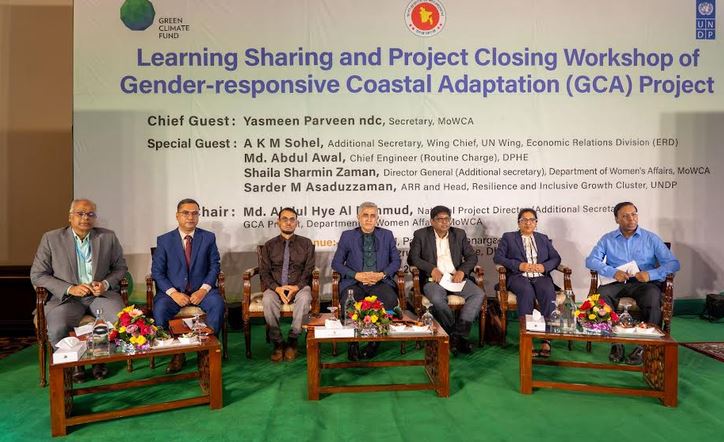
The call was made at the project's Learning Sharing and Closing Workshop in Dhaka, where participants reviewed its achievements, lessons and pathways for sustaining the results beyond the project period, said an UNDP press release.
Implemented from January 2019 to June 2026, the project was supported by the Green Climate Fund and implemented by the United Nations Development Programme in partnership with the Ministry of Women and Children Affairs, the Department of Women Affairs and the Department of Public Health Engineering.
The project reached 719,229 people directly and indirectly in Khulna and Satkhira. It supported 24,724 households to adopt climate-resilient livelihood practices and enabled 144,597 people to gain year-round access to reliable and safe drinking water.
More than 15,700 climate-resilient drinking-water systems were established, while 720 government officials strengthened their skills in climate-risk-informed planning and management.
Mohammad Masud Rana Chowdhury, Additional Secretary, Ministry of Women and Children Affairs, said, "For sustainable development, we have no alternative to adopting a whole-of-society approach."
"As we reflect on the project's accomplishments today, we must also focus on sustainability. The true measure of success will be how these interventions continue to benefit communities long after the project closes. UNDP remains committed to supporting the Government of Bangladesh in scaling up successful adaptation models, strengthening local capacities and mobilising resources for climate-resilient development," said Sonali Dayaratne, Deputy Resident Representative and Officer-in-Charge of the Resident Representative, UNDP Bangladesh.
Md Abdul Hye Al Mahmud, Additional Secretary and National Project Director of the GCA Project, emphasised that women's empowerment must be supported by sustainable income-generation opportunities.
Through salinity-tolerant agriculture, crab farming, hydroponics, homestead gardening and other livelihood options, participating women diversified their incomes and strengthened household food security. Community-managed water systems also reduced dependence on unsafe sources and saved women and girls' time previously spent collecting water.
Participants stressed that the project's experience provides a strong foundation for scaling integrated, locally led and gender-responsive climate adaptation across coastal Bangladesh.
Sarder M Asaduzzaman, Assistant Resident Representative and Head of Resilience and Inclusive Growth, UNDP Bangladesh; Sajal Kanti Banik, Joint Secretary, Ministry of Women and Children Affairs; Md Monir Hossain, Additional Director; and Ehtesamul Russel Khan, Additional Chief Engineer, Department of Public Health Engineering, also spoke at the workshop.