Wednesday
12 August, 2026
News Flash
News Flash
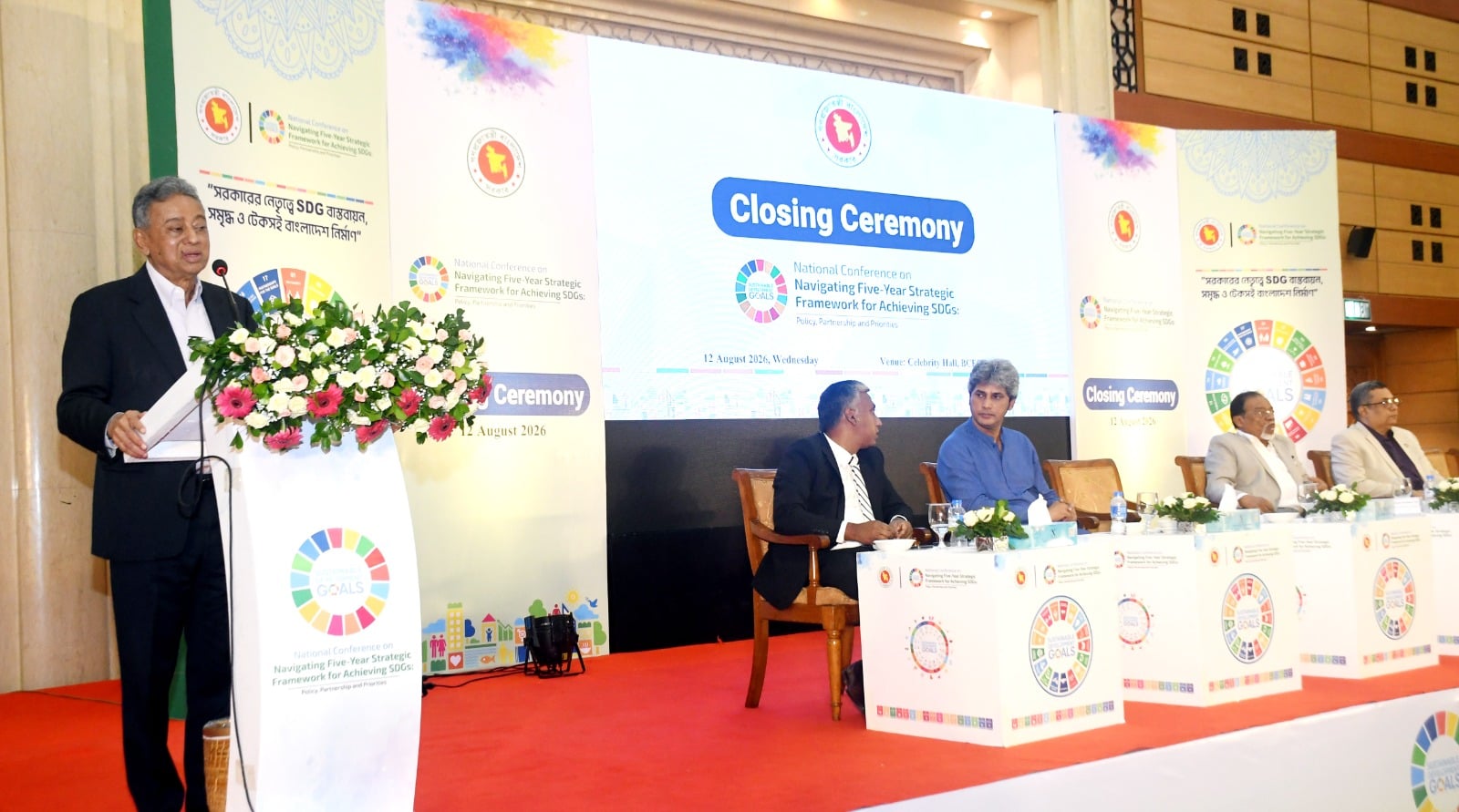
DHAKA, Aug 12, 2026 (BSS) - Finance and Planning Minister Amir Khosru Mahmud Chowdhury today said all stakeholders must work together to ensure effective delivery of the Sustainable Development Goals (SDGs).
"All stakeholders must come together to deliver the SDGs. This is a delivery issue, and all stakeholders have to work together to deliver it," he said.
Khosru also said, "SDG implementation is not a matter of charity. It is about improving the quality of life of every citizen, ensuring their economic, social and civic rights, and creating opportunities for everyone to participate in economic activities," he said.
The Finance Minister was speaking at the closing ceremony of the three-day National Conference on "Navigating Five Year Strategic Framework for Achieving SDGs: Policy, Partnership and Priorities" as the chief guest held today at the Bangladesh-China Friendship Conference Centre (BCFCC) in the capital.
Referring to the government's social protection initiatives, including the Family Card and support for farmers and low-income groups, Amir Khosru said the government has prioritised projects aimed at benefiting poor, vulnerable and disadvantaged people despite the difficult economic situation.
He said resources have been reallocated from some development projects to give greater priority to programmes that directly benefit low-income and vulnerable citizens.
"SDGs are not charity. We have to improve the lives of people by utilising their potential and facilitating them wherever they have the opportunity to be creative," he said.
The finance minister particularly highlighted the concept of "democratisation of the economy", saying political democracy can only be successful when people also have meaningful participation in economic activities.
"Every citizen of Bangladesh has the right to participate in the country's economic activities, to become connected with the economy and to work from their respective positions. The benefits of the economy must also reach every citizen," he said.
He said the government is also working to develop a "creative economy" by supporting artisans, weavers, potters, blacksmiths, theatre workers, musicians and people involved in sports and other creative sectors.
Explaining the initiative, he said people producing traditional handicrafts often receive very low prices despite putting in substantial labour. Through financial support, better inputs, design assistance, branding and marketing platforms, their products can be transformed into higher-value marketable goods.
"We want to monetise these areas. If we do not monetise them, they will not be sustainable," he said, adding that the government wants to connect such products with both domestic and international markets through digital and other marketing platforms.
Referring to Thailand's "One Village, One Product" model, Amir Khosru said Bangladesh could similarly create opportunities for rural people by providing skills development, quality inputs, design support and access to markets.
He, however, acknowledged that the government alone cannot deliver all these services to people across the country. "That is why we have taken the private sector and NGOs as partners. They have outreach and existing connections with people at the grassroots level," he said.
The minister said an executive committee has already been formed involving designers, NGOs, input suppliers and other relevant stakeholders to support the implementation of the creative economy initiative.
He said the government is also working through coordination among ministries, consultations with ordinary citizens and pilot projects to identify and correct gaps and errors before wider implementation.
Amir Khosru said SDG-related objectives are already incorporated into the BNP's election manifesto.
"If we can implement the manifesto 100 percent, the SDGs will be fully fulfilled. In fact, we are beyond SDGs, because there are many things in the manifesto that go beyond the SDGs," he said.
The finance minister also stressed the importance of ensuring inclusion of persons with disabilities in government programmes and resource allocation.
He said the government is giving special attention to persons with disabilities in social programmes and ensuring their participation in various initiatives.
"There is a psychological aspect to SDG implementation. Policies alone are not enough; a government must be prepared to act with humanity," he said.
He expressed optimism that with strong political will and coordinated efforts among all stakeholders, Bangladesh would be able to achieve its SDG targets and move beyond them.
The minister thanked participants who had remained engaged throughout the three-day conference and said the discussions would contribute to Bangladesh's efforts towards inclusive and sustainable development.
Prime Minister's Adviser on the Ministry of Public Administration Md. Ismail Zabihullah called for coordinated, data-driven and accountable efforts at national and grassroots levels to accelerate Bangladesh's progress towards achieving the SDGs.
He said Bangladesh's position at 110th in the 2026 Global SDG Index was not a matter for complacency.
He urged ministries and field administration to implement time-bound action plans and make SDG localisation more effective.
"Leave no one behind" should be the common goal, he said, stressing stronger coordination, local innovation, monitoring and accountability.
State Minister for Planning Md. Zonayed Abdur Rahim Saki said implementation of the SDGs is an integral part of Bangladesh's broader national reconstruction and transformation.
"SDG implementation is not merely an international obligation; improving people's lives is the government's commitment," he said.
Saki said the government is restructuring development projects around programme-based clusters, ensuring accurate data and expanding universal social protection, while prioritising education, health, energy, financial-sector reform, technology and environmental sustainability.
Member (Secretary) of the General Economics Division (GED) of the Planning Commission Dr. Monzur Hossain presented the conference summary and outlined the way forward at the closing session.
Principal Coordinator (SDG Affairs) at the Prime Minister's Office Professor Dr. S M Abdul-Awal also addressed the session, highlighting the importance of effective coordination among government agencies and stakeholders to translate the SDGs into tangible development outcomes.
The three-day conference concluded with a call for stronger policy coordination, inclusive participation and effective implementation of the Five-Year Strategic Framework to achieve the SDGs and ensure equitable development.