Tuesday
25 August, 2026
News Flash
News Flash
By Rezaul Karim Manik
RANGPUR, April 25, 2026 (BSS) - The Teesta Irrigation Project has significantly reduced irrigation costs and boosted agricultural output across northern Bangladesh, saving around Taka 60 crore in diesel usage and benefiting nearly one million farmers in four districts, according to the Water Development Board.
Officials said the project has provided uninterrupted irrigation during the current Boro season, when many parts of the country have faced disruptions due to fuel shortages and electricity constraints. As a result, farmers in Nilphamari, Dinajpur, Bogura, and Rangpur districts have been able to continue cultivation without major setbacks.
Superintending Engineer of the Rangpur region of the Bangladesh Water Development Board (BWDB) Mizanur Rahman said the irrigation system has eased pressure on diesel- and electricity-based irrigation methods.
“Around Taka 60 crore worth of diesel is being saved through the Teesta Irrigation Project,” he said, adding that increased river water flow this season has further improved water availability.
According to BWDB data, approximately 50,000 hectares of farmland across 12 upazilas are currently under irrigation through the system in the 2025–26 Boro season. This includes 32,000 hectares in Nilphamari, 6,000 hectares in Dinajpur, 23,000 hectares in Bogura, and 27,000 hectares in Rangpur district.
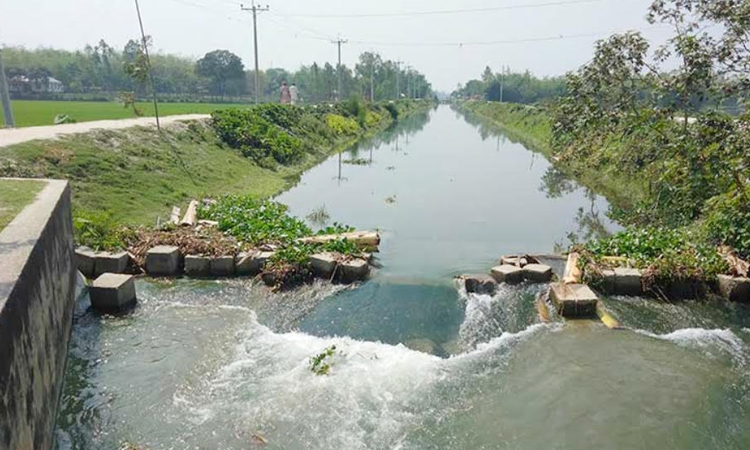
Farmers are receiving water through a network of canals drawn from the Teesta River under the Teesta Irrigation Project, which has been widely credited for lowering irrigation costs and improving soil fertility.
Farmers are turning to this project every year as it is cost-effective compared to diesel and electric irrigation and helps in increasing soil fertility. As a result, the number of cultivable lands is increasing every year. Farmers claim that if the water flow of these canals is normalized by dredging the Teesta, then production will increase several times more.
Farmers said a significant reduction in expenses has been found compared to traditional methods. Abdus Salam, a farmer from Gangachara upazila, said irrigation costs per acre have dropped from around Taka 10,000 to Taka 1,200–1,500 annually under the project. He also expects yields of 85–90 maunds per acre.
Local water management groups said that sediment carried by Teesta water helps improve soil fertility and moisture retention, reducing reliance on chemical fertilizers and increasing yields by 3 to 4 maunds per bigha in some areas.
However, farmers also pointed out challenges, including water shortages during early crop preparation, canal maintenance issues, and temporary supply disruptions in some areas such as Kishoreganj upazila of Nilphamari due to renovation work.
Despite these limitations, demand for expansion and improved water management continues. Farmers have urged authorities to ensure timely water supply and complete necessary dredging and maintenance of canals to enhance efficiency.
BWDB officials said irrigation schedules are being adjusted based on crop patterns and water availability, and supply is expected to continue over the next two months.