Sunday
26 July, 2026
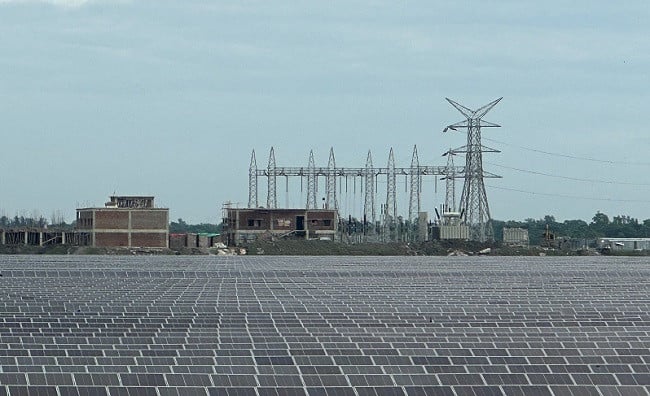
DHAKA, Dec 2, 2025 (BSS)- Bangladesh is set to take another significant stride in scaling up renewable energy generation as the government has cleared a major project proposal for the construction of a 220-megawatt (mw) solar power plant at Sonagazi in Feni.
The project was placed before the meeting of the Executive Committee of the National Economic Council (ECNEC) yesterday (Monday) and subsequently it was approved. The initiative, at an estimated cost of Taka 1,888.10 crore, marks a key milestone in the government's broader transition towards clean, sustainable, and climate-resilient power generation.
The project, titled "Construction of Sonagazi 220 MW Solar Power Plant," will be implemented by the Electricity Generation Company of Bangladesh Ltd. (EGCB) under the Power Division. It aims to expand renewable energy capacity and reduce the country's reliance on imported fossil fuels.
The financing includes Taka 147.56 crore from the government, Taka 1,623.63 crore in foreign assistance, and Taka 116.90 crore from EGCB's own funds. The project will run till June 2028.
According to the Planning Ministry, the proposed solar park will be built on 634 acres of land previously acquired by EGCB in Purba Bardhali mouza of Sonagazi Upazila. The company had procured a total of 999.65 acres of land in 2017, of which 285 acres were earlier used to establish a 75 MW solar power plant. The remaining suitable land will now serve the new 220 MW facility, making Sonagazi one of the largest renewable energy hubs in the country.
Once operational, the solar power plant will supply around 220 MW of clean energy to the national grid through the existing Mirsarai grid substation operated by the Power Grid Company of Bangladesh (PGCB). Officials said this new injection of green power will contribute significantly to enhancing the stability, reliability, and quality of electricity supply nationwide.
The project includes several major components such as the installation of some 469,560 solar PV modules, 26 grid-connected inverters, and construction of a 240 MVA substation. It will also involve the installation of four 230/33 kV transformers, construction of the 13.3 km second circuit of a 230 kV transmission line, establishment of a GIS bay at the BEZA substation, and an AIS bay at EGCB's existing 75 MW substation.
In addition, the initiative will oversee the construction of internal infrastructure including 6.89 km of dyke, CC block protection works, excavation of two canals totaling 3 km, nearly 11 km of internal roads, a modern control room, and a five-storey dormitory building.
The Planning Commission, which reviewed the project at the PEC meeting held on 26 August 2025, endorsed it for ECNEC approval, noting its substantial potential to advance national energy goals.
The Commission observed that the project would play a vital role in achieving the target of generating 20 percent of electricity from renewable sources, as pledged under national energy policies. It will also support the long-term objectives of the Integrated Energy and Power Master Plan (IEPMP) 2023, which aims to raise renewable energy-based generation capacity to 38 gigawatts by 2050.
Talking to BSS, a senior Planning Commission official said that solar-based power will help curb carbon emissions, ensure environmental sustainability, and reduce Bangladesh's dependence on volatile global fuel markets.
"Beyond environmental benefits, the project is also expected to enhance technical capacity within the energy sector, creating opportunities for training and development of skilled manpower in advanced renewable technologies." added the official.
"The Sonagazi 220 MW solar power plant will significantly expand renewable energy supply to the national grid and contribute to meeting the rising electricity demand," the Planning Commission said in its recommendation. "It will support uninterrupted, reliable, and quality power delivery and contribute to the country's broader goals of socioeconomic development."
With the approval by the ECNEC, the project is expected to stand as one of the single largest grid-connected solar power initiatives in Bangladesh, reinforcing the government's commitment to building a cleaner, greener, and more energy-secure future.