Tuesday
04 August, 2026
News Flash
News Flash
By Md Aynal Haque
RAJSHAHI, Feb 9, 2026 (BSS)- Only two days remain before the 13th National Parliamentary Election to he held across the country.
In this election, putting up posters on walls is prohibited. Posters cannot be hung using ropes or by any other means. However, banners, billboards, and leaflets are allowed.
Due to restrictions imposed by the Election Commission (EC), posters or banners on roads, walls, or poles are hardly visible this time.
The ear-splitting sounds of loudspeakers at regular intervals are also absent. As a result, social media has now emerged as a powerful “platform” for election campaigning.
Across all six parliamentary constituencies of Rajshahi district, the online world is currently flooded with digital posters.
The direct posters and loudspeakers of the physical campaign field seem to have been replaced by mobile phone screens.
In all six constituencies, candidates are creating various election-related contents. Facebook is filled with candidates’ or parties’ campaign songs, short videos, and satirical content.
At the same time, the online space also contains false statements created using artificial intelligence (AI), distorted videos, and violent content.
These are having a direct impact on the election field. This is because in this election, online campaigning is not merely a supporting tool; rather, it has become a separate battlefield in itself.
The political party that can control the narrative in the digital space will gain an advantage in ground-level campaigning as well.
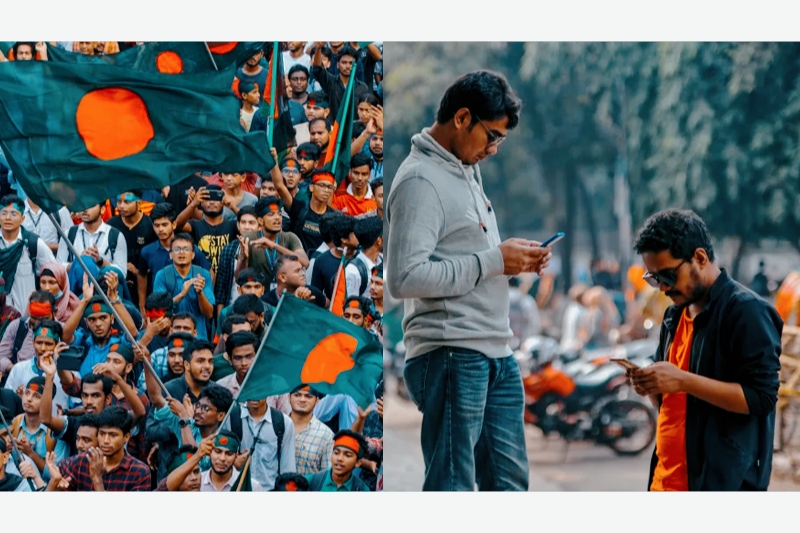
According to technology experts, these digital strategies have been designed primarily targeting the young generation who led the student–public movements in 2024.
Young voters are a major factor in this election, and they also consider digital campaigning to be timely and relevant.
Ali Hasan Simanto, a student of Rajshahi University, said, “The vast majority of the younger generation is involved in social media. So in the digital age, how necessary posters really are deserves discussion. Not having posters is better for the environment. Everything can be found on social media. What someone is saying, what promises they are making—everything can be verified there.”
Several other students living in Rajshahi expressed similar views.
Limon Ahmed, a student of Rajshahi College, said, “Politics used to be in markets, fields, and riverbanks. In villages, politics would come alive over cups of tea at candidates’ campaign camps. Now I mostly see politics in newsfeeds. What someone is saying—often there isn’t even time or opportunity to verify it.”
The electoral contest has already intensified in all six parliamentary constituencies of Rajshahi. Online, the presence of BNP and Jamaat candidates is more noticeable across the six seats.
In Rajshahi-1 (Tanore–Godagari) constituency, Jamaat’s candidate is Professor Mujibur Rahman. Through an election page created in his name, various types of campaign content highlighting his activities are being shared daily.
His followers post positive comments and share the content widely, reaching more people.
In the same constituency, BNP candidate Major General (Retd) Sharif Uddin is also not lagging behind. Strong campaigning is underway on social media in his favor as well, with his daily activities and upcoming programs regularly promoted online.
In Rajshahi-2 (Sadar) constituency, the BNP candidate is former Member of Parliament Mizanur Rahman Minu.
His campaign presence has been particularly noticeable online. In addition to Facebook pages, a dedicated election website has also been created for him. Through this website, voters from his area can share their opinions, and various details of his election campaign are available there.
Similarly, a strong online presence has been observed for Jamaat candidate Dr. Jahangir in Rajshahi-2 constituency. Jamaat supporters are campaigning in his favor through various Facebook pages, maintaining a more or less constant online presence.
Jamaat–Shibir activists are creating photo cards in coordination with the central organization and are working in teams to counter rumors.
The same situation exists in Rajshahi-3 (Paba–Mohanpur) constituency. There, BNP candidate Advocate Shafiqul Haque Milon and Jamaat-nominated candidate Abul Kalam Azad are both actively conducting their campaigns online.
Likewise, extensive social media campaigning is being carried out in favor of BNP candidate DM Ziaur Rahman and Jamaat candidate Dr. Abdul Bari in Rajshahi-4 (Bagmara), BNP candidate Professor Nazrul Islam in Rajshahi-5, and BNP candidate Abu Sayed Chand in Rajshahi-6. They are also presenting their programs and promises to voters through online platforms.
Meanwhile, political parties have created “theme songs” ahead of the election.
The main focus of the BNP’s theme song is the party symbol, the ‘Sheaf of Paddy.’ Jamaat-e-Islami’s theme song focuses on their party symbol, the ‘Scales.’
Similarly, the National Citizen Party (NCP) has highlighted its party symbol, the ‘Water Lily Bud,’ in its theme song.
BNP has released songs as part of its campaign. One song’s lyrics say: “We before me, the country before us, the people before power—Bangladesh above all.” Jamaat’s election song says:
“The days of the boat, the sheaf of paddy, and the plough are over; this time the scales will build Bangladesh.”