Tuesday
25 August, 2026
News Flash
News Flash
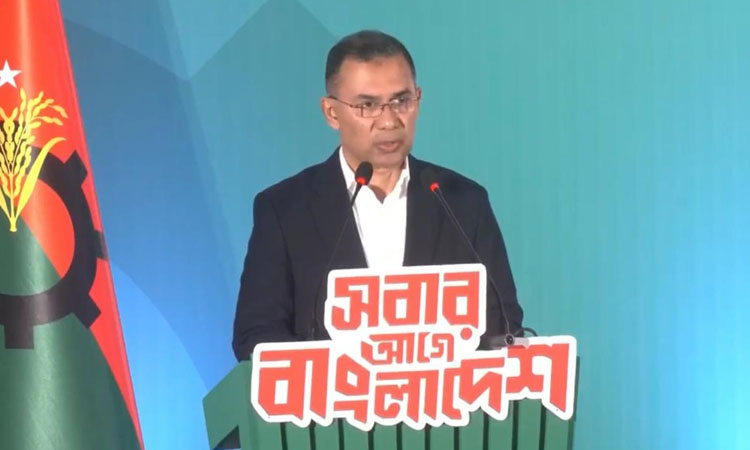
DHAKA, Feb 6, 2026 (BSS) - With the core philosophy of state governance being "Bangladesh First", BNP today unveiled its election manifesto for the upcoming national election pledging to build a justice-based, humane and prosperous Bangladesh.
Based on complete faith and trust in Almighty Allah, the BNP's election manifesto includes promises of various welfare-oriented initiatives for the people, such as family cards, farmer's cards, expatriate cards, and support in education, healthcare, and employment generation.
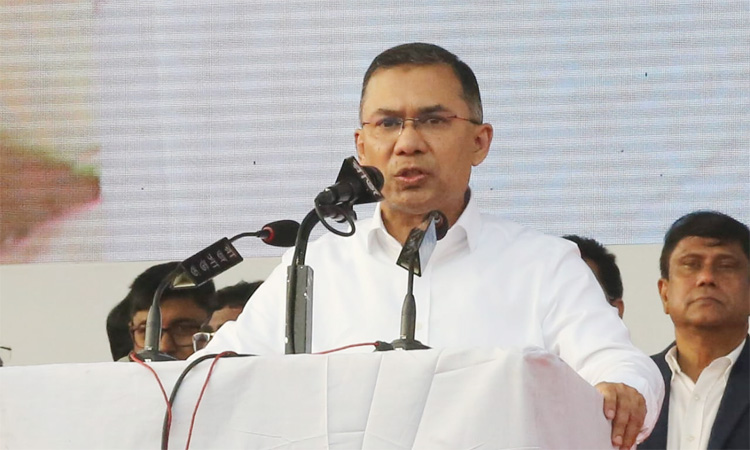
BNP Chairman Tarique Rahman announced the election manifesto this afternoon at a city hotel, six days ahead of the national election slated for February 12.
BNP Secretary General Mirza Fakhrul Islam Alamgir chaired the event while Nazrul Islam Khan, chairman of the BNP Election Steering Committee, conducted it.
The manifesto has been prepared by integrating BNP's 31-point State Reform Outline, the party founder Ziaur Rahman's 19 Points, former Chairperson Begum Khaleda Zia's Vision-2030, and the July National Charter.
The party has outlined plans to create employment for youth, build a trillion-dollar investment-driven economy, and establish a National Reconciliation Commission to strengthen the nation-building process, along with improving the country's structure and environment.
The manifesto also emphasizes investigating capital market scandals during the Awami League's rule and providing monthly honorariums for khatibs, imams, and muezzins, along with other people-centric issues.
At the same time, the manifesto contains a series of pledges, including zero tolerance for corruption, preparing an accurate list of martyrs of the Liberation War, and ensuring justice for the July mass uprising.
The contents of the manifesto have been finalized giving importance to the aspirations of women and youth, and integrating the July National Charter.
The manifesto states that BNP's primary goal is to establish a just society while upholding religious values and morality. Accordingly, based on complete faith in Almighty Allah, the party has reaffirmed its firm commitment to building a justice-based, humane, and prosperous Bangladesh.
According to the manifesto, the Bangladesh Nationalist Party (BNP), which believes in democracy, will adopt "Bangladesh First" as the core philosophy of state governance.
The party will give the highest priority to implementing-faithfully and effectively-the 19 Points of Shaheed President Ziaur Rahman, Vision-2030 of democratic leader Begum Khaleda Zia, the 31-point State Reform plan of BNP Chairman Tarique Rahman, and the consensual and signed provisions of the July National Charter.
Emphasizing reforms in the electoral system and the constitution, the manifesto states that voting will be re-established as the sole legitimate source of state power, and sustainable democratic institutions will be built through necessary reforms. There will be no return of fascism or foreign subservience.
Social justice will be ensured by eliminating all forms of discrimination in society. Accountability will be ensured at every level of the state, a people-oriented welfare state will be built, and freedom of the media and expression will be protected and expanded.
The manifesto further states that, through a comprehensive state-led survey, an accurate list of martyrs of the Liberation War will be prepared to ensure state recognition and honor for freedom fighters.
The true history of the Liberation War will be preserved and presented, and freedom fighter entrepreneurs will be encouraged through investment incentives.
Additionally, government establishments will be named after martyrs of the July mass uprising and the 16-year anti-fascist movement in their respective localities.
Those who were injured, disabled, or lost eyesight in the pro-democracy movement will be given recognition, proper medical care, and employment support.
Comprehensive assistance will be provided to families of martyrs and fighters, and a separate department under the Ministry of Liberation War Affairs will be established for their welfare.
In line with the 31-point National Reconciliation initiative, the manifesto pledges to form a victim-centered and rehabilitative Truth and Healing Commission in establishing justice.
In the election manifesto, the BNP has emphasized ensuring rule of law and accountability at all levels of the state as the foundation of good governance and development.
The party has declared that it will make no compromise with corruption. Alongside legal and systemic reforms, transparency and accountability will be ensured through open tendering, real-time audits, performance audits of projects, single-window clearance, and measures to prevent money laundering and recover laundered funds.
Stating that transparent and accountable public service is its goal, BNP says local government is the heart of democracy and development.
A strong and effective local government system will be built based on the principle of resolving local problems locally, ensuring accountability, adequate financing, public hearings on development activities, and public disclosure of service-related information to enhance transparency and citizen participation.
To eradicate poverty and ensure social protection, BNP has pledged to build a humane, just, and dignity-based social safety framework. The state will take responsibility for protecting the lives and livelihoods of citizens.
Family cards will be provided to all households in phases, and farmer cards will be issued to farmers, small traders, fishermen, and livestock farmers. Social safety coverage will be expanded and benefits increased, including the establishment of an effective pension fund for private-sector workers.
The manifesto also promises sustainable employment in impoverished and backward regions, a national civic service for persons with disabilities, effective implementation of the Parents' Maintenance Act, prioritization of marginalized communities, and the creation of a special fund for the welfare of extremely poor orphaned children.
If elected, BNP pledges to empower women by issuing family cards in the name of the female head of household, ensuring free education up to postgraduate level, and implementing integrated programs for women's social and economic development.
To support farmers and ensure food security, BNP promises comprehensive protection through farmer cards and the waiver of agricultural loans (including interest) up to Taka10,000.
To generate employment nationwide, BNP plans to establish government Employment Exchanges at district and upazila levels. Free internet will be provided at educational institutions, government offices, digital centers, hospitals, railway stations, airports, and other populous locations. Language and skills training centers will be established to support overseas employment.
BNP's foreign policy philosophy is also "Bangladesh First." The party emphasizes independence, sovereignty, national interest, national security, and public welfare, and will pursue bilateral and multilateral relations based on equality, fairness, mutual interest, and international norms.
A zero-tolerance stance against terrorism, militancy, and extremism will be adopted, combining legal, social, and preventive strategies through national consensus.
The manifesto aims to democratize the economy by dismantling oligarchic structures and ensuring public participation. Employment generation is the party's main objective, with a transition from a consumption-based economy to an investment-driven economy. BNP pledges to build a one-trillion-dollar economy by 2034.
Foreign investment will be increased to 2.5% of GDP, and support will be provided to SMEs and startups through guarantee schemes, cash-flow-based loans, district capital funds, crowdfunding, and expanded insurance coverage.
Banking sector governance, inflation control, rationalization of interest rates, and restoration of confidence will be pursued through an Economic Reform Commission.
Capital market reforms will ensure the independence and autonomy of the Securities and Exchange Commission, establish a Capital Market Protection Commission, and form a special investigation commission to probe irregularities over the past 15 years.
To make coastal regions strategic hubs of regional and global trade, integrated logistics hubs will be developed around Chattogram and Mongla ports. Power generation capacity will be increased to 35,000 MW by 2030, with expanded transmission lines, while reducing unnecessary expenditures and ensuring transparency and efficiency.
BNP also plans to transform Bangladesh into a global ICT and hardware manufacturing hub, create one million new ICT jobs, ensure fast and reliable internet for all, and implement a modern connectivity master plan through public-private partnerships.
Revenue management aims to achieve a tax-to-GDP ratio of 15%, with gradual increases in the short and medium term, restoring fiscal discipline and economic credibility.
To ensure balanced regional development, BNP pledges planned urbanization, affordable housing for low-income and slum dwellers, integrated waste and water management, land banking, land service fairs, empowered local governments, and citizen service corners.
On religious freedom, the manifesto reiterates the principle "Religion belongs to individuals; the state belongs to all." Every citizen will enjoy full freedom and security in practicing religion. Initiatives will be taken to enhance the dignity and welfare of khatibs, imams, muezzins, and other religious service providers, and the activities of religious welfare trusts will be expanded.
Finally, the BNP promises to ensure job security and professional freedom for media workers, end harassment and political bias, establish accountable regulatory frameworks, ensure justice for journalist killings, and form a National Journalists' Retirement Welfare Board.