Wednesday
27 May, 2026
News Flash
News Flash
By Salah Uddin Shuvro
DHAKA, Dec 30, 2025 (BSS) - Bangladesh's Liberation War began with the voice of Ziaur Rahman, who at that time was not with his family. He had revolted against the Pakistan Army and was moving along with some 300 soldiers to prepare for war.
Late Journalist Mahfuz Ullah who was personally acquainted with Begum Khaleda Zia, in his book "Begum Khaleda Zia: Her life, Her Story" wrote, when then Major Ziaur Rahman was leaving his abode for war preparedness he was asked, why are you not taking your wife and two sons with you?
Major Zia replied, "If three hundred soldiers can set out for war under my command without their families, why should I go with mine?"
There are very few top-tier political leaders-or later, those who led the state - who put their families and personal safety at risk joining the war for Bangladesh. In the history of Bangladesh, especially those who later held state power at various times, none of them were prepared to make such sacrifices during the Liberation War.
They were at the forefront of political struggles before and after, but during the Liberation War they lacked that courage. In this case, the Zia family stands unique, Mahfuz Ullah wrote.
With Ziaur Rahman's departure for the war began Khaleda Zia's own Liberation War. With her two children she fled from place to place. Had she been caught, the Pakistan Army would have had the opportunity to stop Ziaur Rahman. Perhaps even the declaration of independence would have been thwarted. But Khaleda Zia did not give them that opportunity. Her tactics and firm mentality forced the Pakistan Army to bow.
Several key decisions at the beginning of the Liberation War influenced the journey toward Bangladesh's independence, and Khaleda Zia was involved in some of those. She allowed Zia to proceed with his war mission. She did not compromise regarding the lives of her children. She did not stand as a barrier on Ziaur Rahman's way. She did not care about her own or her children's uncertain future.
In another incident, it is known that soldiers from the Baloch Regiment came to disarm Bengani-dominated 8th East Bengal Regiment just ahead of the war. The disarmament could have exposed the would be freedom fighter Bengali soldiers to Pakistani massacre. A habilder, now called corporal, responsible for the matter went to Ziaur Rahman's house. Ziaur Rahman was not home. The corporal asked Khaleda Zia where "Sir" was. Khaleda Zia said Sir was not at home and asked why he was looking for him. The corporal said that soldiers of the 17th Baloch Regiment were taking away weapons from their battalion. Khaleda Zia asked who had sent him. He said, Corporal Kader. Then Khaleda Zia told him nothing should leave the unit without Ziaur Rahman's order. That corporal, Nurul Haque, later said that if Begum Zia had not given that instruction that day, the 11 hundred patriotic soldiers would have been killed.
Because of Begum Khaleda Zia's order, the freedom-seeking soldiers' lives were saved. Ziaur Rahman was able to proclaim the declaration of independence. With that formal announcement, the Liberation War began. People came to know that the war was going on in the country.
Khaleda Zia too had to remain in hiding from then on. At first, she stayed hidden at a relative's home in Chattogram. For nearly two months she confined herself and her two sons. But Chattogram became more unsafe for them. From there she first went to Narayanganj with her two sons. Her sister Khurshid Jahan Haque lived in Narayanganj at the time. Begum Zia went there on May 16 in 1971. But the journey was not easy. She had to cover herself in a black burqa to reach the Chattogram launch terminal. While going by car, she had to choose an alternative, less-used route, as Pakistani soldiers were guarding major intersections with heavy weapons. Evading their eyes, she boarded a launch from the terminal, along with Lt. Mahfuz's wife.
Throughout the journey she had to constantly watch over Tarique Rahman and Arafat Rahman. If they cried or protested, it would draw the attention of the Pakistani soldiers. Arafat Rahman Coco was only two at the time. She had to make sure her young children did nothing to raise suspicion. Perhaps even the children sensed the horrors of war.
As soon as the launch reached Narayanganj, her sister Khurshid Jahan Haque and her husband Mozammel Haque took Khaleda Zia and her children into their car. The car had a Red Cross sticker. Passing right under the gaze of the Pakistani army, they reached Khilgaon, Dhaka. But soon the Pakistani soldiers got information about her whereabouts. They learned she was sheltered by a relative named "Haque." They went to Mozammel Haque's office to search. Hearing this, Mozammel Haque moved Khaleda Zia to an uncle's house in Dhanmondi on May 28. Still feeling unsafe, Khaleda Zia hid in a house in Siddheswari with her two sons. At that time Mozammel Haque was arrested and tortured. Despite severe abuse, he never revealed where Khaleda Zia was.
Finally, on July 2, Khaleda Zia was arrested. That morning, when she woke and went to the garden, she found Pakistani soldiers surrounding the house.
After her arrest, Khaleda Zia and her two children were first kept in the old Parliament House, and later at a house in Dhaka Cantonment. She remained there until the country was liberated. During the war, shells fired from India would often land in the Cantonment area, Khaleda Zia said. The sound of explosions would terrify them, she added.
But throughout the detention, Khaleda Zia remained calm and silent. During this time, the Pakistan Army threatened Ziaur Rahman with the arrest of his family and demanded his surrender. Even then Khaleda Zia did not panic. Ziaur Rahman instead scolded the Pakistan Army in a letter.
After the country became independent likely on December 16,1971, Khaleda Zia was taken to Shamshernagar along with her two children to meet Ziaur Rahman. Then they began living with Ziaur Rahman in Cumilla.
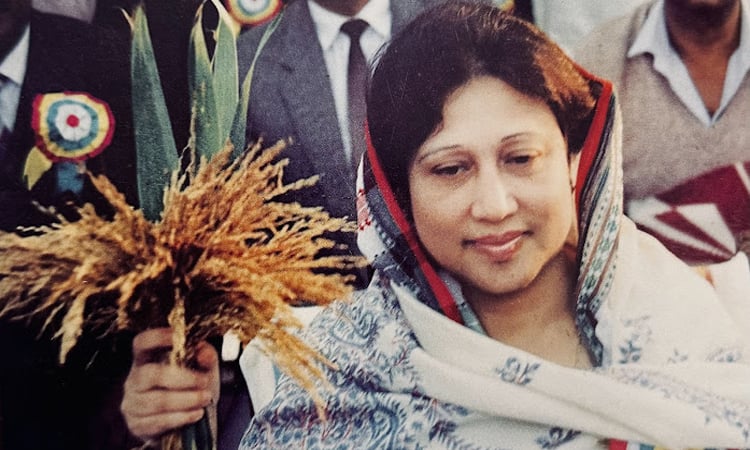
Her contributions did not end only with acts of courage during the Liberation War. After becoming Prime Minister, Khaleda Zia made many contributions for freedom fighters, including forming the Ministry of Liberation War Affairs.
Describing Khaleda Zia's contributions to the freedom fighters, A.K.M. Wahiduzzaman wrote: "In 1991, after winning the election, Begum Khaleda Zia became the first female Prime Minister of Bangladesh. Right after taking responsibility, she decided to honour the greatest sons of the nation. On December 15 in 1992, all decorated freedom fighters were given state medals. But one of the gallantry award winners -- Taramon Bibi, Bir Pratik -- could not be found immediately. On December 19 in 1995, she was found and Begum Zia in person decorated her with the gallantry medal.
In 1993, she took initiatives to preserve the killing grounds of 1971. The Rayerbazar Intellectual Martyrs' Memorial was built. In 2001, to uphold the true spirit of the Liberation War, she formed the Ministry of Liberation War Affairs. In 2002, the monthly allowance for freedom fighters was increased by 20-66 percent. In 2003, state grants were provided to families of martyred freedom fighters. Initiatives were taken to build monuments beside the graves of the Bir Shreshthos.
In 2004, the Bir Shreshtho Matiur Rahman Stadium was established in Khulna. In 2006, at Begum Zia's request, Pakistan sent back the remains of Bir Shreshtho Matiur Rahman, who was given full state honors in burial. At that time, roads across Dhaka were named after freedom fighters. Begum Zia never used the Liberation War as a tool to win elections; the Liberation War was part of her belief."