Sunday
23 August, 2026
News Flash
News Flash
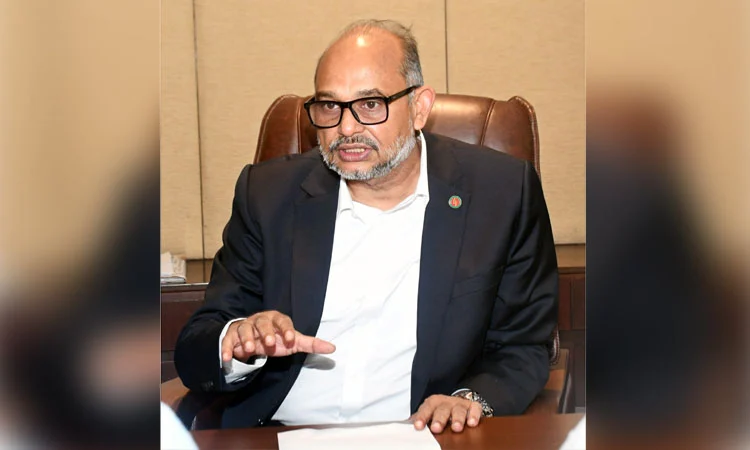
DHAKA, Aug 20, 2026 (BSS) — Adviser to the Prime Minister on Finance and Planning Prof Dr Rashed Al Mahmud Titumir has outlined a three-phase strategy to recover Bangladesh’s economy from its deep-seated crisis, restore sustainable growth and ultimately rebuild institutions to accelerate economic expansion.
In an interview with BSS, the adviser said the government’s Five-Year Strategic Framework for Reform and Development is centred on three successive stages — recovery, restoration and reconstruction for acceleration — aimed at bringing the economy back to stability and placing it on a sustainable growth trajectory.
Prof Titumir said the first phase, recovery, is focused on reclaiming lost ground and stabilising the macroeconomy.
He said the immediate priority is to address the accumulated economic crisis, including debt burdens, weakened institutions, liquidity constraints, declining production and employment, and to restore confidence in the economy.
The government has already taken steps to strengthen fiscal and monetary coordination, expand revenue collection and improve macroeconomic stability.
The adviser pointed to 12 percent revenue growth between mid-February and June 30, compared with only 2 percent growth during the corresponding period of the previous year, as an indication of improving fiscal performance.
He said the government is seeking to expand the tax base and prevent tax evasion rather than putting additional pressure on existing taxpayers.
Rising foreign reserves, an appreciation of the taka, increased remittances and lower interest rates were also identified as positive indicators supporting the recovery process, he said.
The second phase, restoration, will focus on moving the economy from stabilisation towards sustainable and inclusive growth.
Prof Titumir said restoring production, investment and employment would be central to this phase.
The government is seeking to improve the investment environment through deregulation and the proposed “Trace and Track” approach, while positioning Bangladesh as a gateway between South and Southeast Asia.
He said investment commitments have emerged from North America, Western Europe, the Gulf region and East Asia, particularly in the Chattogram and Mongla economic zones.
The government wants to prioritise production-oriented investment that creates employment and strengthens exports rather than debt-heavy and import-dependent projects.
Several sectors have been identified as priority industries, including agriculture and agro-products, electronics, pharmaceuticals, leather goods and light engineering.
The restoration phase will also link economic growth with social development through expanded social protection, primary education reform and increased healthcare capacity.
The third phase, reconstruction for acceleration, will focus on completing institutional reforms and creating the conditions for faster economic expansion.
Prof Titumir said institutional rebuilding is essential to ensure that the gains from recovery and restoration become sustainable.
The government also plans to transform the energy sector as part of this process. The strategy envisages moving from immediate energy stabilisation to capacity expansion in line with economic demand and eventually enabling households and businesses to become energy producers through solar power and net metering.
“The citizen is no longer just a client, but a producer,” the adviser said.
He said the three phases should not be viewed as isolated measures but as a sequential process — first stabilising the economy, then restoring productive capacity and inclusive growth, and finally reconstructing institutions to accelerate development.
He cited the expansion of overseas employment and remittances after the mid-1970s and the subsequent rise of female education, employment and the RMG sector as examples of how strategic policy decisions can transform structural weaknesses into economic strengths.
The current strategy, he said, similarly seeks to identify Bangladesh’s economic strengths and mobilise them through pragmatic policy interventions.
The adviser described the first 180 days of the government as the initial footprint of this recovery process, saying the ultimate objective is to move Bangladesh from crisis management toward a stable, productive and inclusive economy.
He said the three-phase framework — recovery, restoration and reconstruction for acceleration — represents a roadmap for reclaiming lost ground, restoring economic dynamism and laying the institutional foundation for accelerated growth.