Thursday
30 July, 2026
News Flash
News Flash
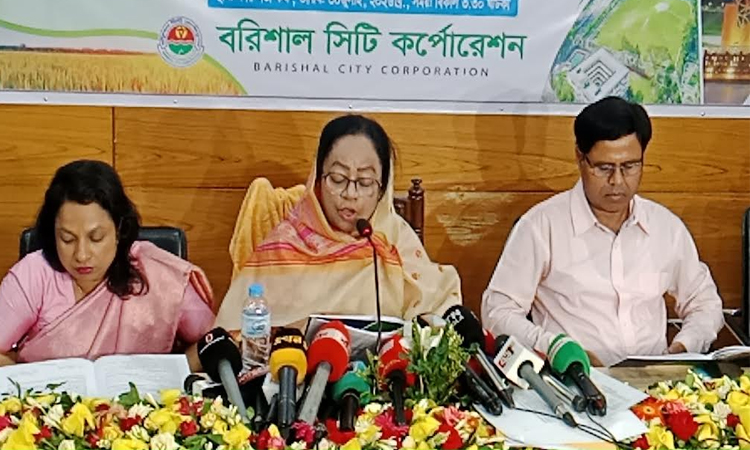
BARISHAL, July 30, 2026 (BSS) - Barishal City Corporation (BCC) has announced a proposed budget of Taka 647.53 crore for the 2026–27 fiscal year without introducing any new taxes.
The budget prioritizes urban development, waterlogging mitigation, safe water supply, modern waste management, environmental protection, women and child welfare and digital public services.
Speaking at the budget announcement ceremony held at the city corporation headquarters on Thursday, BCC Administrator Advocate Bilkis Akter Jahan Shirin said the budget had been prepared without increasing taxes despite limited revenue resources.
"Our goal is to build a planned, green, clean, and smart metropolitan city that is friendly to women and children for future generations," she said.
The original budget for the 2025–26 fiscal year stood at Tk 520.86 crore, while the revised budget was reduced to Tk 462.86 crore.
The proposed budget places strong emphasis on resolving the city's long-standing waterlogging problem. A Tk 769.40 crore project has been submitted to the ministry for the re-excavation and protection of the Jail Canal, Amanatganj Canal, Sagardi Canal, and Lakutia Canal. Officials expect the project to provide a permanent solution if approved.
The budget also highlights a proposed Tk 533 crore project to construct a protective embankment along the western bank of the Kirtankhola River to safeguard the city.
BCC announced that the Rupatali Surface Water Treatment Plant has become operational, while the Beltala Treatment Plant is nearing completion. A development proposal has also been prepared for a new Kirtankhola Surface Water Treatment Plant to meet future water demand.
The city corporation continues to expand its water supply network through new pipelines. During the previous fiscal year, 1,064 new water connections were approved.
The city corporation currently collects approximately 200 tonnes of waste every day. An agreement has been signed with a South Korean company to introduce modern waste management technologies and generate electricity from waste.
The budget includes initiatives to build modern public toilets for women, establish a dedicated market for women entrepreneurs, provide legal assistance to underprivileged women, and construct a hostel for working women.
For children, funds have been allocated to renovate Green City Park, install new rides, purchase sports equipment, and organize sports competitions.
As part of its climate resilience strategy, BCC plans to plant 50,000 trees in the coming fiscal year. Other beautification projects include new fountains, park upgrades, decorative lighting, and the construction of a sculpture titled "Sobar Age Bangladesh".
The city corporation plans to digitize several civic services, including tax collection, trade licence issuance, building plan approvals, and land-use clearance certificates. Officials believe the move will improve efficiency and reduce public inconvenience.
Since assuming office, the administration has completed 42 kilometres of bituminous roads, 4.5 kilometres of RCC roads, 8.5 kilometres of CC roads, and 16.5 kilometres of RCC drains.
A separate Tk 24.76 crore lighting project has also been submitted for government approval. If approved, more than 16,000 electric poles and 20,000 streetlights will be installed across the city.
During the previous fiscal year, 10,479 women and children received routine vaccinations. The Measles-Rubella campaign covered 43,850 people, while the Vitamin A Plus campaign reached 58,557 children.
From the next fiscal year, BCC plans to provide free medical treatment and medicines for women and children through health centres in the city's three administrative zones.
The budget also allocates funds for the renovation of the buildings of the Barishal Press Club and the Barishal Reporters Unity.Concluding her budget speech, Advocate Bilkis Akter Jahan Shirin emphasized the efficient use of limited resources, prevention of corruption, and elimination of wasteful expenditure to improve public services.
She called on residents, journalists, government agencies, private organizations, and all stakeholders to work together in building a modern, clean, green, and smart Barishal without increasing the tax burden on citizens.