Wednesday
05 August, 2026
News Flash
News Flash
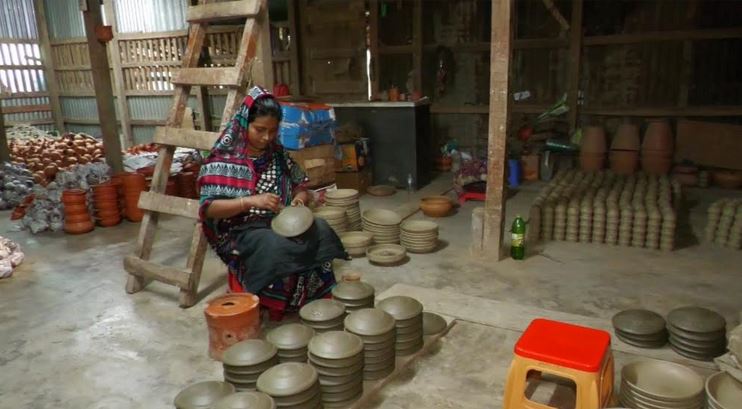
PATUAKHALI, April 12, 2026 (BSS) - As the Bengali New Year 1433 approaches, potters in Palpara village under Madanpura Union of Bauphal upazila here are experiencing their busiest time of the year, preparing a wide range of clay products for Pahela Baishakh celebrations.
Craftsmen are working tirelessly to produce traditional and decorative items
such as mugs, dishes, vases, dinner sets, cups, saucers, and various home
decor pieces. With orders pouring in, many are engaged in different stages of
production-from shaping and drying to firing, coloring, and preparing goods
for distributing those into various markets.
Palpara has been renowned for its pottery for nearly 50 years. Once known
primarily for clay toys sold at Baishakhi fairs across Patuakhali, the
village has evolved with modern designs and diversified products. Today, its
pottery reaches major markets across the country, including Dhaka, and has
even found buyers abroad in recent years.
Despite growing demand, artisans are facing mounting challenges. Rising costs
of raw materials such as clay and fuel have significantly reduced profit
margins compared to previous years. Many families dependent on pottery worry
whether they will achieve expected earnings this season.
The legacy of the late Rajeshwar Pal, a pioneer of Palpara's pottery
tradition, continues to shape the industry. His efforts once took local
crafts to fairs across the region, and his established production line still
supplies major outlets today.
Currently, around 50 families are directly involved in pottery in Palpara,
though the workforce has declined from 100-150 workers in the past to about
30-50 today. Still, those remaining in the trade remain hopeful.
Bishweshwar Pal, president of the Baufal Palpara Pottery Association, said an
increase in buyers and wholesalers ahead of the New Year.
However, he highlighted key challenges, including the scarcity of quality
clay and lack of financial support. "With adequate government assistance and
access to raw materials, we could significantly expand production," he said.
Local stakeholders emphasize that Palpara's pottery is not just an economic
activity but a vital part of cultural heritage. Kamruzzaman Bachchu, former
president of the Bauphal Press Club, stressed the need for financial aid,
modern training, and better marketing opportunities to sustain the industry.
Officials have acknowledged the importance of the sector. Bauphal Upazila
Nirbahi Officer (UNO) Saleh Ahmed said that steps are being considered to
provide necessary government support.
He expressed optimism that with proper sponsorship and training, the pottery
industry could expand further and contribute to both domestic demand and
export growth.
As demand for clay products continues to rise-not only during Pahela Baishakh
but also for social events and home decoration-experts say planned support
and investment will be crucial to preserving and advancing this traditional
crafts.