Tuesday
04 August, 2026
News Flash
News Flash
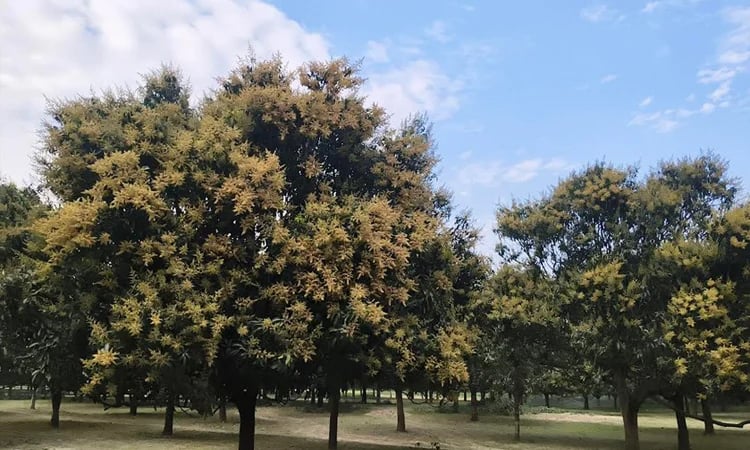
CHAPAINAWABGANJ, Feb 20, 2026 (BSS) - As the winter season draws to a close,
the landscape of Chapainawabganj has been transformed into a sea of green and
gold, with thousands of mango trees erupting in buds (mukul).
The widespread blossoming has blanketed the district in a sweet, all-
pervasive fragrance, a heady aroma that has captivated the local senses and
sounded the arrival message of the upcoming honey month.
Agricultural officials and growers alike are expressing high hopes for a
bumper harvest in the 2026 season, contingent on the continuation of
favorable weather conditions.
Data from the Department of Agricultural Extension (DAE) has confirmed that
Chapainawabganj remains the nation's premier hub for mango production.
The scale of the current mango harvest season is defined by 37,487 hectares
of land under cultivation. This land supports a total of 9,244,765 mango
trees, with an official production target of 458,912 metric tons for the
year.
During an on-the-ground visit, orchards across the Sadar and Shibganj
upazilas were observed to be heavily laden with buds, with trees in every row
showing robust growth. Farmers have been proactive this season, completing
primary orchard maintenance well before the first buds appeared to ensure
maximum yield.
Abdur Razzak, a veteran mango grower from Ranihati Union in Sadar upazila,
noted that the buds have arrived earlier than in previous years.
He remains optimistic about the output but voiced a common concern regarding
the elements. "If the crop is not destroyed by heavy fog, we anticipate a
massive production this year," he stated.
In the Jagannathpur area of Durlabhpur Union under Shibganj upazila, farmer
Monirul Islam Manik reported that his trees began budding approximately two
weeks ago.
He observed a nuanced progression in his orchards, noting that while most
trees are now densely covered in buds, some are still in the sprouting stage.
"I am currently applying necessary sprays to protect the 'mukul' from disease
and pest attacks as per the advice of the agriculture department," Manik
said, adding that current conditions are perfectly conducive to a successful
harvest.
The vibrant blossoming is most visible across the five upazilas of the
district-- Sadar, Shibganj, Bholahat, Gomastapur and Nachol.
According to official assessments, several popular and traditional varieties
are already in the budding stage, including Guti, Lakhonbhog, Amrapali,
Gopalbhog, Langra, Fazli, Khirsapat and Ashwina.
Dr. Md. Yeasin Ali, deputy director of the DAE, provided a satisfied
assessment of the season's progress, reporting that approximately 70 percent
of the trees in the district have already budded.
He anticipates that the remaining trees will follow suit within the next few
days, bolstered by the prevailing favorable climate.
The DAE has issued expert directives and technical support to the farming
community to ensure the budding phase transitions into a high-yield harvest.
Dr. Md. Yeasin Ali remains positive about the district's ability to meet its
ambitious production targets, noting that the synergy between favorable
weather and disciplined orchard management is a promising sign for the local
economy.
The early and abundant blossoming of the orchards serves as a vital economic
signal for the region. As Chapainawabganj prepares for the arrival of the
honey month, the successful management of this delicate budding phase is
expected to play a crucial role in the district's seasonal economic output
and its significant contribution to the national fruit supply.