Saturday
22 August, 2026
By Kamrul Hasan
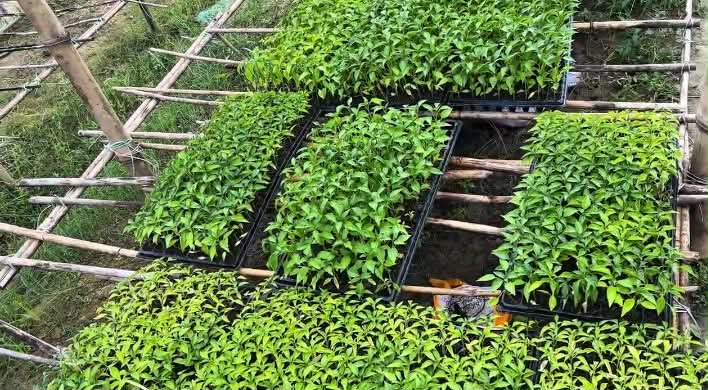
CUMILLA, Dec 23, 2025 (BSS) - Young expatriate-returned farmer Hossain Rabbi has drawn widespread attention by successfully producing winter vegetable seedlings using the cocopeat method in Somespur village of Burichang upazila in Cumilla.
His initiative has opened up new possibilities for the area, which has a long-standing reputation for seedling production. Farmers from different districts of the country are now visiting Somespur in hopes of obtaining high-quality seedlings and ensuring better crop yields.
Cocopeat is produced from coconut husk. After collecting the husk, it is cut into small pieces, ground into powder, and the fibers are separated to make cocopeat. It is lightweight, has a high water-holding capacity, and is widely used as an alternative to soil.
Cocopeat also contains essential nutrients such as nitrogen, phosphorus, and potassium, which are beneficial for plant growth.
Somespur village has been involved in seedling production for nearly 70 years. Every winter, the area turns green with seedlings of various vegetables including cauliflower, cabbage, bottle gourd, tomato, brinjal, and chili.
Traditionally, farmers have produced seedlings in soil. However, this season, the introduction of the cocopeat method has added a new dimension to local agricultural practices.
Local farmers said seedlings produced using cocopeat are healthier and largely disease-free. In conventional soil-based methods, seedlings are often damaged by pests and diseases, causing significant losses.
In contrast, nearly 100 percent of cocopeat-grown seedlings survive, and once transplanted into the field, plant growth and yields are notably better. As a result, demand for these seedlings is increasing rapidly.
Hossain Rabbi said he adopted the cocopeat method for the first time after gaining knowledge from YouTube and other online platforms, as well as advice from the Department of Agricultural Extension (DAE).
“Cocopeat is basically a mixture of coconut husk and vermicompost. Unlike soil, it does not retain excess moisture and is less prone to insect infestation. That’s why the seedlings remain healthy and production risks are much lower,” he said.
During a recent visit to Somespur village, it was observed that farmers from distant areas, in addition to nearby upazilas, are coming to collect cocopeat-grown seedlings. While many are purchasing seedlings, others are keen to learn about the method. Several farmers expressed plans to adopt this technique on their own land in the near future.
The Department of Agricultural Extension is actively working at the field level to promote the cocopeat method. Under an ongoing project, farmers are being provided with training, technical support, and regular guidance.
Burichang Upazila Agriculture Officer Afrina Akhter said, “Seedlings produced through the cocopeat method are of better quality and less affected by diseases. If this method is expanded, farmers are expected to gain greater financial benefits.”
Agricultural experts believe that hundreds of farmers in Somespur and surrounding villages have already achieved self-reliance through seedling production.
The introduction of the cocopeat system is expected to make this success more sustainable. By improving both the quality and quantity of seedlings, the initiative is likely to increase farmers’ incomes while promoting modern and efficient agricultural practices.