Friday
11 September, 2026
TANGAIL, Dec 11, 2025 (BSS) - Today, December 11, is the Tangail Free Day. On this day in 1971, the valiant freedom fighters of the district freed Tangail from the occupation of the Pakistani forces and their collaborators.
The flag of independent Bangladesh was hoisted on this day and since then, the day has been observed as Tangail Free Day.
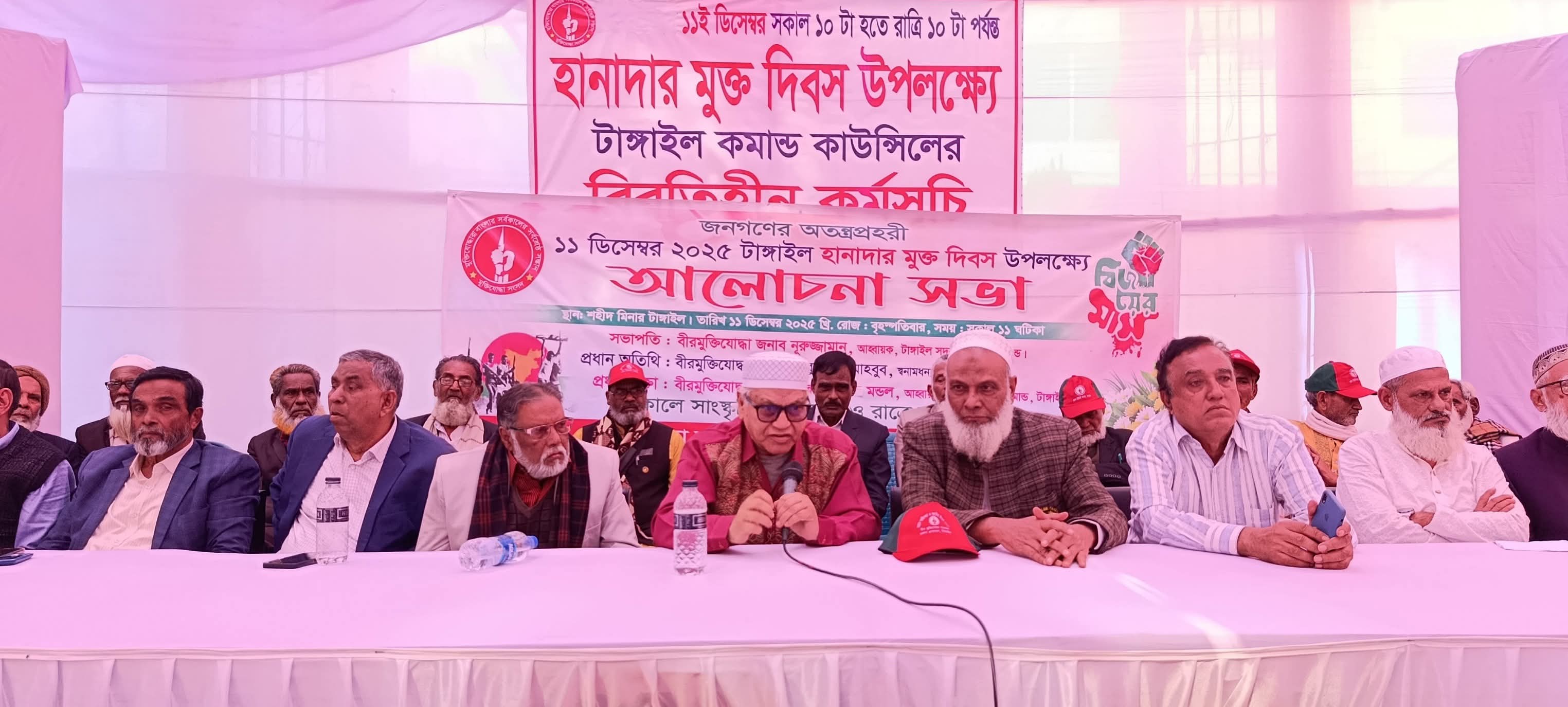
The district unit of the Freedom Fighters’ Command Council and Kaderia Bahini organized day-long programmes including placing wreaths at the Shaheed Minar, brining out victory rally, stick-fighting demonstration and a discussion.
Marking the day, General Secretary of the Nationalist Freedom Fighters’ Council, Advocate Golam Mostafa Mia, said, “December 11 is the Tangail Free Day. This day is unforgettable in our lives. Every brick and stone of this town bears the history of sacrifice of the martyrs. The young generation must learn and uphold this glorious history. Everyone must play a responsible role in honoring freedom fighters and preserving the history.”
He further claimed that over the past 17 years, the fascist Hasina government created a partisan list of fake freedom fighters by excluding genuine ones. He demanded justice for the fake ones and inclusion of the real freedom fighters in the official list.
Abdul Khalek Mondol, convener of the district unit Command of the Freedom Fighters’ Council, said, “11 December marks the liberation of Tangail. It is a memorable day for the people of Tangail. The sacrifices of those who freed Tangail under the leadership of the Kaderia Bahini must never be undermined.”
During the war, the bravery of the freedom fighters of Tangail spread beyond the borders of the country. The Kaderia Bahini, formed and commanded by Bangabir Kader Siddiqui, remains unforgettable in the history of the Liberation War.
Some other freedom fighters of the district said that the Kaderia Bahini, operating from Baheddatali in Sakhipur upazila of Tangail, played an important role in the Liberation War. From the declaration of independence on 26 March until April 3, Tangail remained free. On the morning of 26 March, a meeting was held at the residence of Advocate Nurul Islam at the court area of the town, where the Tangail District Muktijoddha Council of Independent Bengal was formed.
Former minister Abdul Latif Siddiqui was appointed as the convener and chief of the armed Liberation Forces, while Badiuzzaman Khan was made chairman, along with Abdul Kader Siddiqui and eight others as members. Among the organizers of the Liberation War abroad during the nine months of war, Justice Abu Sayeed Chowdhury, Abdul Mannan of the Swadhin Bangla Betar Kendra and Constituent Assembly member Shamsur Rahman Khan Shahjahan played significant roles.
On March 27, at a gathering at Bindubasini Government Boys’ High School ground, Tangail declared its independence. That night, freedom fighters carried out a surprise attack on the circuit house. Two Pakistani soldiers were killed in the attack and 150 surrendered. After that, youths in villages started organizing themselves and training for the Liberation War continued.
As Tangail fell under the control of the freedom fighters, the Pakistan Army attempted to advance from Dhaka on April 3. On their way, at Goran-Satiyachra under Mirzapur upazila, the freedom fighters set up a defensive formation and resisted the Pakistani convoy. At least 23 Pakistani soldiers were killed in that battle.
Later, with the help of local Razakars, the occupation forces launched counter attack, resulting in the massacre of 107 Bengalis including freedom fighters.
The Pakistani invading forces occupied Tangail town in the afternoon of April 3. The freedom fighters were scattered. The entire force then moved to the remote Baheddatali of Sakhipur. There, the force was reorganized and recruitment and training began. Later, this force became known as the Kaderia Bahini. The number of trained fighters in this force reached 17,000. In addition, 70,000 volunteers also assisted the Kaderia Bahini during the war.
By December 8 in 1971, around 5,000 Pakistani troops and 7,000 Razakar–Al-Badr members were positioned in Tangail. From April to December 8, the Kaderia Bahini engaged in battles across Tangail, Jamalpur, Sherpur, Kishoreganj, Sylhet, Sirajganj and Pabna—defeating the Pakistani forces. In these battles, over three hundred heroic freedom fighters were martyred.
A plan to attack Tangail was finalized on December 8. Near Pauli Bridge under Kalihati upazila, the Allied forces clashed with the Pakistani troops. Sensing danger, the occupation forces fled away from Tangail and marched towards Dhaka. As per the plan, the Kaderia Bahini launched attacks from all sides and succeeded in driving the invaders out of Tangail. Commander Abdur Razzaq of the Kaderia Bahini entered into Tangail town on the night of December 10.
On that night, Commander Abdur Razzaq captured Tangail Sadar Police Station and hoisted the flag of independent Bangladesh. At dawn on December 11, Commander Khandaker Bayezid Alam and Khandaker Anwar Hossain entered into the town from the east, Brigadier Fazlur Rahman came from the south and Kader Siddiqui arrived with an armored convoy from the north via Mymensingh Road. As the convoy neared the town, Pakistani troops opened fire from atop the district water tank.
Kader Siddiqui and his troops returned fire. One by one, the Pakistani soldiers stationed there were killed. The remaining soldiers stationed at the Circuit House surrendered. After securing control of the Circuit House, the freedom fighters entered into the town, took control of the entire area and began searching for the fleeing invaders. Thus, Tangail was completely liberated.