Sunday
30 August, 2026
News Flash
News Flash
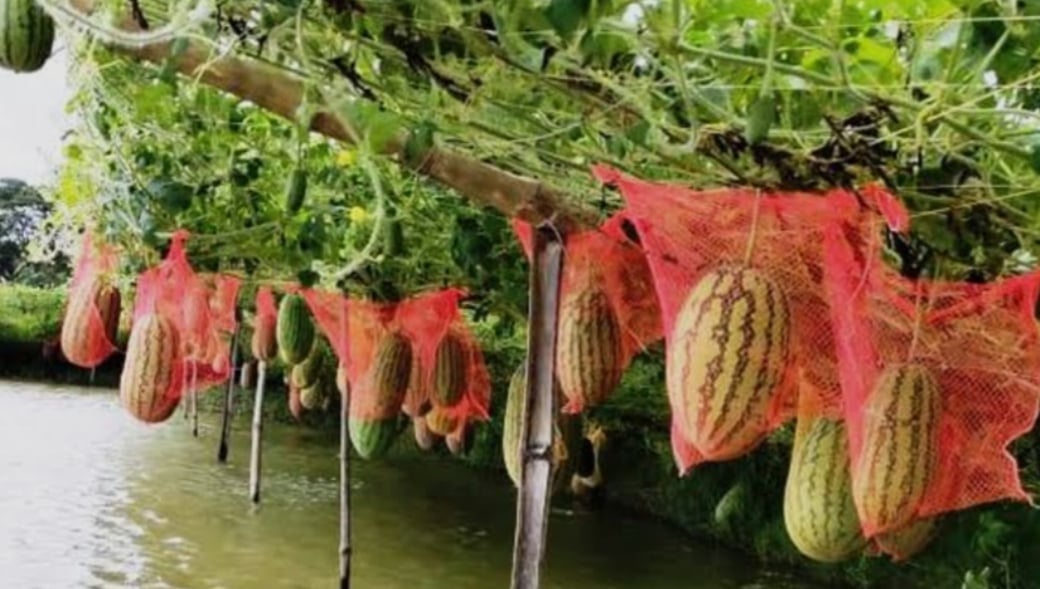
KHULNA, July 18, 2026 (BSS) - Off-season watermelon cultivation has emerged as a profitable venture for farmers in Khulna, opening up a new avenue for agricultural diversification and income generation.
The introduction of off-season watermelon farming, supported by the Department of Agricultural Extension (DAE) and financed under the Agricultural Development Project for the Region, has encouraged local farmers to adopt the high-value crop due to its short production cycle, relatively
low cultivation cost and high yield.
A total of 60 percent of off-season watermelons were cultivated till July 14 in the agriculture region-- covering Khulna, Bagerhat, Satkhira and Narail, according to the Department of Khulna Agriculture region.
The DAE has set a target to produce around 37,000 tonnes of watermelon from 1,229 hectares of land across four districts in the agricultural region.
In Khulna, the production target was set at 29,938 tonnes of watermelon from 1,015 hectares of land while in Bagerhat, the production target was set at 2,120 tonnes from 68 hectares of land.
In Satkhira, production targets were set at 4,221 tonnes of watermelon from 123 hectares of land while 703 tonnes of watermelon production targets were set from 23 hectares of land in Narail.
Till July 14, at least 738 hectares of land or 60 percent watermelon were cultivated in the region.
In Khulna, a total of 660 hectares of land, or 65 percent of the watermelon, was cultivated, and 10 hectares of land, or 15 percent of the watermelon, was cultivated in Bagerhat.
In Satkhira, 62 hectares of land or 50 percent of the watermelon were cultivated, while 6 hectares of land or 26 percent of the watermelon were cultivated in Narail.
A recent visit to Chandgarh, Sundar Mahal and Kalikapur villages under Shovna, Kharnia, Sahos and Sharafpur Unions of Dumuria upazila in Khulna, revealed extensive watermelon cultivation using modern farming techniques.
Farmer Rahmat Ali of Kalikapur village cultivated hybrid varieties 'Smart Boy' and 'Mim Astha' on 33 decimals of land using the mulching method. The field was ready for harvest within 60 to 65 days of transplanting.
He received seeds, fertilisers, pesticides, other agricultural inputs and cash assistance from the Upazila Agriculture Office.
Rezaul said he returned from Saudi Arabia three years ago and started commercial farming. After cultivating tomato, chilli and brinjal, he opted for summer watermelon this year following advice from agriculture officials.
He sold watermelons at wholesale prices ranging from Taka 60 to Taka 70 per kilogram, earning around Taka 2 lakh from his 33-decimal plot, he said on Friday last. After deducting production costs, Rezaul made a net profit of approximately Taka 1.50 lakh.
Encouraged by the success, he plans to expand watermelon cultivation in the coming seasons.
Upazila Agriculture Officer Md Nazmul Huda said the demonstration programme has highlighted the potential of climate-resilient, high-yield summer crops in boosting farmers' incomes.
"The successful implementation of the project has created strong interest among farmers in adopting modern watermelon cultivation technologies. We expect the cultivation of summer watermelon to expand significantly across the region in the future," he said.
United Seed Company Limited Marketing Sales Officer Palash Mallik said the demonstration programme was introduced to increase agricultural production and improve farmers' livelihoods.
The use of improved varieties and modern production techniques has enabled farmers to achieve higher yields and better financial returns, he added.
Officials believe the combination of Dumuria's fertile soil and modern farming technologies has the potential to transform summer watermelon cultivation into an important driver of the local rural economy.
Talking to BSS, Additional Director of Khulna DAE Md Rafiqul Islam said farmers are more interested in watermelon cultivation than shrimp farming now.
Besides, the government has provided fertilisers, seeds, pesticides and training free of cost, he said.
The DAE official added that off-season watermelon cultivation is less expensive than seasonal cultivation, and no irrigation is required due to sufficient rainfall.