Friday
21 August, 2026
News Flash
News Flash
By Md Aynal Haque
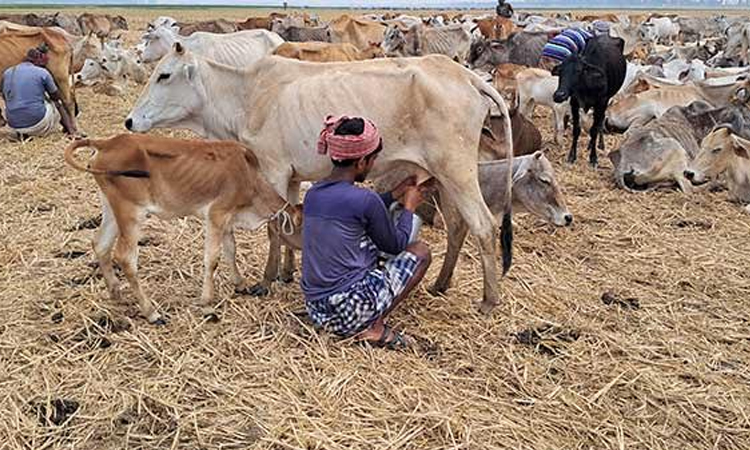
RAJSHAHI, April 15, 2026 (BSS) - Carrying forward a centuries-old tradition, groups of herdsmen continue to roam across northern Bangladesh with large cattle herds, relying on milk sales and seasonal livestock trading for their livelihoods.
Rafiqul Islam, 62, from Ranighati area of Shibganj upazila in Chapainawabganj, is among those preserving the practice. Along with five associates, he has brought a herd of around 150 dairy cows to the open fields of Jumarpara village in Tanore upazila of Rajshahi.
The group moves from one upazila to another in search of open land and adequate fodder. Wherever grazing opportunities are available, they settle temporarily, living in makeshift conditions while tending to their cattle and selling milk directly from the fields.
"Our livelihood depends entirely on milk sales," Rafiqul said, adding that they usually remain in one location for 15 to 20 days before moving on.
He noted that eight people jointly manage the herd, often rotating trips back home. "Several owners rear their cattle together in this way. Each of us earns nearly Tk 40,000 per month from milk sales," he said.
In addition to milk, the herdsmen earn by selling cattle throughout the year. Rafiqul aims to sell at least 15 cows during the month of Bhadra, when cattle are typically healthier and fetch higher prices.
"By selling 15 to 20 cows annually, we can earn around Tk 6 to 7 lakh," he said, adding that they mostly rear hardy native breeds that adapt well to different environments and are less prone to disease.
Milk collectors are arranged wherever the herds settle, ensuring a steady market. Rafiqul also mentioned that at least four other herds, totaling more than 400 cattle, are currently grazing in different parts of Tanore.
Lal Mohammad, another herdsman from the same area, has been in the profession for about a decade and currently owns around 60 cattle. He said he earns between Tk 20,000 and Tk 30,000 per month from milk sales and about Tk 5 lakh annually from selling cattle.
"We travel across different upazilas with the herd and stay in one place for 20 to 25 days," he said. "At night, we set up polythene tents under trees and take turns guarding the cattle."
He added that daily expenses and household needs are met from milk income, while earnings from cattle sales are largely saved for major expenditures.
"If we need money for treatment, weddings or emergencies, we can sell a cow," Lal Mohammad said, noting that cattle prices are usually higher in Bhadra.
However, the monsoon season poses challenges, as floods and waterlogging reduce access to grazing land. "During heavy rains, we have to buy feed, which increases costs," he added.
Despite such difficulties, cattle rearing remains the sole source of livelihood for many herdsmen.
At the same time, the livestock sector is seeing broader growth, with poor and marginalised communities, including women, increasingly engaging in cattle rearing and fattening with support from government and development partners.
The use of artificial insemination is expanding, contributing to improved cattle breeds and higher milk production.
Abdur Razzaque, 45, a farmer from Charghat upazila, said he has been fattening eight cattle for about seven months in preparation for upcoming sacrificial animal markets.
Dairy farmer Arafat Hossain said crossbreeding has significantly boosted milk yields, in some cases increasing production several times compared to previous levels.
He added that farmers are adopting improved practices and modern technologies in cattle rearing, while the involvement of private companies is helping expand the livestock market across the region.