Sunday
13 September, 2026
News Flash
News Flash
By Md Aynal Haque
RAJSHAHI, Jan 17, 2026 (BSS) - An increasing number of slum dwellers in Rajshahi city are turning to vegetable gardening to supplement their income and ensure food security, transforming small and unused spaces into productive green plots.
Residents living on city fringes and in congested settlements are cultivating vegetables in courtyards, rooftops, along unused railway land and even in discarded containers such as sacks and plastic bottles. Many have been able to significantly improve their livelihoods, with some farmers doubling their investment when conditions are favourable.
Vegetable cultivation has emerged as a key livelihood option for the urban poor, helping families reduce dependence on costly market produce while improving nutrition. Crops such as red amaranth, spinach, bottle gourd, beans, cucumber and chilies are commonly grown using organic, chemical-free methods.
With support from government and non-government organisations, slum residents are learning modern urban gardening techniques that promote sustainability and self-reliance.
Latifa Begum, 47, a resident of Budhpara near Rajshahi University, said she began growing vegetables after struggling to afford market prices.
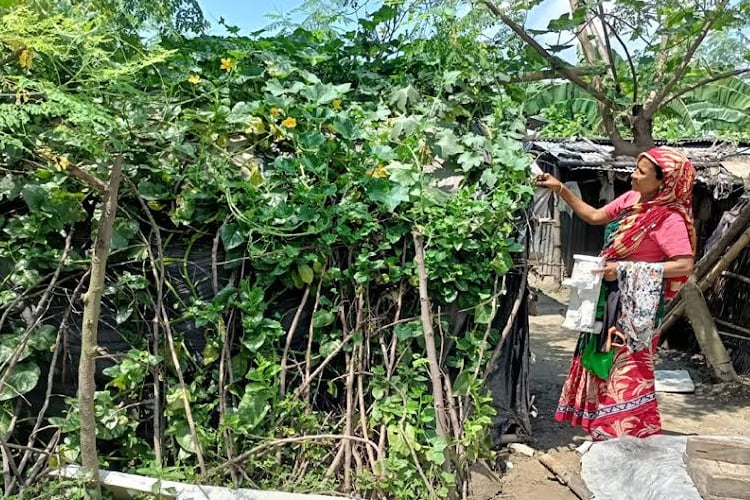
Displaced by river erosion around 15 years ago, she now cultivates bottle gourd, chili, tomato, ginger, cucumber, Malabar spinach, pumpkin, cabbage and cauliflower in her small courtyard using bamboo supports, plastic bottles and sacks.
Talking to BSS, Latifa said her family now meets most of its vegetable needs at home and earns a small income by selling surplus produce. "Earlier, we had to buy everything from the market. Now our surroundings are greener and we depend less on outside sources," she said.
Omar Ali, 54, another Budhpara resident, has also seen positive changes. After migrating from Pabna about 20 years ago in search of work, he now grows vegetables, flowers and medicinal plants in 46 plastic bottles using compost and bamboo structures. He also cultivates ginger and elephant foot yam in sacks.
At present, his small space is filled with papaya, dragon fruit, gourds, tomatoes, eggplant, chilies and flowers. He meets most of his family's needs and earns extra income by selling seedlings grown in discarded plastic cups.
Inspired by such success, others in the slum are following suit. Marufa Begum, 42, now grows leafy vegetables and chilies beside her kitchen, cutting daily market expenses.
Sohel Islam, 25, who once depended on irregular day labour, now cultivates vegetables in his yard, gaining confidence and a renewed sense of purpose.
Champa Rani, a resident of the Namo Bhadra slum, said her family has benefited greatly from cultivating both winter and summer vegetables throughout the year using modern techniques.
"I cultivated bottle gourd, cucumber and coriander according to my choice this year and got the expected yield," she said, adding that regular access to fresh, safe vegetables has helped protect her family from malnutrition-related diseases.
She said the family uses organic fertiliser and sells surplus produce in local markets after meeting household needs. Encouraged by the results, many others in the area have shown interest in chemical-free vegetable farming.
Recalling past hardships, Rani said she struggled for years to improve her family's income. To overcome poverty, she began growing vegetables alongside rearing poultry and goats. She now meets her family's nutritional needs with homegrown vegetables, milk and meat.
In the initial stage, participating families received technical support and farming inputs, including indigenous vegetable seeds and organic fertiliser, from the Bangladesh Resource Centre for Indigenous Knowledge (BARCIK).
Quoting a slum census conducted in 2014, Shahidul Islam, Regional Coordinator of BARCIK, said Rajshahi city has around 104 large and small slums with 12,202 households and a population of about 39,077.